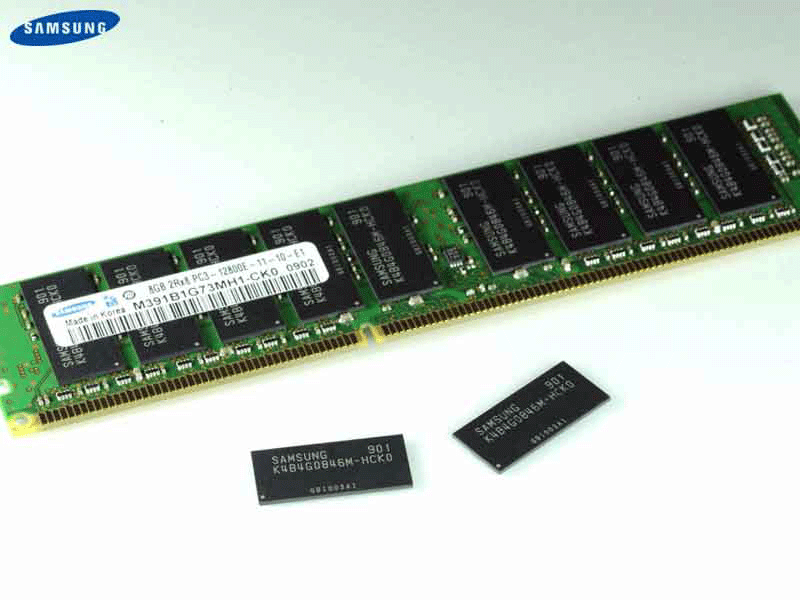
DDR3 Modules to Near 90% Market Share in 2011
DDR3 memory will climb to a dominant market range of almost 90% this year, market researchers from IHS iSuppli said today.
The company predicts that it will begin to fade in 2014 and hand over the majority of the market to next version of DRAM in 2015.
According to IHS iSuppli, DDR3 will account for 89% of a total of 808 million DRAM modules that will be shipped this year. DDR2's share will decrease to just 9%, down from 29% in 2010. DDR3 market share in 2010 was 67%. The market research firm predicts DDR3 will hit 92% next year and 94% in 2013.
“DDR3 has been the main DRAM module technology shipped in terms of bits since the first quarter of 2010, gaining adoption quickly in the PC ecosphere as the market’s primary driver,” said Clifford Leimbach, analyst for memory demand forecasting at IHS. “Not only is DDR3 the dominant technology today in the three PC channels for original equipment manufacturers, the PC white-box space and the upgrade market, DDR3 is also the chief presence across all PC applications, such as desktops and laptops, as well as their subcategories in the performance, mainstream and entry-level computing sectors.”

DDR4 is expected to account for 12% market share in 2014 and approach 56% in 2015, while DDR3 is estimated to drop to just 42%.
What makes you say that?
We'll probably see the same thing in about three years when it comes to DDR4.
Depending on how you interpret the article I would agree. If you read it "90% market share in 2011", meaning that 90 percent of computers will have ddr3 then I doubt the report. If that were the case then 90 percent of computers would be windows 7 or vista since DDR3 became popular in that era.
If you read it as 90 percent "shipping" market share, then that makes more sense. Tom's didn't do a good job clarifying.
If we were to follow the logic in this article, Windows 7 would have over 90% market share this year, which is absolute BS.
Or maybe it could be that you meant something else and didn't express it right. :thinking:
why ddr4? graphics cards already come equipped with DDR5, i dont see why they cant use this for motherboards. I dont think i have ever seen DDR4 used in anything....it was a jump from ddr3-ddr5 in graphics cards.
The graphics numbering system doesn't have anything to do with the normal numbering system for DDR SDRAM. GDDR4 did exist, but wasn't widely used. I think it was only in two cards, ever. GDDR5 is based of DDR3. There is no graphics card using a DDR4-based graphics memory, as DDR4 has yet to enter widespread production, and thus hasn't had time to have a graphics memory standard based off of it.
TLDR The "DDR5" you are talking about is actually DDR3. DDR4 will come, and with it will come GDDR6 or GDDR7. It's a good thing. For gamers, the more relevant point (until more memory bandwidth intensive games come out) is that any GDDR based off DDR4 will allow for more performance than comparable GDDR5, which should help with graphics memory bandwidth bottlenecks.
Yeah, I think the article just meant market share of this year's sales. Or else, DDR1 would still be a big segment of the market.
how important is ddr3 and 4? i mean on a benchmark for lets say a game, how big a difference will it make?
ram drive, video editing, and a few other take advantage of high speed ram, but average consumer?
what i would love to see instead of ddr4 is a new way ram is put together, and housed on the motherboard.
lets say that a stick pops out twice-4 times as much, and its a 24-32gb ram drive. it has its own power supply like thing, really a battery to keep data stored. it will last about a week while the computer is off, and this drive is really more like a hdd/ssd mirror, because (wiki quote) ddr3 can go 6400 MB/s
imagine this, you right click a program, and you can load it into ram drive as an option, it mirrors every file opened over to the drive and now opening the program is effortless. game load times would sease to exist.
or have it for a os boot.
after a week when the battery dies, it just goes back over to loading from the hdd/ssd
really wish some company would steal my idea... just so it exists.
Right there in the article guys.
That's GDDR not just DDR, it's a different type of technology.
no, in theoretical performance, ddr3 is allot faster, but in real world apps, nothing takes full advantage of that, as in if ddr2 was 100, than ddr3 would be about 150, however in real world applications you would only see about 80-90 on either ram.
the only real way to take advantage of that speed is like i stated above, a ram drive.
Not necessarily. If I were upgrading to a new PC this year it would be new MB+CPU+RAM (DDR3) & vga card. Would keep old HDD & reinstall windows xp