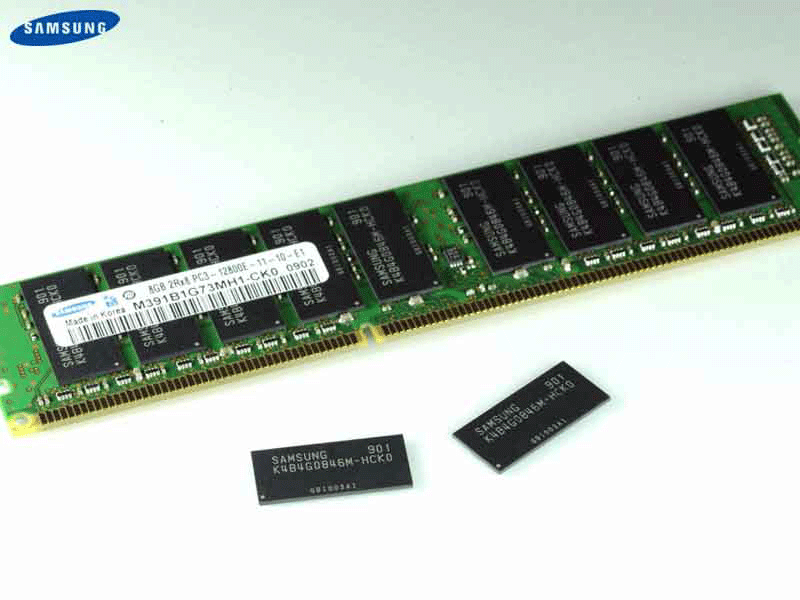
RAMCloud: The Idea of Storing All Data in RAM
Researchers at Stanford University have an idea how to overcome latency and performance bottlenecks of hard drive and solid state disk-based storage systems.
According to a recently published paper, they believe that a RAM-based cloud system with about 1000 servers and a total RAM capacity of 64 TB can be built for about $4 million and is feasible today.
Compared to a disk-based system, a RAMCloud could have a 100-1000x lower latency than disk-based systems and 100-1000x greater throughput, the researchers said. The system would use replication and backup techniques to overcome the problem of volatility and data loss if the power supply is interrupted. The approach would provide enough performance for cloud systems to solve scalability issues for web applications, enable a "a new class of data-intensive applications" due to the extremely low latency of RAM and provide a growth path for small applications to grow into a large application on demand.
The estimate is that latencies of only 5 to 10 microseconds should be achievable by a measured RAMCloud system, which is about 1000x faster than the 5 - 10 milliseconds that is provided by disk-based systems for data that is accessed over a network. The researchers estimate that a single multi-core RAM server could support at least 1,000,000 small requests per second, while disk based systems are typically maxed out at 1000 to 10,000 requests.

Cost is the barrier for a broad use of such RAMClouds. However, the scientists noted that "the cost of DRAM today is roughly the same as the cost of disk 10 years ago ($ 10-30/GB)", which, of course, does not help much considering the massive storage space requirements today.
;(
Prices keep going down. RAM is dirt cheap; 8GB costs $50 (2x4GB), the new 8GB chips are costly but prices WILL fall, and having your stuff in the RAM is awesome. And for servers, it's even better. Did you read this:
That is, bye-bye to DDOS.
;(
Prices keep going down. RAM is dirt cheap; 8GB costs $50 (2x4GB), the new 8GB chips are costly but prices WILL fall, and having your stuff in the RAM is awesome. And for servers, it's even better. Did you read this:
That is, bye-bye to DDOS.
UPS for you
Elaborate, please!
more than 8GB is recommended if you do some CS5.5 or 3D uses... 8GB is need for gaming system... Your all about the games instead of what's out there in the internet that you needa experience...
There is non-volatile ram in development. Not sure if it will ever become a real product, but it's there.
I thought SSDs use non-volatile NAND RAM? or is that NAND flash? :\
Why do they call it a "could" system? Isn't this just a ram-based server? Cloud is like, for storing data and things right? "Run your shitz of the cloud". I can't see the point of it for cloud storage, would be too expensive. What's the point of the super-low latency if your ping to the RamCloud will be 200ms? A movie streams a ms late, big deal...
If it's used for regular server hosting (like game servers, etc) then i can see the point, because computation time would reduce.
Also nice if you have a couple VMs running. My board is maxed out at 16.
Use chrome, 32-bit, 3.2GB RAM and a Core 2 Quad. Tried on a C2D laptop and happens there too, had used chrome again.
EDIT: Just tried with IE, spike happens but you cant notice it. Chrome actually stutters a bit...
Why do they call it a "could" system? Isn't this just a ram-based server? Cloud is like, for storing data and things right? "Run your shitz of the cloud". I can't see the point of it for cloud storage, would be too expensive. What's the point of the super-low latency if your ping to the RamCloud will be 200ms? A movie streams a ms late, big deal...
If it's used for regular server hosting (like game servers, etc) then i can see the point, because computation time would reduce.
yeah if you are the ONLY one using it then the timing difference is almost nothing compared to the ping, but if you have hundreds of thousands of users accessing the data HDD's and even SSD's wouldn't be able to keep up, that is where the Ram Cloud would come in
About 29GB. My current OS/programs partition takes 35GB. U mad?
Ah...didn't think of that!
For the past 20 years or so OS's have used redundancy to help with this issue via the swap file on the HDD. Using buffered ECC RAM can eliminate about 99% of this problem, but can cost 2-3 times as much in some cases. Although, I suppose you could offset the cost by using twice as much "regular" RAM and using half for redundancy. Still, the best option would be to store the data on a typical storage device and have a newer better buffering system which keeps and accurate and updated copy in the RAM "cloud" which could keep the data integrity in check. This way there would only be the older latency issue initially when the data is being uploaded or altered, or when it needs to be rebuffered because of corruption. Plus that thing about the power going out would be a non issue.
I can see this ram cloud service now . "Tech support: how can i help you", "you: all my files are missing", "tech: ya we had a power failure, sorry everything is stored in ram, all data is gone", "you: excuse me?"