Overhauled: AMD Athlon XP 2600+

Suddenly, the results have come in: Intel, for all its ambition, has failed. On the other hand, AMD, despite being less well-off, has all the more reason to be pleased, because it has succeeded in passing the test with flying colors, without even trying that hard. That's reason enough for the company to be proud of itself.
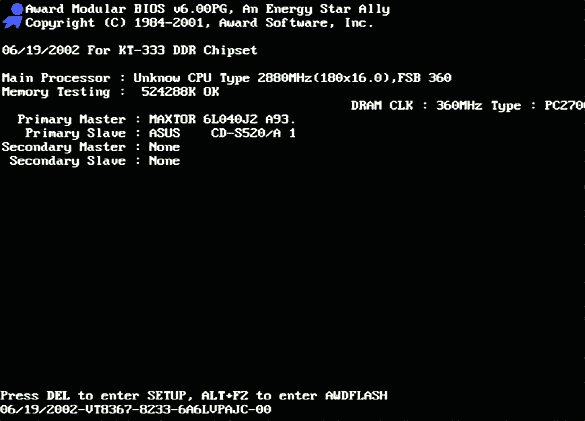
Never been seen before: an AMD Athlon XP with 2880 MHz - this corresponds to a model number of over 3700.
What in the world has happened? After the launch of the new AMD Athlon with the Thoroughbred core , the fans were rather disappointed because the new processor only provided a nominally higher clock rate (Athlon XP 2200+ with 1800 MHz), while having an identical thermal loss. There was no trace of overclockability, which was a big turn-off for tuning freaks. This quickly widened the performance gap between it and arch-enemy Intel with its Pentium 4 by a significant amount.

Intel turned up the clock rate repeatedly and introduced the P4/2533, and here, the Athlon XP 2200+ could not keep up with it in any of the disciplines. Not even when the theoretical and older benchmarks were used. AMD had a big problem, and it went all out in search of an explanation that could serve as a sales pitch at the same time.
The result of this is that some of the disappointed AMD fans wandered over to the Intel camp and got themselves a P4. Others comforted themselves with the thought that the "Hammer," slated for launch at the end of the year, would take care of the performance deficit, and be cheaper to boot.

The top two models compared: Thoroughbred "B" (Athlon XP 2600+) vs. Thoroughbred "A" (Athlon XP 2200+). The die size has increased by 4 mm², which is visually unnoticeable.
Now, however, it's all different. Even AMD employees were surprised by the announcement from Dresden: various optimizations have made it possible to turn up the clock speed significantly for the Athlon XP with the Thoroughbred core. This is a first: AMD makes a 333 MHz jump in clock speed and launches the Athlon XP 2600+. Up till now, the clock rate was only increased by 66 MHz. And that's not all - the test sample of the Athlon XP shows that it's possible to overclock this puppy to 2800 MHz, which would correspond to an Athlon XP 3600+.