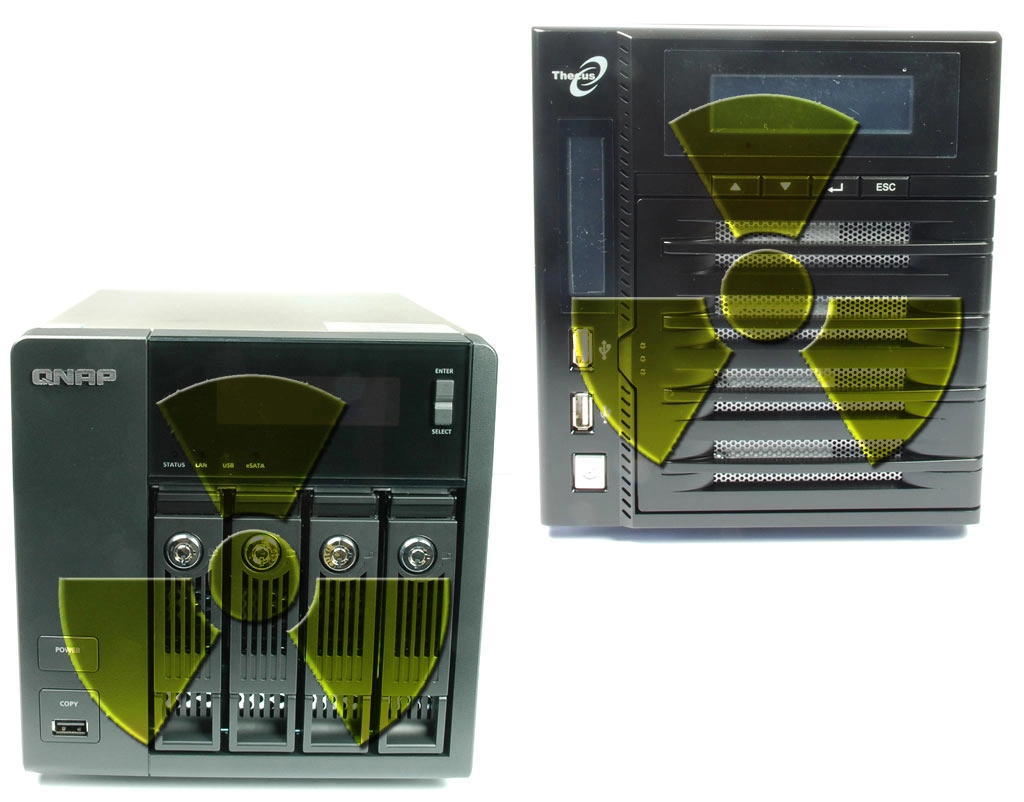
Intel's most modern dual-core Pineview-based Atom processor isn't just aimed at energy-efficient netbooks. It can also be found in NAS servers from a variety of manufacturers. We tested two mid-range appliances in order to measure the CPU's capabilities.
With the Atom processor's introduction, Intel triggered what could almost be called a small revolution. The processor played—and is playing—a significant role in the rapidly-growing popularity of netbooks and nettops. Now Intel's third-generation Atom processor, also designed for use in energy-efficient and affordable systems, is working its charm in the network-attached storage (NAS) segment.
Previous NAS devices used the second-gen "Diamondville"-based Atom 330. Such devices have already demonstrated some pretty convincing data transfer rates. Thus, our expectations are set high when it comes to NAS devices that use the new, third-generation Pineview-based Atom processors.
For cost reasons, these entry-level storage devices typically aren't equipped with hardware-acclerated RAID controllers. Instead, they let the CPU execute XOR calculations for various RAID modes, making data transfer rates for these NAS units partially dependent on CPU performance.

Pineview, What's New?
Clock speeds of the older Diamondville-based CPUs look very similar to those of new Pineview models. The dual-core Atom 330 (Diamondville) has a clock frequency of 1,600 MHz, while the dual-core Atom D510 (Pineview) runs slightly quicker, clocked at 1,660 MHz. The L2 cache is still 1MB (2 x 512KB), and the solution is manufactured using a 45 nm process. The biggest changes implemented in Pineview are the graphics and memory interfaces. For more on the architecture underlying Intel's Pine Trail platform, check out our launch coverage.
In short, Intel incorporated a graphics processor and memory controller onto the Atom processor die, and although this increases the processor's TDP by a few watts, the entire platform's power consumption drops due to the consolidation of chipset components. Because of this integration, a new chipset (little more than a southbridge, really) called NM10 Intel Express had to be developed.
The Intel 945GC chipset, used for the older Atom 230 and 330 processors, had a TDP of 22W. The NM10 Express dramatically lowers this to only about 2 watts. The combined TDP of an Atom 330 and 945GC chipset is around 30W, whereas a Pineview-based Atom D510/NM10 nets a TDP of around 15W. It should be noted, however, that the NM10 chipset only has two SATA ports, which makes it poorly-suited to NAS applications. We expect NAS vendors to look for other solutions to get more storage scalability.
In order to see what kind of power consumption and data transfer rates one can expect from a Pineview-based NAS, we took a closer look at the Thecus N4200 and QNAP TS-459 Pro. Both launched in the first quarter of 2010.
not sure what the advantage of the 4200 is over that except for the battery and that is what a UPS is for.
I just built me a data/media server with exponentially more power for only $533 tax/title/license and no freaking rebates.
My build may consume more power than these but it is much more versitle than these NAS boxes and at least a few hundred bucks cheaper. Plus I it will be suited to use as an HTPC or workstation if ever needed.
FTR the build is: LiteOn dvd burner, MicroATX tower case (6 3.5 bays), 2 Samsung EcoGreen 2tb hd (will be raid 1), AMD athlon x2 250 (65w), Gigabyte ga-ma785gm (5 sata2, 6 usb, 1 esata, radeon 4250 integrated graphics, dvi-hdmi-dsub out), Antec EarthWatts Green 380w power supply, 4gb RAM.
I build my ''NAS'' with a low end PC and 2 SATA controllers. I have 8x 1.5 TB HDDs in 2 RAID-5 config.
Seriously a 4 bay NAS cost like 900$ w/o HDDs...
These are foolish and expensive.
Keep in mind to all the home-NAS and custom guys out there, these units are PROFESSIONAL, not SoHo class units. The qNap 410 and 419 are small business/home units, and even those still include native AD integration, and more, and not only operate as NAS systems, but backup systems, media servers, and more (dozens of features). These still are not even in the "personal" NAS class most home users can build on their own for about the same money.
These are professional class systems, with iSCSI, Native AD support, IP multipathing, load balancing, VMWare certification, and more. These are not cheap "file share" NAS systems like you might want for a media server in your house, or simple storage and backup. Simply features like online data migration to larger disks, archive by file age automatically, IP camera support, iTunes servers, TimeMachine support, and more make these very different from what you can do with a mini-NAS or FreeNAS setup on old PC hardware (not to mention the savings in electricity). qNap does sell "home" system that are less capable, but still FAR more than most people need. If all you want is a bid gisk and media server, get a WHS or a home-built solution. if you;re hooking servers or VMs up to it, using it in a high bandwidth or office environment, and care about the NAS ability to protect itself, back itself up, and migrate data to larger drives later, that's what the $300 price difference covers.
Also, cats don't normally chew on wires. Dogs are much more likely too. A cat might knock it off the desk, or spill a glass of water near it, but chew wires? That's what dogs do, not to mention eat homework.
We purchased the Qnap TS-239 Pro for the location. I was able to install BIND on it as well to handle DNS. I was quite impressed with just how flexible the units are.
And so which of those features are unavailable from the open source FreeNAS operating system, and thus validate the $300 hike?
If I had to put a few of these in place I'd probably do it just to have my IT guy (or me) put them all out in a day and be done with it.
It's just the nature that these types of articles on Tom's Hardware are read by us types that like to do it ourselves. No, most likely these would not find a place in our homes or small businesses that we intimately manage. But I don't think that's their target group.
It is a really bad idea to run a RAID box off USB 2 or 3. One bus reset and you stand to have some corrupted data. Stick with Ethernet and iSCSI if you care about your data.