Inside The Dual Core 'Smithfield'

230 million transistors, 206 mm2 die size, 90 nm production process and maximum 95/130 Watts power envelope (varies)
Many things will change when Intel formally introduces the dual core desktop processor Smithfield in Q2/2005. First of all, you will need to purchase a new motherboard, since the dual core processor requires a modified boot sequence in order to determine whether a single or a dual core processor is deployed. Unfortunately, a BIOS update isn't sufficient, since this requires slight pinout changes.
Intel also made modifications to its model naming and numbering strategy. The dual core Pentium 4 is called the Pentium D; it will be given a model number starting with 8. At the same time, there will be a new Pentium Extreme Edition (not called Pentium 4 any more) based on the Smithfield core. The only technical difference here will be the enabling of Hyper Threading for the Pentium Extreme Edition. This means that Windows will have access to four logical CPUs.

For the first time, Intel will drop the clock speed number with the Extreme Edition and replace it by the same model numbering that is applied to the Pentium D. Pricing will remain unchanged - as will the general question about whether something like the Extreme Edition really is necessary. As before, customers will get the best available processor, but at a very steep price.
Intel will keep using socket LGA 775 with minor modifications. The 2005 platform design allows for a thermal design power of 130 rather than 115 Watts. This has basically been done for the Pentium D 840 and the Extreme Edition 840, since the 830 and 820 versions operate at a maximum of 95 W. FSB1066 will not be supported for the time being, leaving some margin for product changes and overclocking space for the enthusiast.
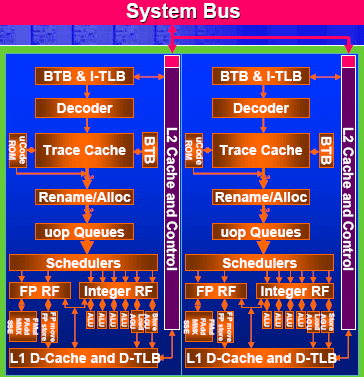
Internally, two Prescott style NetBurst processors are bound together. Intel decided to stay with 1 MB L2 cache per core, since a total of 4 MB L2 cache would inflate the die size of the 90 nm Smithfield by almost a third. Right now, the Pentium D or EE comes in at a size of 206 mm2 with 230 million transistors.
The cores talk to each other via a special bus interface. This means the cores can physically access each other's L2 caches by accessing this interface, or through the front side bus. All Smithfield based products support the XD bit, Intel's 64 Bit extension EM64T, and Enhanced SpeedStep, reducing the clock speed of the faster models to 2.8 GHz whenever less performance is required.
| CPU | Model Number | Clock Speed | Cache | Hyper Threading |
|---|---|---|---|---|
| Pentium D | 820 | 2.8 GHz (FSB800) | 2x 1 MB | No |
| Pentium D | 830 | 3.0 GHz (FSB800) | 2x 1 MB | No |
| Pentium D | 840 | 3.2 GHz (FSB800) | 2x 1 MB | No |
| Pentium Extreme Edition | 840 | 3.2 GHz (FSB800) | 2x 1 MB | Yes |
