Introduction
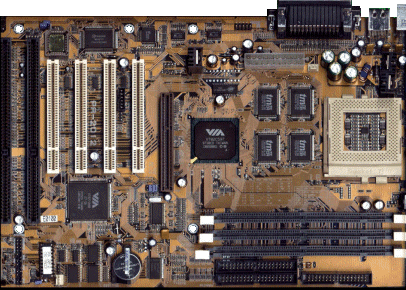
It was taking quite a while from VIA's announcement of the Apollo VP3 chipset until this first board arrived here for testing. FIC as well as VIA had to find out that it's not exactly easy building an AGP board without the support of Intel. The chipset as well as the PA-2012 board had to go through several revisions until FIC felt confident sending out boards for testing. A FIC spokesman told me that only 3 boards were shipped to the press so far, all of them went to Germans, one to c't Magazine (Georg Schnurer), one to PC Professional (Kai Schmerer) and one to me. These boards are all revision 1.1 boards, which still is pre-production. The first production revision shall be revision 1.2 and is supposed to ship within the next two weeks ... I'm supposed to get one of the first ones.
The biggest problems FIC had with this board were getting all the different SDRAM brands to work as well as AGP. They found out that a special driver is needed to take advantage of the important AGP features like sidebanding and DIME. For proper use of AGP a special 'VIA_VGART.VxD has to be installed, shipping on a CD that comes with the board. The AGP x2 mode seems to be another problem and so far it doesn't seem to be supported by the VP3 chipset. This is not that important currently, since only two 3D chips are using this feature, the ATI Rage Pro and the pretty slow AGP 3D chip from Trident. If you want to run an ATI Rage Pro (XPERT) card you will need a special driver that's written for the VP3 chipset, but so far only 4 MB cards work with this driver and the performance is awful. This could maybe be due to the missing x2 mode, although AGP obviously works with these cards. The large texture scene showed a performance increase of 900% of AGP over PCI. I had to make another strange observation comparing the 3D benchmark results between corresponding AGP and PCI 3D cards. The PCI cards are almost always slightly faster. Only the ATI XPERT cards showed some really strange results when used with a K6 CPU. The AGP 3D benchmark is about 10% slower than with a the PCI card and this does not happen when using the Intel Pentium MMX. These observations don't really show any reason to go for AGP on Socket 7 boards for now.
If you now wondering how the PA-2012 performs against the currently fastest Socket 7 board PA-2007 (VIA Apollo VP2 chipset) from the same manufacturer, you'll be very disappointed as well. The PA-2007 is the faster board. VIA even admitted this to me when I was visited by them last week. They told me that the main focus for the VP3 chipset was getting AGP to work and they let some performance features out, which made the VP2 chipset so fast. Hence there doesn't even seem to be a reason getting this board in case you just want to have a future proof Socket 7 solution. You rather buy the PA-2007 now and wait until AGP on Socket 7 is showing an actual performance advantage.

The last complaint I have about the PA-2012 is the complete inability running the 6x86MX CPU. Neither at 75 nor at 66 MHz bus speed and not even at slowest RAM timings the PA-2012 was willing to run Windows crash free with the 6x86MX CPU. As you can see, VIA and FIC will still have to make quite a bit of homework until boards with the Apollo VP3 chipset will become attractive.
Board Features
The PA-2012 is a motherboard in ATX form factor and as you can see from the picture above it has one AGP, four PCI and two ISA slots. There are three DIMM sockets for SDRAM or EDO DIMMs and it support RAM sizes of up to 128 MB DIMMs. The board is just as the PA-2007 equipped with 1 MB level 2 cache. Included with the board is a CD with the new bus master IDE driver, the VIA=VGART.VxD and another VIA patch for the Windows 95 system manager. All these patches are installed and even de-installed (!!) very easily, the installation software is really well made. The PA-2012 does not include the 'linear burst' feature for Cyrix and IBM CPUs, although it is supported by the VIA Apollo VP3 chipset. Supported bus speeds: 55, 60, 66, 75 MHz.