









Why you can trust Tom's Hardware Our expert reviewers spend hours testing and comparing products and services so you can choose the best for you. Find out more about how we test.
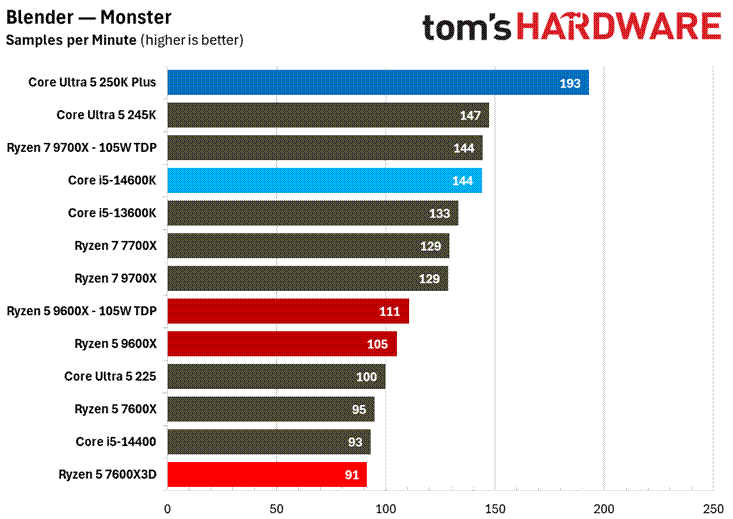
As we already saw in the gaming benchmarks, the Ryzen 5 7600X3D barely sips power, often falling below 100W even when it’s running at full tilt. When looking at application performance, however, that doesn’t translate into better efficiency. The Ryzen 5 7600X3D doesn’t consume a ton of power, but it also lags behind most other chips in our test pool in applications.




View Original
View Original
View Original
View Original
View Original
View Original
View Original
View Original
View Original
View Original
View Original
View Original
View Original
View Original
Looking at raw power consumption, you can see how little the Ryzen 5 7600X3D demands in an all-out workload like Cinebench 2024 multi-core. In demanding, heavily-threaded workloads like encoding via Handbrake and rendering via Blender, the Ryzen 5 7600X3D tops out around 70W, and sometimes doesn’t even manage that. Meanwhile, the base Ryzen 5 7600X is around 30% higher near 100W.
What’s interesting about these results is how AMD defines a 65W TDP and maximum power of 88W. Other chips, such as the Ryzen 5 9600X and 9700X, fall into this same bucket out of the box, and yet they consume far more power when running in their default 65W mode. AMD is clearly far more conservative with power draw with its older X3D chips, as the SRAM acts as a thermal insulator between the CCD and IHS.
Although the Ryzen 5 7600X3D doesn’t demand much in all-out workloads, it draws a decent chunk of power at idle. At true idle, it drew 25W, and in active idle (YouTube playback), it climbed to 28W. Both are still within acceptable ranges, but the Ryzen 5 7600X3D’s low power draw really only shows up when it hits the upper ceiling of power that AMD has defined.


View Original
View Original
View Original
View Original
Bringing performance into the mix, the Ryzen 5 7600X3D isn’t nearly as efficient in applications as its power consumption would suggest. It gains a higher ranking in Handbrake on the back of its lower power draw, and it operates more efficiently in Cinebench and Linpack than the Ryzen 5 7600X. That’s mainly due to low power draw, however, not better performance.


Our scatterplots show that relationship more clearly. Here, the bottom-right corner is the best (best performance and lowest power) while the upper-left corner is the worst (worst performance and highest power). You can see the Ryzen 5 7600X3D falls near the left side of the graph. It’s technically efficient, but the real efficiency of this chip shows up in games, not applications.
Test Setup
All of our CPUs are run on identical test benches, short of the motherboard and, of course, the processor. For applications, we use an RTX 2080 FE, as no compute is running on the GPU, and it shares a driver with our gaming GPU, the RTX 5090 FE. The only other difference is memory. For Intel platforms, we use DDR5-7200, while for AMD platforms, we use DDR5-6000. Weaker Intel chips that can’t sustain DDR5-7200, such as the Core i5-14400, were run at 6000 MT/s.
Get Tom's Hardware's best news and in-depth reviews, straight to your inbox.
In addition to the hardware, we have a specific software configuration. Both AMD and Intel platforms have separate test images that are frozen; in other words, we are running the same version of the same application with the same software stack. We leave most settings at default, short of a few specific tweaks in the BIOS.
We turn on XMP/EXPO, as well as enable Resizeable BAR. We also disable Virtualization-Based Security (VBS). Finally, we disable any automatic overclocking features that aren’t covered by your processor’s warranty, which includes AMD’s Precision Boost Overdrive (PBO) and Intel’s Extreme Power Profile. You can turn on these features for peak performance, but they aren’t covered under warranty, so they aren’t included in testing results.
Intel LGA 1851 (Arrow Lake and Refresh) |
Row 0 - Cell 1 |
Motherboard |
|
RAM |
|
Intel LGA 1700 (Raptor Lake, Alder Lake) |
Row 3 - Cell 1 |
Motherboard |
|
RAM |
|
AMD AM5 (Zen 5, Zen 4) |
Row 6 - Cell 1 |
Motherboard |
MSI MPG X870E Carbon Wi-Fi, Gigabyte Aorus X870E Elite X3D ICE |
RAM |
|
All Systems |
Row 9 - Cell 1 |
Gaming CPU |
Nvidia GeForce RTX 5090 Founder’s Edition |
Application GPU |
Nvidia GeForce RTX 2080 Ti Founder’s Edition |
Cooler |
Corsair iCue Link H150i RGB |
Storage |
2TB Sabrent Rocket 4 Plus |
PSU |
|
Other |
Arctic MX-4 TIM, Windows 11 Pro, Alamengda open test bench |
- MORE: Best CPU for gaming
- MORE: CPU Benchmark Hierarchy
- MORE: Intel vs AMD
- MORE: How to Overclock a CPU
Current page: AMD Ryzen 5 7600X3D power consumption, efficiency, test setup
Prev Page AMD Ryzen 5 7600X3D productivity benchmarks Next Page A banging value for gaming PCs
Jake Roach is the Senior CPU Analyst at Tom’s Hardware, writing reviews, news, and features about the latest consumer and workstation processors.
-
ohio_buckeye The article talks about the 7600x3d but another one not to discount is the 7500x3d. Nearly as fast and worth looking at if its significantly less.Reply -
usertests Reply
Availability/pricing for the 7500X3D may be bad. For example, I see the 7600X3D for $230 on Amazon via Micro Center, cheaper than the $240 stated. But the 7500X3D is $300 from a different third party seller.ohio_buckeye said:The article talks about the 7600x3d but another one not to discount is the 7500x3d. Nearly as fast and worth looking at if its significantly less. -
ohio_buckeye In that case for sure the 7600x3d makes sense. However if someone is in the USA near Microcenter, they have a bundle with a 7500x3d, 16gb ram and b850 board for $300 which really is a great deal if you happen to have access to Microcenter.Reply -
cknobman I'd buy this chip if I wasnt stuck on AM4.Reply
Patiently waiting on the 5800x3d re-release this year so I can upgrade my vanilla 5600.