









Early Verdict
A notebook with a factory-installed PM981 512GB will be great unless the system runs professional applications with heavy write workloads. This drive has a sharper sustained write dropoff that begins much sooner than the 1TB model. It still delivers very high mixed workload performance and is one of the most balanced drives for notebook use.
Pros
- +
Strong low queue depth performance
- +
Class-leading mixed workload performance
- +
Exceptional balanced notebook power/performance
Cons
- -
Sustained write drop off
- -
Availability
Why you can trust Tom's Hardware Our expert reviewers spend hours testing and comparing products and services so you can choose the best for you. Find out more about how we test.
Features & Specifications
We found Samsung's PM981 SSD in Asia. This new OEM model is the early foundation for Samsung's next-gen enthusiast SSD that will likely be called the 980. This drive features Samsung's new 64-layer V-NAND and a high-performance controller that delivers up to 3,500 MB/s of sequential read throughput and 250,000 random read IOPS.
Samsung, like other major flash foundries, has business units that supply products to OEM customers like Lenovo, Dell, and HP. Many of the drives they supply to the OEMs go through a slight refinement and then come to the retail channel for the DIY upgrade market. In the past, we've reviewed Samsung OEM models that were better than the existing models in the retail market. That's simply because they are early versions of the next generation drives.

The Samsung PM981 is the company's current OEM flagship M.2 NVMe SSD. It ships in the Lenovo Yoga 700 if you select a 1TB NVMe drive. The PM981 also appears on Dell and HP's websites in technical briefs, but we've yet to find an official data sheet for this series, even after contacting Samsung representatives. There is little information available about the PM981, and that makes it difficult to provide accurate technical details.
For those still in denial, enthusiast SSDs with 3-bit per cell (TLC) flash are becoming very real. We tested the Toshiba XG5 with 3D TLC that would eventually come to market as the company's flagship RD series, but some believed that TLC wouldn't be an industry-wide trend in high-performance SSDs. We knew otherwise. Your expectations will be shattered if you were waiting for Samsung to go against the grain.
At the time of writing, there are very few PM981 SSDs available. This is reminiscent of the SM961 that came to market in limited numbers last year. In years past, going back to the Samsung XP941 in 2014, the Australia-based RamCity was our primary contact and the predominant third-party OEM SSD supplier. This time around all the PM981 drives we've found have come from Asia.

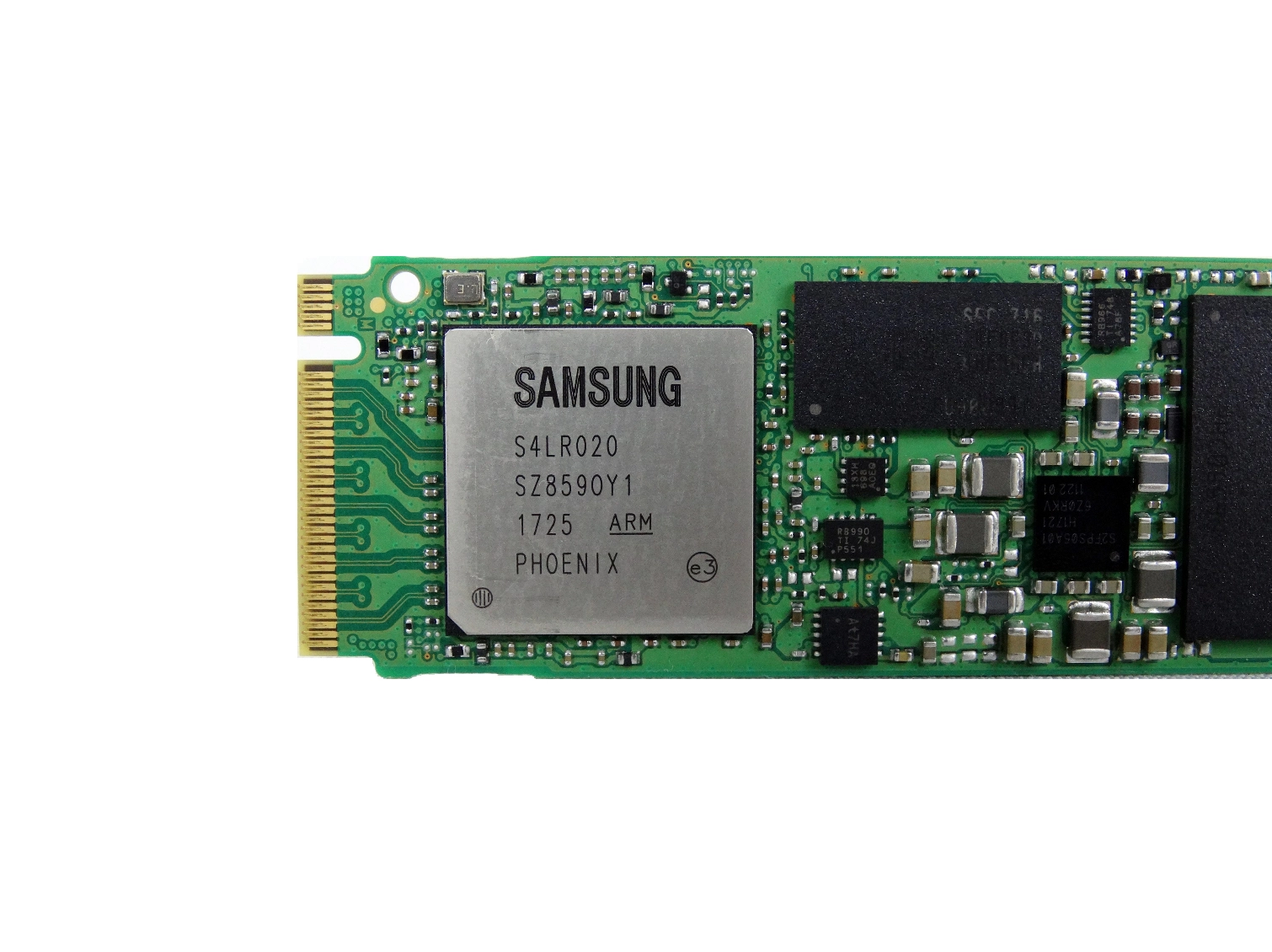
For now, the series only comes in 512GB and 1TB capacities. Both have the same M.2 2280 single-sided design. Samsung equipped this series with the new Phoenix controller that we first encountered at Flash Memory Summit 2017. Samsung also uses the Phoenix in the PM983 Next Generation Small Form Factor (NGSFF) SSDs designed for server applications.
Even though we know very little about the PM983 SSD, we do know its Phoenix controller can address at least 16TB of NAND. That gives Samsung ample room to create high-capacity consumer SSDs. The Phoenix controller also has enterprise roots like the previous-gen Polaris, which was also a key component in several enterprise SSDs.
Get Tom's Hardware's best news and in-depth reviews, straight to your inbox.
Specifications

* Estimates Based On Our Testing With Four Managers At QD4
SSD manufacturers restrict OEM SSDs to the most popular capacities. We've spotted the PM981 in 512GB and 1TB so far, but Samsung could produce other capacities. The OEM SM961 from last year never surfaced as a 2TB product, but Samsung didn't have any issues bringing its retail-equivalent 960 Pro 2TB to market.
As we mentioned, we've yet to find a proper data sheet for the new PM981 SSDs, so we set out to make our own. We used Iometer with four managers at a queue depth (QD) of four each to gauge what Samsung may use for the official specifications. This mirrors a common industry methodology for measuring NVMe SSD specifications.
The PM981 512GB and 1TB models both reached nearly 3,500 MB/s of sequential read throughput. The 512GB model topped 3,000 MB/s of sequential write speed, but the 1TB drive managed to write sequential data at 3,200 MB/s. Both drives hit 170,000 random read IOPS, but we recorded roughly 250,000 IOPS with a single worker at higher queue depths. Both drives took off in our random write burst test and exceeded 440,000 IOPS.
Most of us are more interested in random QD1 performance because it has the biggest impact on the user experience. Samsung raised the bar again. Every year the company has increased QD1 random read performance by 2,000 IOPS. That's a streak that dates back to the XP941 PCIe M.2 SSD. We achieved over 18,200 random read IOPS at QD1 with the PM981, which is a ~2,000 IOPS increase over the 960 EVO 1TB we tested last year.
Samsung paired its latest NVMe controller with its new 64-layer NAND. We don't know much about the Phoenix controller, but we know more about the new 64-layer V-NAND. The new flash features a 1.5x performance increase over 48-layer NAND and uses less power. Samsung's 64-layer V-NAND debuted in the Portable SSD T5 and boosted its capacity to 2TB. The company will release 4-bit per cell (QLC) NAND in the future, but for now, 3-bit per cell (TLC) NAND is standard for consumer products.
Features
With the last generation, Samsung introduced a new label with a copper layer that dissipates heat generated by the controller. Also, the PM981 Phoenix controller features a new copper cover like SMI used on the SM2260, which helps dissipate heat. We examined the copper cover in our Intel 600p review.

We tested for thermal throttling with an extended sequential read workload at QD1. The drive read data for 109 seconds, or roughly 207GB, before performance dropped due to thermal throttling. The 960 Pro and SM961 took longer to throttle in the same system with the same amount of airflow, but both drives read data at a slightly lower speed. The PM981 is still young and will undergo several firmware upgrades over its lifespan. Different OEMs will also likely work with Samsung to build custom firmware for specific systems and applications.
In our testing, the PM981 NVMe SSDs delivered exceptional mixed workload performance that surpassed every NAND-based SSD we've ever tested. The truth is, the PM981 shrinks the gap between Intel's 900P Optane and normal NAND-based SSDs; we recorded a 3x increase over the 960 EVO with an 80% sequential read mixture at QD2.
Pricing, Warranty & Endurance
We paid ~$200 for the 512GB PM981 and ~$400 for the 1TB model. The seller doesn't provide a warranty or an accompanying endurance rating. Samsung's Magician software doesn't support the OEM drives, so we can't use the software for a deeper examination.
A Closer Look


Samsung's OEM products ship in bulk packaging that usually consists of trays full of drives. These products don't come with retail boxes, specifications, or support numbers. Our drives arrived in a nondescript box with the drives in anti-static gray bags surrounded by a foam packaging material.
Both the 1TB and 512GB drives look identical other than the markings on the NAND. There are two NAND packages, a separate DRAM package, and the Phoenix controller. This is quite different from the 960 Pro that uses four NAND packages and a PoP (Package on Package) design for the controller and the DRAM. That compact PoP design allowed Samsung to place all the components on one side of the M.2 2280 960 Pro.
The drives have noticeably more surface mount capacitors than the 960-series products. This may be an OEM requirement to protect data-at-rest or data-in-flight in the event of a host power failure.


The Phoenix controller, the copper cover plate, and the 64-layer V-NAND packages are the exciting new components.
MORE: Best SSDs
MORE: How We Test HDDs And SSDs
MORE: All SSD Content

Chris Ramseyer was a senior contributing editor for Tom's Hardware. He tested and reviewed consumer storage.
-
kiniku "The PM981's biggest drawback is TLC NAND, and as a result, sustained write performance took a step back." For most high-end gamers this won't be a factor unless you are writing multi-GBs of data back at a time back to the SSD. Which is why most gamers are throwing money away buying the "PRO" version of Samsung's NVE SSDs.Reply -
dgpadia Here's a question. I have a Lenovo Thinkpad Yoga 15, 20DQ Series. 200 or so SSD. Would I want to upgrade to this? Would absolutely kill my battery? If so, is there a better option. Let's assume reasonable budget (no more than $600-700, tops)Reply -
doesitmatter There's an error on page 2 in the Sequential Write Performance charts. The bar chart for QD2 128k write for the 960 Pro 1tb doesn't agree with what the line graph says. The bar chart shows it at 1544MB/s (exact same as the PM981), but the line graph shows it somewhere between 2100MB/s and 2200 MB/s, which should make it the top performer on the bar chart.Reply -
mapesdhs Why are PCMark 8 tests still included? They've never shown statistically meaningful or useful differences between products. The variation in results is miniscule.Reply -
AgentLozen ReplyGASARAKI said:Not impressed.
Hey! Thanks for the comment Gasaraki! Short, sweet, and to the point. I was sort of curious as to WHY you weren't impressed. You sort of left me hanging, but that's alright.
I think there's a lot to be excited about with the PM981. There are also a few disappointments.
I really liked the mixed work load performance. At low queue depth, the PM981 performed exceptionally well. Also, the battery life was a nice improvement over Samsung's last generation TLC drive (the 960 EVO).
With that said, I think the most interesting comparison to make is between the 960 PRO and the PM981. There were a number of sequential and random benchmarks where the PM981 wasn't as good a performer. I expected some inadequacies between MLC and TLC flash, but even the 960 EVO (with TLC flash) was beating it. The article states that the 64 layer flash being used in the PM981 was supposed to be faster and more power efficient. Is it a problem with the Phoenix controller? The author of the article claims that the culprit was probably thermal throttling.
Personally, the news I'm most happy to see is the pricing. I know $400 for 1TB probably doesn't reflect the final price of the consumer Samsung 980 drive due out in a few months, but if we could get this level of performance for $.40 per GB, that would be really terrific.
Edit: Typo and clarification -
Green_4 Can you please inclunde in this charts Intel Optane SSD 900p .... http://www.tomshardware.com/reviews/intel-optane-ssd-900p-3d-xpoint,5292-2.htmlReply -
Brian_R170 Reply20432954 said:Why are PCMark 8 tests still included? They've never shown statistically meaningful or useful differences between products. The variation in results is miniscule.
They pretty much show that the difference between the best and the worst SSD is hardly noticeable to most users.
Reviewers have found ways to use real applications to show CPU and GPU performance, but all of the SSD tests that are "meaningful" are synthetic and therefor, not actually meaningful. I liken most of the synthetic SSD benchmark data to automobile reviews that tout a vehicle's top speed. It's cool data, but not useful to nearly any owner. -
CRamseyer If you know what you are looking at all of the tests from PCMark 8 on have meaning for most of our readers. Please see the How We Test SSDs and HDDs article for details.Reply