Join for quick access. Enter your email below and we'll send confirmation plus sign you up to our newsletter.
By submitting your information, you confirm you are aged 16 or over,
have read our
Privacy Policy
and agree to the
Terms & Conditions. Geographical rules apply.
Stay On the Cutting Edge: Get the Tom's Hardware Newsletter
Get Tom's Hardware's best news and in-depth reviews, straight to your inbox.
You are now subscribed
Your newsletter sign-up was successful
Join the club
Get full access to premium articles, exclusive features and a growing list of member rewards.
An account already exists for this email address, please log in.
New AI-compute cryptocurrency Pearl sparks a GPU mining rush but profitability is already sliding — RTX 5090 daily revenue has halved to $17.19 since April
A new cryptocurrency called Pearl (ticker PRL), which secures its blockchain by running the matrix multiplication behind AI workloads instead of conventional hashing, has set off a short-lived GPU mining rush, with profitability tracker hashrate.no recently listing an RTX 5090 at roughly $33.80 a day in mining revenue. The coin launched its mainnet in late April 2026 and recently drew attention when AI cloud provider Together AI announced an exclusive partnership, but PRL's price and per-card returns are already dropping precipitously as more miners pile onto the network.
Pearl, built by Pearl Research Labs, uses a consensus mechanism it calls Proof-of-Useful-Work, in which the computation that secures the network is large-scale matrix multiplication, also used in AI training and inference.
AI mining is real now lmao https://t.co/FF7ZGiZnTPMay 31, 2026
Together AI, which announced the tie-up in a May 15th blog post, launched a discounted inference endpoint for an instruction-tuned model called Gemma-4-31B-it-pearl, priced more than 25% below its usual rate and offset by the future value of PRL emissions. "Pearl changes the unit economics of AI," said Omri Weinstein, co-founder and CEO of Pearl Research Labs, in the announcement. Mining is limited to Nvidia hardware.
The protocol can extract a mining proof from genuine inference, as Together's endpoint does, but the rigs driving the rush run inference nobody requested or pays for, so the output goes nowhere. By Pearl's own research, computation is useful only if someone pays for the result, which makes most of the current mining AI-shaped proof-of-work.
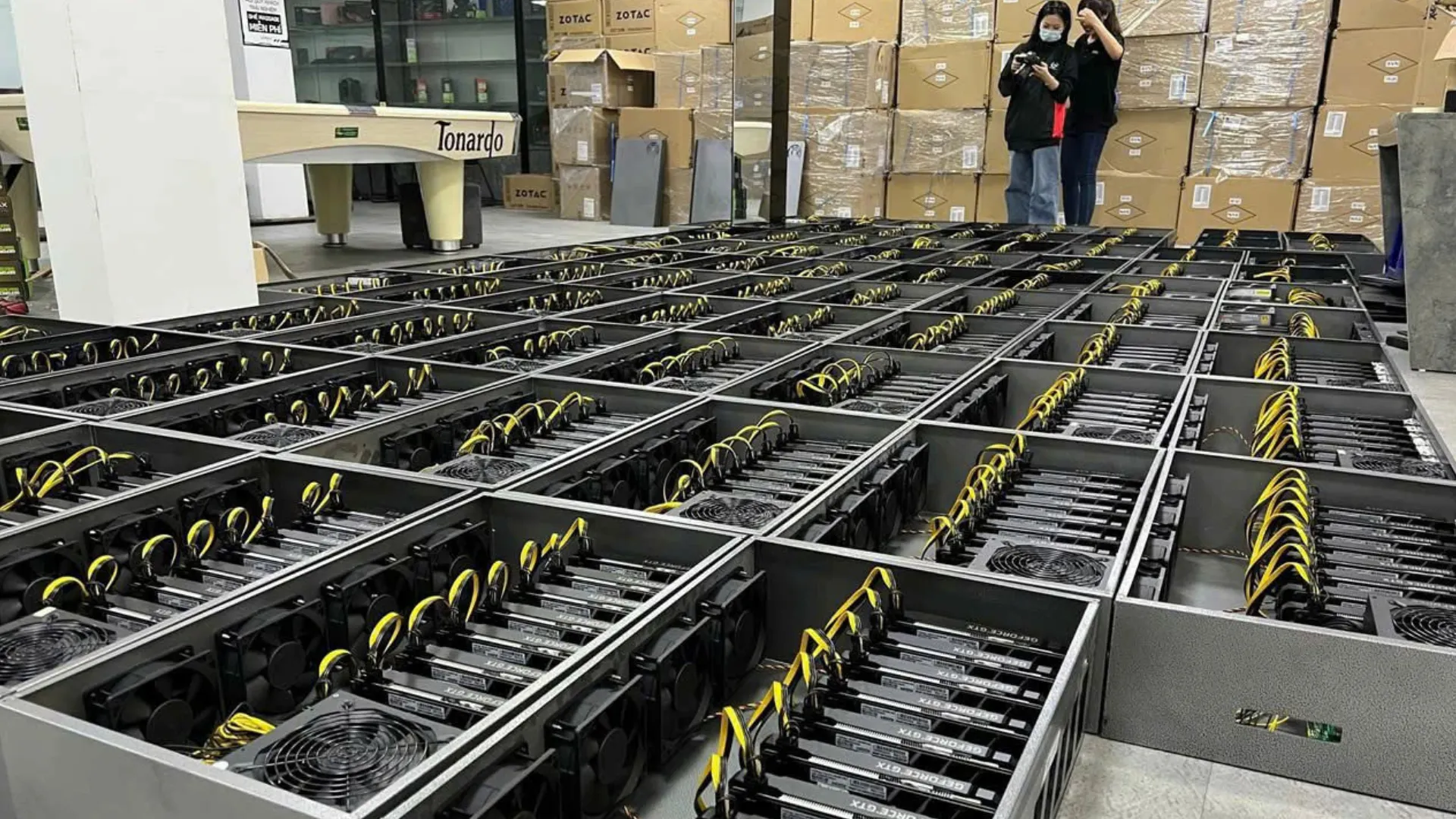
Most of the mining activity has run on rented cloud capacity, with miners spinning up RTX 4090 and RTX 5090 instances on services such as RunPod and Vast.ai and pointing them at community mining pools. As that capacity flooded in, Pearl's network difficulty climbed steeply and cut the per-card payout, and hashrate.no now estimates the RTX 5090's daily revenue at $17.19, a 49% reduction compared to the previous $33.80 figure.
Pearl is a brand-new chain, and its block reward will only decline. It can also only be exchanged on minor exchanges where liquidity is thin, such as SafeTrade and MEXC. Officially, the Pearl pool is optimized for H100 and H200 cards, but as we’ve seen, community miners have produced builds that run on consumer-grade cards.
That split makes a repeat of previous crypto-rush GPU shortages unlikely, since the protocol is optimized for datacenter silicon and most of the rush has concerned rented cloud cards. With the reward set only to fall and the network's hashrate still climbing, returns are thinning in the same way past mining booms have unwound before.
Stay On the Cutting Edge: Get the Tom's Hardware Newsletter
Get Tom's Hardware's best news and in-depth reviews, straight to your inbox.
Luke James is a freelance writer and journalist. Although his background is in legal, he has a personal interest in all things tech, especially hardware and microelectronics, and anything regulatory.
gpu mining is less worth it even then as unlike the cheap as heck electric we had during the 10 series the cost in pwoer to do so today makes it way worse.
gpu mining is less worth it even then as unlike the cheap as heck electric we had during the 10 series the cost in pwoer to do so today makes it way worse.
I haven't been doing any mining, but at $60/day with a couple of cards, it could have been worth doing during midday when I am producing excess solar - the utilities don't pay that well for returning power to the grid.