New one-meter-cubed 3D printer pumps out large-scale prints at 3kg an hour — Modix MAMA-1000 also needs a big wallet with prices starting at $35,000
Design uses a Canadian-made DYZE Design Pulsar pellet print head.
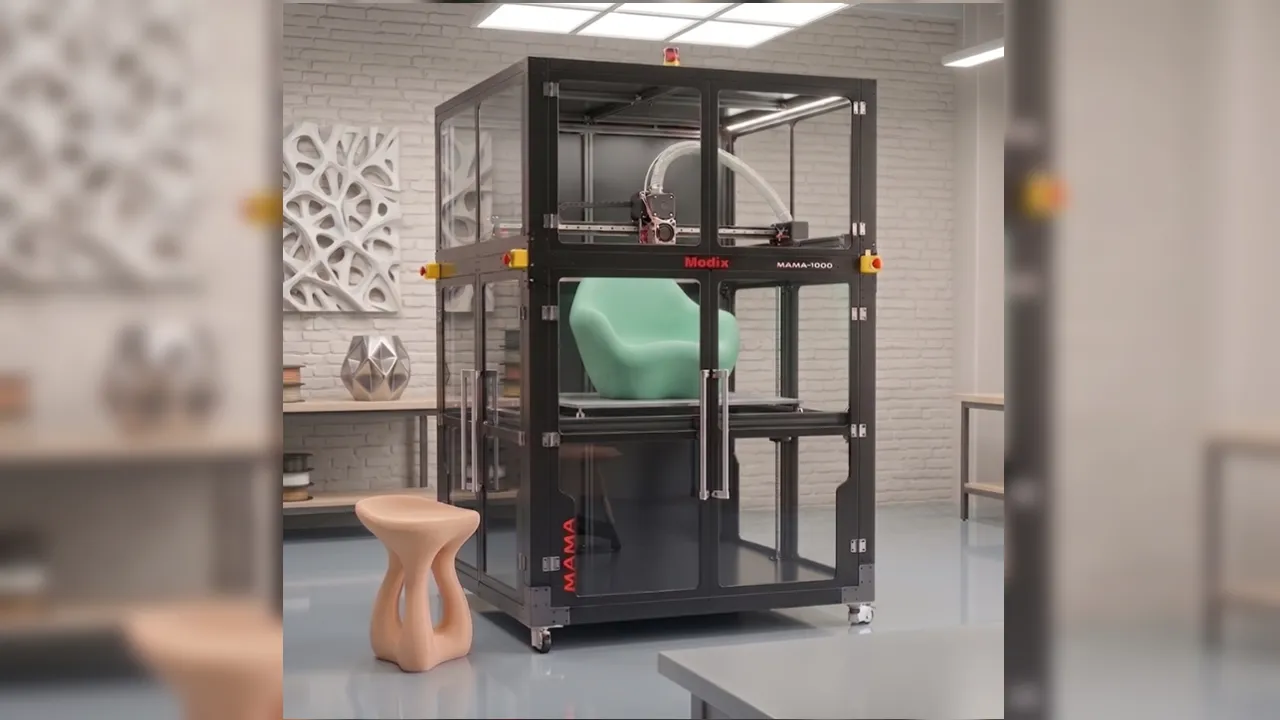
If you want to 3D print industrial-sized, large-scale models, like tables, chairs, and life-sized statues, then a pellet printer is the way to go. With a 5mm nozzle that’s more than 10 times the size of standard desktop machines, the MAMA-1000 pellet 3D printer from Modix can seriously chew through some polymer.
This is where industrial pellet printers have the advantage. Melting pellets, with their greater surface area, is faster and more efficient than melting a strand of plastic. The MAMA-1000 is equipped with a Canadian-made DYZE Design Pulsar pellet print head, which has three heating zones and a screw to push plastic granules out a 3 to 5mm nozzle with a whopping 3kg an hour throughput.
Pellets are also extremely economical, with the PLA going for as little as $2 a kilo when bought in bulk. Printing pellets skips over the manufacturing process required for turning plastic into reels of filament we feed to 'normal' sized desktop 3D printers, like many of our best picks. It’s also the same raw material the plastics industry has been using for injection molding for nearly a hundred years.

For prints requiring more “fine details”, the MAMA-1000 can swap its tool head for a Modix Griffin Ultra that uses standard 1.75mm filament and a 1.6mm nozzle. Closed-loop Nema23 Motors track the tool head with precision for greater accuracy.
The fully enclosed MAMA-1000 has a cubic meter build volume, making it capable of printing anything from PLA to nylon. Though the same size as the mammoth Orange Storm Giga we reviewed in my living room, this machine is on the small side for Modix. Modix, a company that specializes in large-format printing, has printers large enough to print a couple of Wookiees in one go.
The MAMA-1000 uses compressed air to push pellets from a hopper into the extruder. Buyers can add a 25kg dryer, a pigment mixer for custom colors, and an IDEX-style dual print head for printing supports.
“The MAMA-1000 is an important expansion of our MAMA family,” said Shachar Gafni, CEO of Modix in a press release. “Not every customer needs the full size of the MAMA-1700, but many still want the unique flexibility of combining pellet and filament extrusion in one professional system. The MAMA-1000 answers those needs by offering a more compact format without compromising on versatility.”
Get Tom's Hardware's best news and in-depth reviews, straight to your inbox.
Those interested in acquiring a MAMA-1000 are advised that this new model starts at $35,000 and ships fully assembled. The purchase price also includes professional installation, so you can put away those hex keys.

Follow Tom's Hardware on Google News, or add us as a preferred source, to get our latest news, analysis, & reviews in your feeds.

Denise Bertacchi is a Contributing Writer for Tom’s Hardware US, covering 3D printing. Denise has been crafting with PCs since she discovered Print Shop had clip art on her Apple IIe. She loves reviewing 3D printers because she can mix all her passions: printing, photography, and writing.
-
chaos215bar2 ReplyMelting pellets, with their greater surface area, is faster and more efficient than melting a strand of plastic.
Someone obviously read the marketing in the press release, but doesn't really understand how this works.
Yes, you can process pelletized polymer at high volume more easily than filament, but the reasons why are a little more complicated than this. It's not as if each pellet is enveloped by heated metal, meaning the actual surface area as a raw metric has relatively little to do with it.
I would assume this printer uses a similar process to injection molding devices, where pellets are forced through a corkscrew device and heated in large part due to friction. Completely different process than your standard home 3D printer. -
qxp A correction - the sphere has the smallest area among all the shapes with the given volume. So if you are trying to pump heat fast enough to melt plastic while avoiding burning the surface you do not want a spherical pellet and should use something else, such as a filament - the thinner the more surface area it has.Reply
Where this printer wins is that you can use industry standard pellets and the nozzle and processing mechanism is bigger. -
Conor Stewart Reply
The pellet is soft though so it doesn't stay in its original shape for long. The screw mainly heats it using friction and the dimensions of the screw change along its length to essentially squish the hot plastic together and melt it together.qxp said:A correction - the sphere has the smallest area among all the shapes with the given volume. So if you are trying to pump heat fast enough to melt plastic while avoiding burning the surface you do not want a spherical pellet and should use something else, such as a filament - the thinner the more surface area it has.
Where this printer wins is that you can use industry standard pellets and the nozzle and processing mechanism is bigger. -
thrus $2 a kilo in bulk, what is bulk to pellets? I would expect it is measured in pallets of pellets. And the main perk is that you can refill the hopper while it is running and not have a pause like in a diligent orinter to increase the chance of a failed print between those two layers.Reply
Also nice risk taking to be running that size print without locking the wheels.