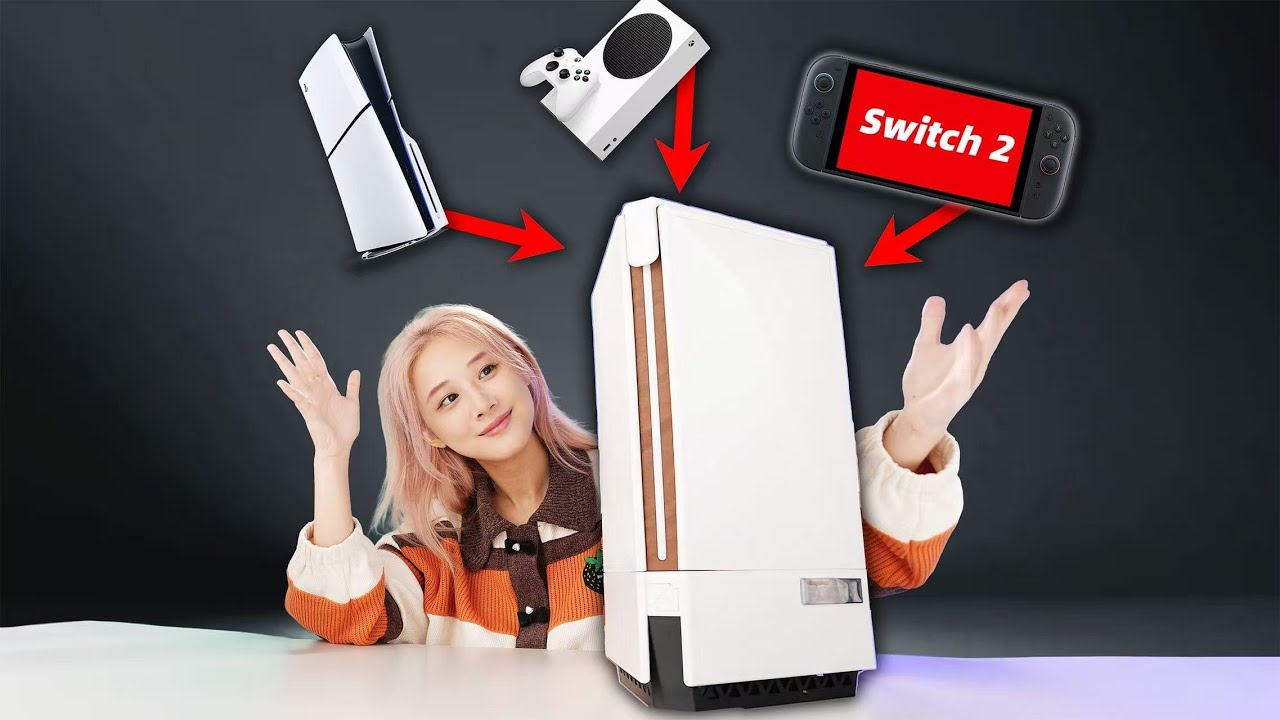
Chinese enthusiast 小宁子 XNZ has built an all-encompassing console with a PS5, Xbox Series X, & Switch 2 in a single system, at the heart of which lies traditional lost-wax casting techniques. This project materialized when XNZ realized she wanted to play platform-exclusive games on one device instead of having to power and manually switch between three different ones. The end result, lovingly dubbed "Ningtendo PXBOX 5," achieves this exactly, ingeniously combining ancient craft with modern technology.
The idea being that each of the three PCBs would be attached to each side of the triangle, with a fan at the bottom cooling all three simultaneously. This is actually not too dissimilar to how the Xbox Series X is already built — cooling from the top down. XNZ quickly modeled and 3D-printed a triangular heatsink, but the CNC costs to mill such a complicated design were too high.

Here's where tradition takes the front seat. Lost-wax casting, also known as lost-clay, is an ancient metalworking technique in China that can help create intricate structures without breaking the bank. It maintains fine surface details and allows for complex shapes that would otherwise not be feasible without the high prices. The entire process is pretty simple, too.
You build something out of a disposable material like wax or clay, XNZ uses plastic (PLA) and generously coats it with a heat-resistant material on top. When heated, the soft material inside will melt or burn away, leaving behind an empty cavity that can be used as the real mold. At this point, you'd put in molten metal that will solidify quickly, giving you the actual metal structure you need.


Once the cooler was acquired from the lost-wax apparatus, it still needed a bit of polish, and XNZ had to remove the support bracket used for pouring. The block didn't look too high quality, but that doesn't matter because it won't make direct contact with the motherboards; that honor still goes to copper plates, which will spread the heat evenly. XNZ built two and attached them to the block using screws.
Now, all that was left was attaching the PS5 and Xbox Series X motherboards to the new cooler, a relatively straightforward task compared to what came before. The video dives into details of the casting shenanigans, including one failed attempt, so make sure to check it out.

XNZ also swapped the liquid metal TIM for a standard thermal paste on the PS5's SoC and saw the temps top out at 60 degrees Celsius when tested. Now, the third side of the cooler block, conspicuously left without a copper plate, was reserved for the Switch 2, which "doesn't need cooling" according to our host. Since the Switch is a handheld device, too, simply sticking its motherboard to the cooler won't cut it.
The dock needs to become part of the equation as well, so XNZ gutted it to get the small motherboard out and put it inside a custom 3D-printed case. This housing was significantly thinner and had a spring-loaded mechanism to eject and/or connect the Switch to the case, which had a USB-C plug at the bottom for docking functionality.


The last part of the internals was the power supply. XNZ measured the idle power draw of the PS5 and Xbox at less than 5W while they both topped out at 225W under full load. So, a single 250W unit can power all three consoles together, as long as you're not running more than one game at a time.
XNZ printed a triangular housing for the power supply with holes for ventilation, putting a 250W GaN PSU in it. Right above that lies the fan compartment powered by a Phanteks T30 120mm case fan that will suck air through the bottom, blowing it toward the top, where the cooler block will sit along with all the motherboards.


At this point, you can see the console taking shape with all the different shells coming together. Everything was assembled to fit inside the final enclosure that would act as the player-facing chassis, kitted with a color-coded LED strip. This light would be controlled by a custom Arduino board dangling inside, responsible for the actual power (and display output) switching.
XNZ added a few decorative pieces like wooden accents and a "Ningtendo PXBOX 5" label on the device. The last addition was a large button on top, connected to that Arduino, pressing which would change between the three consoles. With the final product ready, XNZ tested it on her TV, and it worked perfectly.


It took about three seconds to switch from playing Dong Kong Bananza on the Switch 2 to booting up Ghost of Yotei on the PS5, but there's a catch. Remember the bit about not having two games running simultaneously? Yeah, you'd have to close whatever you're playing on one console before pressing the button to switch to the other one, or else the power supply will become overwhelmed and just trip.
Another caveat is the lack of disc drives on both the Xbox and the PS5, making this is a digital-only console. For PCs which are often the recipient of such modding, that's fine, but consoles are associated with physical media even as both Microsoft and Sony have disc-less options these days. At the end, though, it's still a brilliantly creative "AIO" that looks like something that came off a production line, rather than being milled in someone's backyard.

Follow Tom's Hardware on Google News, or add us as a preferred source, to get our latest news, analysis, & reviews in your feeds.