Gigabit Ethernet
Power users should keep Gigabit Ethernet in mind. While most controllers are able to transfer more than 100 MB/s, the PCI bus will quickly slow them down, as soon as it has to share the total bandwidth, 132 MB/s at 33 MHz, with other devices (which actually happens frequently).
Intel has a solution to this, the so-called CSA or Command Streaming Architecture. It allows a network controller to hook up at the Northbridge at comfortable 266 MB/s (the MCH or 82875P) rather than to the slower south bridge.
Unfortunately, the protocol can only be used after paying license fees to Intel. This likely is the reason why neither SiS nor VIA implemented it. However, this does not explain why they do not have anything similar that would prevent fast network connections to be slowed down. Even though none of the two new chipsets addresses the highest performance segment, features like this one shouldn't just be left out.

VIA PT880 Aka SL-PT880E-RL
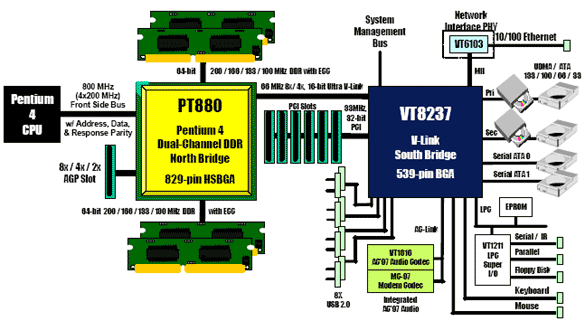
VIA has faced quite a difficult time, since they lost a considerable amount of market share due to the fact that they simply did not have the license for producing Pentium 4 chipsets.
The PT880 implements VIA's newly developed dual-channel memory interface, which could also be used in other upcoming chipset products for AMD's processors. Since there is not much sense in developing a memory interface for the Athlon 64, you might easily guess what we could expect for fall.
In contrast to SiS, VIA decided to equip the chipset with as many features as possible and supports ECC memory as well as eight memory banks. In addition, up to 8 GB of RAM are supported, while both Intel and SiS do only support 4 GB, which usually is the maximum a 32 Bit processor is able to address. Although there might only be little sense in equipping a Pentium 4 desktop machine with multiple gigabytes of RAM, it's certainly nothing wrong with keeping this upgrade path open.
While there's still no DDR2 memory around, VIA's technical specifications already mention quad-band memory support, both for single and dual channel. Thus we might see VIA-based motherboards from DDR2 from the very beginning.
Apart from the news, the PT880 includes all features that you likely already know. This includes an AGP 8X interface, dual UltraATA/133 interface, six channel sound controller, network controller, up to six PCI slots and a total of eight USB 2.0 slots.
