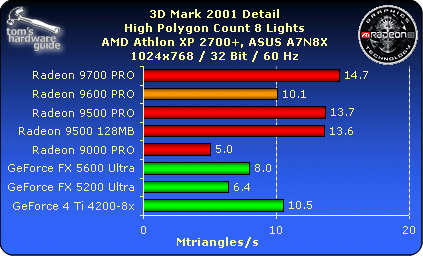
In this test, the "missing" two vertex shaders really hurt the 9600 PRO, resulting in lower polygon throughput.
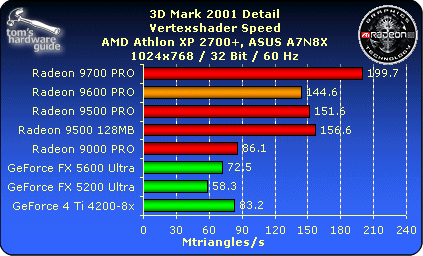
3D Mark 2001: Vertex Shader Speed

Interestingly, the lower polygon performance of the 9600 PRO compared to the 9500 is not as pronounced in the 3DMark 2001 vertex shader test. The fact that the vanilla 9500 scores higher than the PRO version can be attributed to our review sample's higher clock speeds.
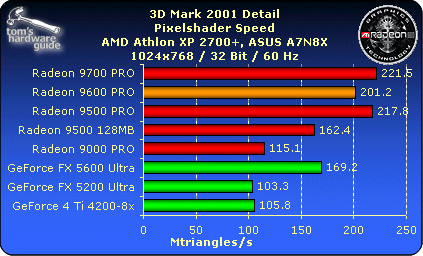
3D Mark 2001: Pixel Shader Speed

The 9600 PRO offers solid performance here. It can almost close the gap to the 9500 PRO, and clearly outpaces the FX 5600.
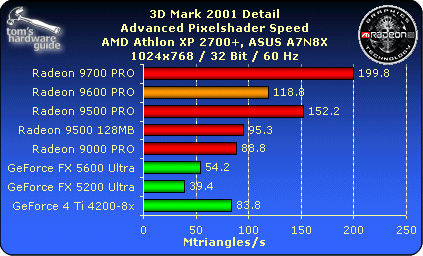
3D Mark 2001: Adv. Pixel Shader Speed

It remains unclear why both FX cards fall this far behind in this test, since they both support PS 1.4 in hardware, thanks to DX9 support. It's worth noting that the 9600 PRO once again trails the 9500 PRO by a wide margin.
Previous
Next
Summary
- Introduction
- Radeon 9600 PRO, Alias RV350
- The Radeon 9600 PRO In Summary
- Radeon 9600 PRO Card Versions
- A Matter Of IQ
- A Matter Of IQ, Continued
- Test Setup
- Benchmarks
- Unreal Tournament 2003: 2x FSAA
- Unreal Tournament 2003: 4x FSAA
- Unreal Tournament 2003: 8x Anisotropic
- Unreal Tournament 2003: 4xFSAA + 8x Anisotropic
- Serious Sam - Second Encounter: Standard Test
- Serious Sam - Second Encounter: Min FPS
- Serious Sam - Second Encounter: 2x FSAA
- Serious Sam - Second Encounter: 4x FSAA
- Serious Sam - Second Encounter: 8x Anisotropic
- Serious Sam - Second Encounter: 4xFSAA + 8x Anisotropic
- Splinter Cell: Standard Test
- Splinter Cell: Min FPS
- Aquanox 2: Standard Test
- Codecreatures: Standard Test
- Codecreatures: Avg # Of Polys
- 3D Mark 2001: Standard 1024x768
- 3D Mark 2001: Game 4 Nature
- 3D Mark 2001: High Polygon Count
- 3D Mark 2003: Standard 1024x768
- 3D Mark 2003: Vertex Shader Speed
- Conclusion
Ask a Category Expert
Create a new thread in the Reviews comments forum about this subject
There are 0 comments.
This thread is closed for comments