PCI-X Vs. PCI Express
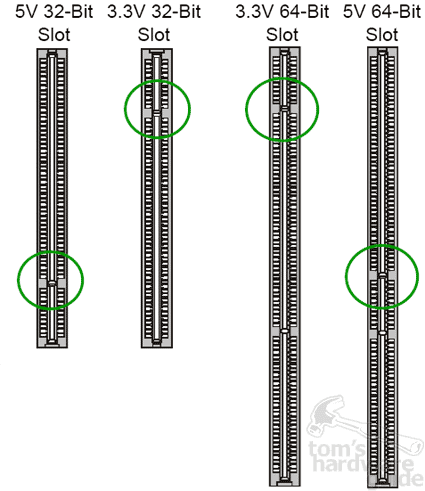
Parallel PCI standards with 5 V and 3.3 V are incompatible. Whatever is electronically possible is allowed mechanically.
Source: Digi PCI Technology Overview.
When looking at the comparison table below, you might be tempted to question whether PCI-X would be rendered superfluous. While PCI Express will mainly be around in desktop systems, PCI-X will remain the prevailing high-performance interface for high-end workstations and server systems. Finally, PCI-X 1066 will be able to provide up to 8.5 GB/s.

Swipe to scroll horizontally
| Standard | Bus Width | Clock | Transfer |
|---|---|---|---|
| PCI 2.3 | 32 Bit | 33 MHz66 MHz | 133 MB/s266 MB/s |
| PCI 64 | 64 Bit | 33 MHz66 MHz | 266 MB/s533 MB/s |
| PCI-X 1.0 | 64 Bit | 66 MHz100 MHz133 MHz | 533 MB/s800 MB/s1066 MB/s |
| PCI-X 2.0 (DDR) | 64 Bit | 133 MHz | 2132 MB/s |
| PCI-X 2.0 (QDR) | 64 Bit | 133 MHz | 4264 MB/s |
| PCI Express | 1 Lines, 8 Bit | 2.5 GHz | 512 MB/s |
| PCI Express | 2 Lines, 8 Bit | 2.5 GHz | 1 GB/s (Duplex) |
| PCI Express | 4 Lines, 8 Bit | 2.5 GHz | 2 GB/s (Duplex) |
| PCI Express | 8 Lines, 8 Bit | 2.5 GHz | 4 GB/s (Duplex) |
| PCI Express | 16 Lines, 8 Bit | 2.5 GHz | 8 GB/s (Duplex) |
| PCI Express | 32 Lanes, 8 Bit | 2.5 GHz | 16 GB/s (Duplex) |
TOPICS
