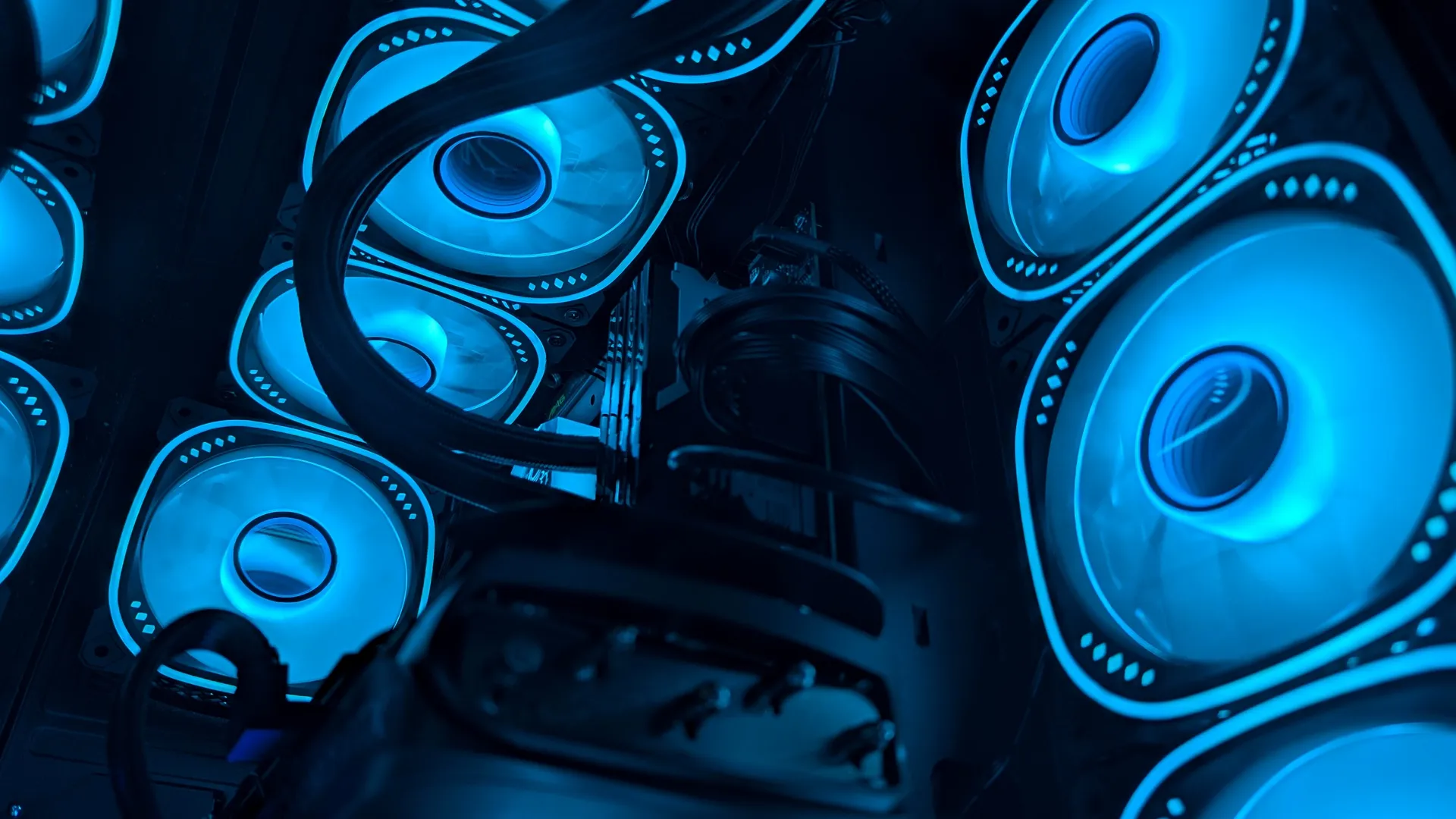
You’ve seen the debates, and you’ve seen the Reddit threads. You’ve probably even flipped your rear fan orientation at 2 a.m. “just to test something.” As enthusiasts, we obsess over the tiniest details of our PCs just to get that extra frame while gaming, or to lower the temperatures of our GPU by one degree. This is where the importance of airflow becomes paramount.
Most PC builders spend hours finding the perfect CPU and GPU combination that stretches every penny of their budget. They pick the most optimal cooling components and even think about the conductivity numbers of their thermal paste, but when it comes to case airflow, it all becomes a bit rudimentary. In fact, some PC builders nowadays prioritize aesthetics over performance when it comes to choosing the number and size of their case fans.
The airflow configuration (i.e., where and how the air is flowing) of your PC build is one of the most overlooked parts of the entire process. It is something that is considered tedious and frequently glossed over, even though it can be a significant factor in determining the performance and longevity of your expensive internals.
If you've ever wondered why two identical builds running the same components in different cases can have wildly different thermals, this is often the culprit. And no, the fix isn't always "more fans." That's a rabbit hole we'll get into later.
So let’s jump into the ins and outs of airflow in a PC case and how you can use the various pressure configurations to maximize the performance of your rig. But first, let’s brush up on the basics.
The (Already Established) Importance of Airflow
Of course, airflow being important isn’t exactly breaking news. Your PC’s components generate heat, and that heat needs to go somewhere to prevent thermal issues. Airflow helps to take the heat away from the components and dissipates it to the outside of your case. The case airflow is doubly important in cooling down components that don’t have a heatsink or fan directly attached to them.
Fail to cool your internal components properly, and you’re putting both the performance and longevity of your PC at risk. Modern components such as CPUs and GPUs are smart and dynamically adjust their performance based on the thermal headroom. If your CPU or GPU is overheating, it will slow itself down in order to keep the temperatures within a safe limit. This process is called thermal throttling, and it can be highly detrimental to the performance of your rig.
Components like graphics cards and CPU coolers have their own cooling mechanisms that move air within the case to help in cooling, but they still depend on the overall airflow of the PC case to perform optimally. If the PC case has restrictive airflow, the fans on your expensive graphics card or tower cooler will do little else than make a load of noise.
Good airflow ensures that a steady supply of cool ambient air reaches your components. It creates a path for hot air to escape efficiently. It prevents hotspots, which are pockets of stagnant warm air that can accumulate near heat-generating components with no direct cooling coverage. And when done right, it even helps keep dust manageable by controlling where and how air enters the system.
Positive Pressure: What It Is And How To Achieve It
First off, "pressure" is generally a relative term when PC building, since cases aren't sealed, but differences can definitely change airflow patterns.
Positive pressure is exactly what it sounds like. You are pushing more air into the case than you are pulling out of it. There is increased pressure inside the PC case, which forces air out of the case through the exhaust fans, vents, cracks, and crevices of your case. This type of airflow configuration is the most popular in pre-built PCs and overall in the DIY space as well.
Simply put, you can achieve positive pressure inside the PC case by having more intake fans than exhaust fans. If you want to get a bit technical, the intake fans need to have a higher combined airflow rating (measured in CFM or cubic feet per minute) than the exhaust fans.
This configuration typically looks like 2 or 3 intake fans installed at the front of the case, with 1 or 2 exhaust fans installed at the rear or top of the case. This way, there is more air entering the case through the front than is leaving through the rear, resulting in a net positive pressure inside the chassis.
Here's a practical example: imagine a system with three 120mm intake fans at the front running at 1200 RPM, paired with a single 120mm exhaust at the rear running at 900 RPM, and a 120mm top exhaust at 900 RPM. Even with two exhaust fans, if the three front intakes are moving more total CFM, you're net positive. You don't need to get bogged down in the math, but the rough principle holds.
It is worth noting that if you're running a 360mm radiator as a front intake, that radiator also acts as a significant intake just like the regular fans. A system with a 240mm or 360mm radiator in the front and a 120mm exhaust fan in the back is also in a positive pressure state, though the restriction that radiator fins add to airflow does complicate things slightly.
You can also swap the position of the intake fans and the exhaust fans while still achieving positive pressure, provided that the total CFM of the intake fans remains higher than the exhaust fans.
Mastering Negative Pressure
Negative pressure is a bit of a sneaky one, as it is less popular and there is also a bit of misinformation about it that drives away new builders. In this configuration, more air is being exhausted out of the PC case than is being actively pulled in, resulting in a negative pressure inside the case.
You can think of negative pressure as a vacuum that pulls air into the case from the surrounding environment through the vents and crevices in the case. Contrary to popular belief, this also results in significant airflow within the system that effectively cools your components, provided you are smart about fan placement.
The classic negative pressure setup is a rear exhaust fan, a top exhaust fan or two (usually there's room for three), and fewer (or no) front intakes. The case becomes a giant vacuum, drawing air in through every available opening. You can also flip the front fans and use the front of the case as an exhaust, but that is not recommended if there is a dust filter on your front panel.
Of course, just like with positive pressure, the RPM and/or CFM rating of your fans matters if you want to build a negative pressure system. If your exhaust fans have a higher CFM than your intake fans, then you will achieve negative pressure. You can also use custom fan curves to ramp up your exhaust fans higher than intakes.
The major drawback of a negative pressure system is dust buildup. Since the inside of the case acts as a vacuum, the air (and accompanying dust) is pulled from all the vents, cracks, and crevices in the case, not just the filtered intakes. This means that dust builds up quickly and unevenly in your PC case. Most of the dust also builds up in areas that do not have a dust filter, making them a pain to clean.
Also, the difference in buildup between positive and negative pressure can vary substantially depending on how much small particulate matter is actually in the air around your PC.
When Is Positive Pressure The Clear Choice?
Positive pressure is the safe, tried-and-tested popular option that most PC builders tend to go with. It provides a balanced airflow pattern inside the system that keeps the temperatures of your core components under control. Here are a few scenarios where positive pressure makes the most sense.
1. You want to prevent dust buildup: The most important benefit of a positive pressure configuration is dust control. Since the inside of the system theoretically acts as a balloon being inflated, the air tends to escape to the outside of the case through any possible pathway. This means that air is exhausted through vents, grilles, or any opening that is present in the case.
Dust accompanies air, which is why this configuration prevents dust buildup inside your PC case. You will still need to regularly clean your dust filters, but this setup will prevent you from cleaning dust bunnies out of your GPU every week. If you have a pet cat or dog, you should go with a positive pressure layout to prevent pet hair from choking your PC components.
2. You have a high-airflow case with front mesh: Cases like the Fractal Torrent, Lian Li Lancool III, Corsair 4000D Airflow, or be quiet! Pure Base 500DX are designed to accommodate large front intakes efficiently. The unrestricted front mesh combined with large fans is one of the most effective thermal solutions available, and positive pressure maximizes that design.
3. You are using a tower air cooler: A large tower cooler will extract heat from the CPU and dump it into the case, which needs to be effectively removed. A positive pressure layout will create a nice airflow pattern from the front of the case to the rear or top, which will cause the heat to be exhausted regularly.
4. You are using a blower-style graphics card: While a bit uncommon nowadays, blower-style GPUs used to be everywhere in the last decade. A positive pressure system is quite nice for a blower-style GPU since it needs a lot of airflow inside the case to work optimally. With large front intakes, a blower-style card will get ample airflow to effectively cool its GPU, and it does act as an exhaust as well.
Is Negative Pressure Any Good? (Spoiler: Yes!)
While it gets a bad rap due to dust buildup, negative pressure also has its place and should not be dismissed entirely. It is a slightly more outside-the-box approach to airflow configuration, but under certain circumstances, it can be the right choice.
1. Your case has a restricted front panel: This is the primary use case of a negative pressure layout. If your PC case has a glass front panel or the vents are more for “aesthetics” than functionality, then you might want to give negative pressure a try. Instead of trying to bend the laws of physics by trying to force air through or around a solid metal panel, you can suck the air in through the other gaps that are present in every PC case.
Negative pressure uses the vacuum inside the PC case to bypass the restriction of the solid front panel. The target is to achieve airflow inside the case, and it does not really matter where that air comes from. However, you should get some cans of compressed air and be ready for more frequent cleaning sessions.
2. Better GPU temperatures (in certain cases): That’s right. A negative pressure setup can be better than a positive pressure setup when it comes to GPU cooling. This point goes hand-in-hand with the first one.
If you have a case with a restrictive front panel, then a negative pressure setup will provide better GPU cooling since it pulls in air from vents and PCIe holes that are physically close to the GPU. Moreover, any heat that is dumped from the graphics card into the case is promptly removed by the exhaust fans that also sit very close to the GPU (at the rear and top of the case).
Even if you don’t have a particularly restrictive PC case, going with a negative pressure setup could shave a few degrees off your GPU temps simply due to the way the air behaves near the graphics card.
3. Prevent heat buildup or “hotspots”: Negative pressure has an inherent advantage of preventing the creation of hotspots in the PC case. In a positive-pressure system, there can potentially be several spots of heat buildup where air cannot directly reach. If these areas have heat-sensitive electronics like SSDs or memory sticks, then they can also be negatively affected by the heat buildup.
In a negative pressure system, the air moves throughout the system due to the vacuum effect. Smoke tests show negative setups create turbulent flow, scrubbing hot boundary layers off components faster. This means that negative pressure could be better for components that are passively cooled and do not have direct access to airflow from a fan.
4. In Small Form Factor PCs: Negative pressure is especially relevant in small form factor (SFF) and compact mid-tower builds where component density is high, and there simply isn't room for a conventional airflow path.
In these scenarios, controlled negative pressure (combined with case designs that have strategically placed ventilation holes near the GPU bay) can result in meaningfully better graphics card temperatures. Of course, this will vary significantly from case to case, but if you are struggling with GPU temperatures in an SFF chassis, give negative pressure a go.
The Law Of Diminishing Returns
You don't have to go off to buy a boatload of fans for your new PC; this is where we need to talk about the law of diminishing returns.
Here's the underlying principle: airflow efficiency is limited by the thermal load of your components and the physical limits of your case. Once you've established adequate intake and exhaust to handle the heat your system generates, adding more fans produces rapidly diminishing returns.
This means that adding more fans is not necessarily better. At a certain point, the cost of adding another fan significantly outweighs its benefit, making it a poor value for your money. If you just have extra fans lying around and don’t mind the added noise, by all means install them. But if you are building a new PC from scratch or want to optimize the airflow of your existing build, throwing on more fans does not necessarily solve the problem.
For a regular mid-tower case with mid-range components, a couple of front 120mm intake fans and a singular rear 120mm exhaust fan are typically enough for a positive pressure layout. On the flip side, you may want to use a couple of 120mm or 140mm fans with no intake fans in order to get a good negative pressure system.
If you have an AiO, then it is your personal preference whether you want to use it as an intake or an exhaust. Both configurations are fine and should help you move adequate air in or out of the system, provided you have other fans in relevant positions.
Time To Clear The Air
At the end of the day, optimizing your PC’s airflow is a balancing act. You need to find the right mix of intake and exhaust that works for your build, keeps temperatures in check, while being relatively quiet and dust-free. Don’t be afraid to experiment.
It is easy to just go for the reliable positive pressure just because it provides better dust control. However, if you are struggling with GPU temperatures or have bought one of those PC cases that treat airflow as “optional,” then you may want to give negative pressure a go.
You definitely don't need the extra fans. Instead, you can spend that money on better quality fans in the positions that actually matter, route your cables properly, and make sure your case has adequate mesh coverage to support the setup you're going for. Three great fans doing their job properly will outperform six mediocre ones fighting each other every single time.
Also, don’t put your PC on a carpet. Just don’t.

Follow Tom's Hardware on Google News, or add us as a preferred source, to get our latest news, analysis, & reviews in your feeds.