









Electronics enthusiast begins breadboard-based Intel 386 system build — a large step up from their previous PC-XT and PC-AT breadboard projects
This is far more complex PC DIY than we are accustomed to.

Motherboards, who needs them? Not Breadboarding Labs, which recently outlined plans to build a retro Intel 80386 (i386) PC using solderless breadboards. Don’t worry, this project isn’t pie-in-the-sky. Breadboarding Labs has two prior similar and successful feats behind them – two breadboard-based PC-XT and PC-AT (Intel 8088) computers. However, this new project, aiming to replicate the functionality of Compaq’s milestone DeskPro 386 system, will be a tougher challenge.
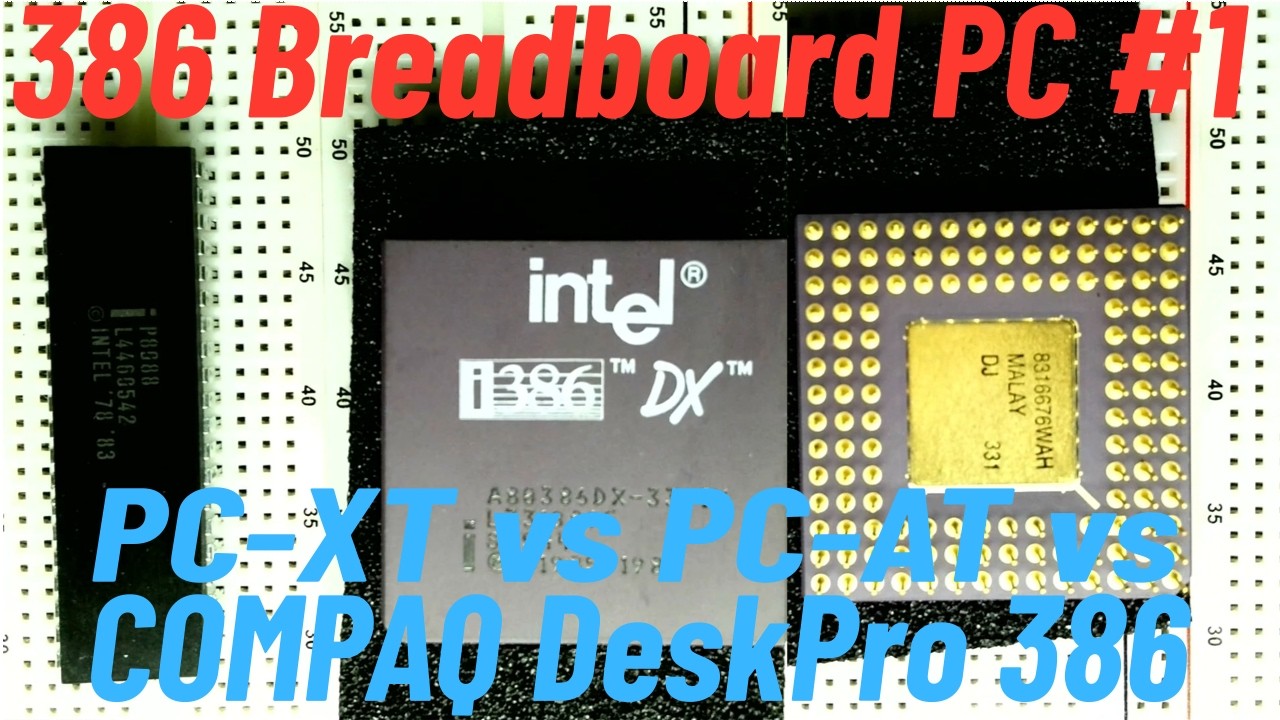
A new breadboard PC project based on the 386 CPU is a more advanced electronics maker task due to the generations newer, relatively complex hardware involved. The maker will be spared making everything from scratch, though, as some breadboard modules from previous 8088 projects will be able to be reused.

The 386 Breadboard PC will be able to reuse the following prior works:
- Clock and bus controller
- MDA video controller
- CGA video controller
- Timer
- Parallel port
- Speaker
- Real-time clock
- Serial port
- Dual interrupt controller
- Power on self test port
- IDE hard disk and controller

Above you can see an annotated image showing the maker’s immediately previous project, the Breadboard PC 8088 Version 2. It is clear some of those assemblies will be taken forward for the 386 Breadboard PC project.
There remains a lot of extra work that needs addressing to complete the 386 project, such as:
- 80386 CPU interface
- 32-bit RAM, DMA, 16-bit ISA bus
- 16-bit DMA
- Timer 2 and variable speed control
- DMA-free DRAM refresh logic
- 16/8 MHz (reduced clocks)
- PS/2 mouse and keyboard
- VGA video
- 3.5-inch floppy drive and controller
Work will begin with the breadboard adapter for the 386 CPU. This will be a significant challenge compared to the prior 8088 processor-based systems the enthusiast has made. Not least because a 386 chip has 136 pins that need wiring up, compared with just 40 for the 8088.
If you are interested in following the progress of the freshly started 386 Breadboard PC project, then it will be worth staying tuned to the YouTube channel. We also hope to keep up to date with this and check out the finished remake. Some performance tests and comparisons of the functioning PC system would be very interesting to see. Overall, it is a far more complex grade of PC DIY than we are accustomed to.
Get Tom's Hardware's best news and in-depth reviews, straight to your inbox.

Follow Tom's Hardware on Google News, or add us as a preferred source, to get our latest news, analysis, & reviews in your feeds.

Mark Tyson is a news editor at Tom's Hardware. He enjoys covering the full breadth of PC tech; from business and semiconductor design to products approaching the edge of reason.
-
8086 such bad timing, Linux just dropped 486 support.Reply
https://www.tomshardware.com/software/linux/linux-devs-start-removing-support-for-37-year-old-intel-486-cpu-head-honcho-linus-torvalds-says-zero-real-reason-to-continue-support -
MobileJAD Reply
If someone is putting together a 386 or 486 system together as a fun project, do they really need the most bleeding edge Linux kernel?8086 said:such bad timing, Linux just dropped 486 support.
https://www.tomshardware.com/software/linux/linux-devs-start-removing-support-for-37-year-old-intel-486-cpu-head-honcho-linus-torvalds-says-zero-real-reason-to-continue-support -
MobileJAD Reply
Honestly so many motherboards from the 80s and 90s are dying out each year, if you want to build such a system today your options are going to be playing the Goodwill or eBay lottery, searching for a industrial PC motherboard at a decent price or... Build it yourself.Admin said:Motherboards, who needs them? Not Breadboarding Labs, which recently drafted plans for a retro Intel 80386 (i386) PC build using solderless breadboards.
Electronics enthusiast begins breadboard-based Intel 386 system build — a large step up from their previous PC-XT and PC-AT breadboard projects : Read more -
bit_user Reply
Not really that bad, considering there are LTS kernels that support it and will keep getting bugfix patches for a long time.8086 said:such bad timing, Linux just dropped 486 support.
https://www.tomshardware.com/software/linux/linux-devs-start-removing-support-for-37-year-old-intel-486-cpu-head-honcho-linus-torvalds-says-zero-real-reason-to-continue-support
Usually, by the time the Linux kernel drops support for hardware, the code paths for it have already broken to the point of being unusable and nobody has stepped up to contribute fixes for at least a couple kernel releases. I doubt i486 is that broken, but it's a fact that the fewer people are actually using hardware, the more bugs it tends to accumulate. -
Dave - Breadboarding Labs Reply
Dave here from Breadboarding Labs. No problem as will only have 8-10MB of RAM so need a really old LINUX distribution like Slackware 2. I have fond memories of getting this running back in 1995 on my 486 based PC (even with the Mitsumi CD-ROM running off the sound card!).8086 said:such bad timing, Linux just dropped 486 support.
https://www.tomshardware.com/software/linux/linux-devs-start-removing-support-for-37-year-old-intel-486-cpu-head-honcho-linus-torvalds-says-zero-real-reason-to-continue-support
Aiming for Windows 3.1 Enhanced Mode, Windows 95 A (retail - no USB) and Slackware LINUX. -
Dave - Breadboarding Labs Reply
If you want to understand how stuff works then the DeskPro 386/16 was about the last PC model which didn't have huge 100+ pin VLSI chips with most of the logic on them. This is the design I am basing this project on. A lot of the components (Timer, DMA, Interrupt Controllers) are still available new today in DIP form. Its only the CPU and a few other obscure parts (74LS612 Memory Mapper) that are needed from eBay. Most of these components are still emulated in modern chipsets. Intel have been planning to drop legacy hardware support at some point but I think most modern CPUs can still boot MS-DOS 3.30 in legacy BIOS mode.MobileJAD said:Honestly so many motherboards from the 80s and 90s are dying out each year, if you want to build such a system today your options are going to be playing the Goodwill or eBay lottery, searching for a industrial PC motherboard at a decent price or... Build it yourself.
Dave (Breadboarding Labs) -
bit_user Reply
386DX-25 was the first computer I truly used on a daily basis. I had fond memories from seeing that chip in the photos!Dave - Breadboarding Labs said:Dave here from Breadboarding Labs.
I also first tinkered with Linux on it. At the time, I had no real clue what to do with it, so I pretty much just booted it up, learned a few shell commands, and marveled at how much faster Linux could format a floppy disk (and the PC didn't even get unresponsive, during the process!).
Good luck!
: ) -
Dave - Breadboarding Labs Reply
Thanks for the article Mark. You can contact me on the email on the YouTube site (also registered for the account) if you would like notification of new updates. Planning on doing 1-2 videos per week but wiring up and testing the 132 pin breadboard adapter likely to take a little while longer.Admin said:Motherboards, who needs them? Not Breadboarding Labs, which recently drafted plans for a retro Intel 80386 (i386) PC build using solderless breadboards.
Electronics enthusiast begins breadboard-based Intel 386 system build — a large step up from their previous PC-XT and PC-AT breadboard projects : Read more
Dave -
Dave - Breadboarding Labs Reply
Thanks, I think I will need it with so many more wires! During floppy disk access the PC BIOS just did a tight loop waiting for the floppy disk interrupt to signal the data transfer was finished. It was only when the BIOS wasn't used that other activities could go on in the background like with LINUX (and possibly 32 bit Windows VxD floppy disk drivers or virtual 86 - though not done this yet).bit_user said:386DX-25 was the first computer I truly used on a daily basis. I had fond memories from seeing that chip in the photos!
I also first tinkered with Linux on it. At the time, I had no real clue what to do with it, so I pretty much just booted it up, learned a few shell commands, and marveled at how much faster Linux could format a floppy disk (and the PC didn't even get unresponsive, during the process!).
Good luck!
: )
Dave (Breadboarding Labs)