









Why you can trust Tom's Hardware Our expert reviewers spend hours testing and comparing products and services so you can choose the best for you. Find out more about how we test.
AMD Ryzen 7 9850X3D Gaming Benchmarks — The TLDR
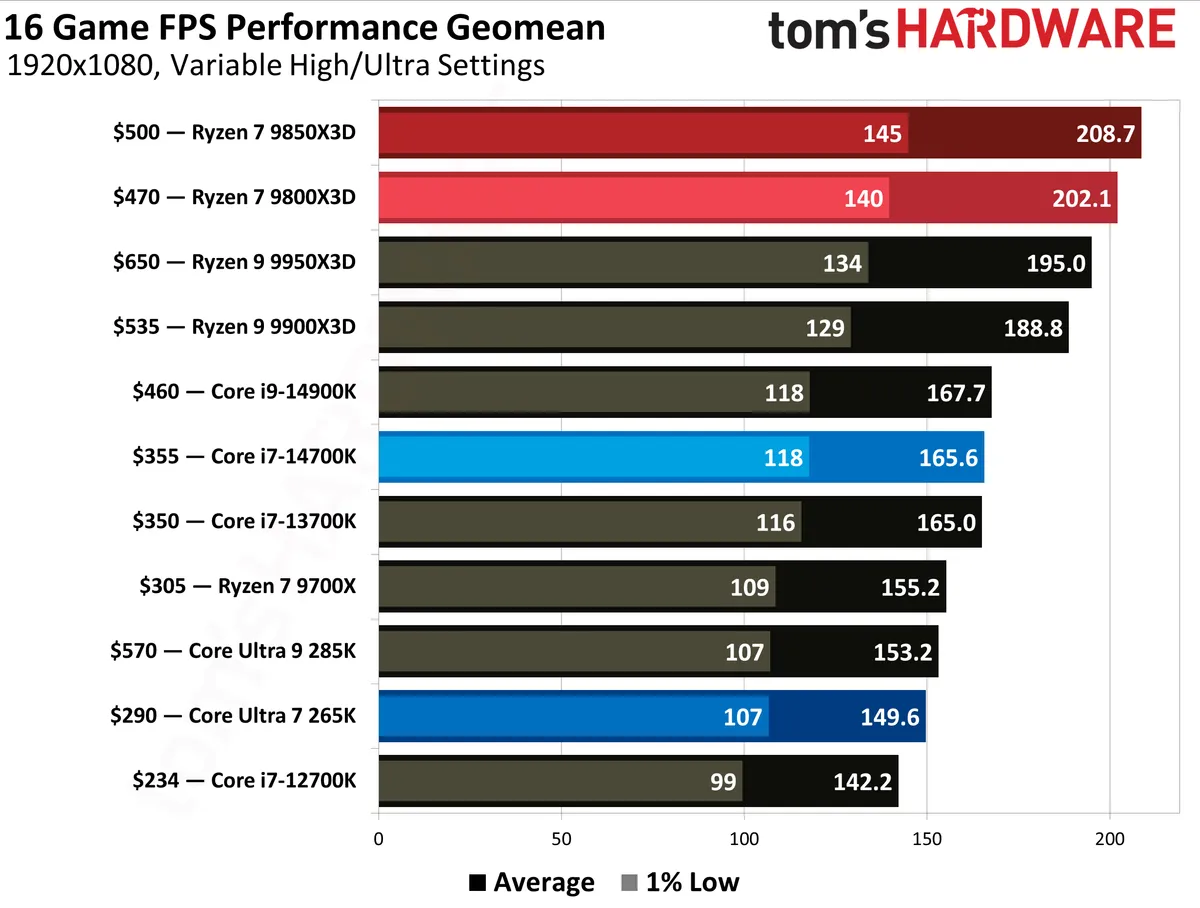
The Ryzen 7 9850X3D is the world’s fastest gaming processor, if only by 3.3%. It’s faster than the Ryzen 7 9800X3D, regardless of how marginal that victory is and how little it meaningfully impacts the gaming experience. Then again, if you already own the Ryzen 7 9800X3D, you probably never planned on upgrading to the Ryzen 7 9850X3D.
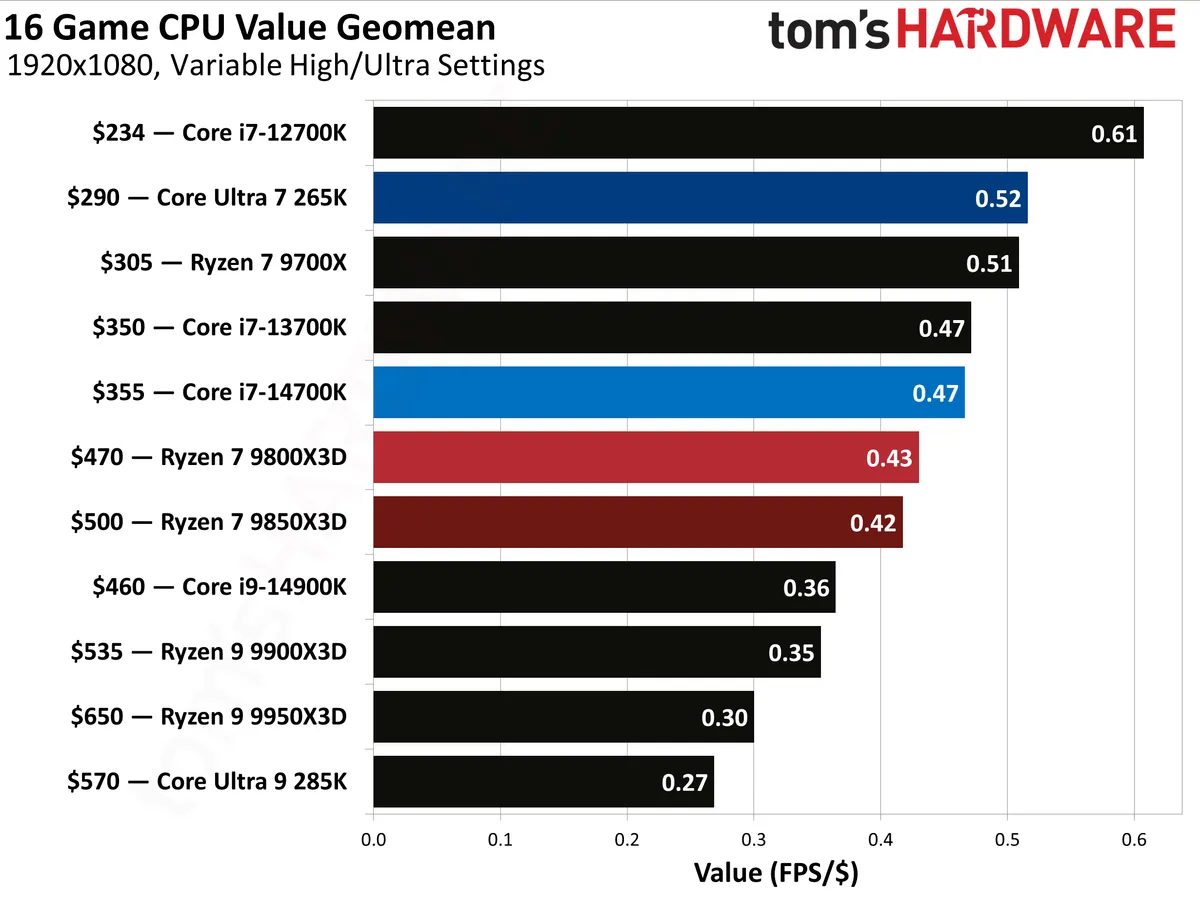
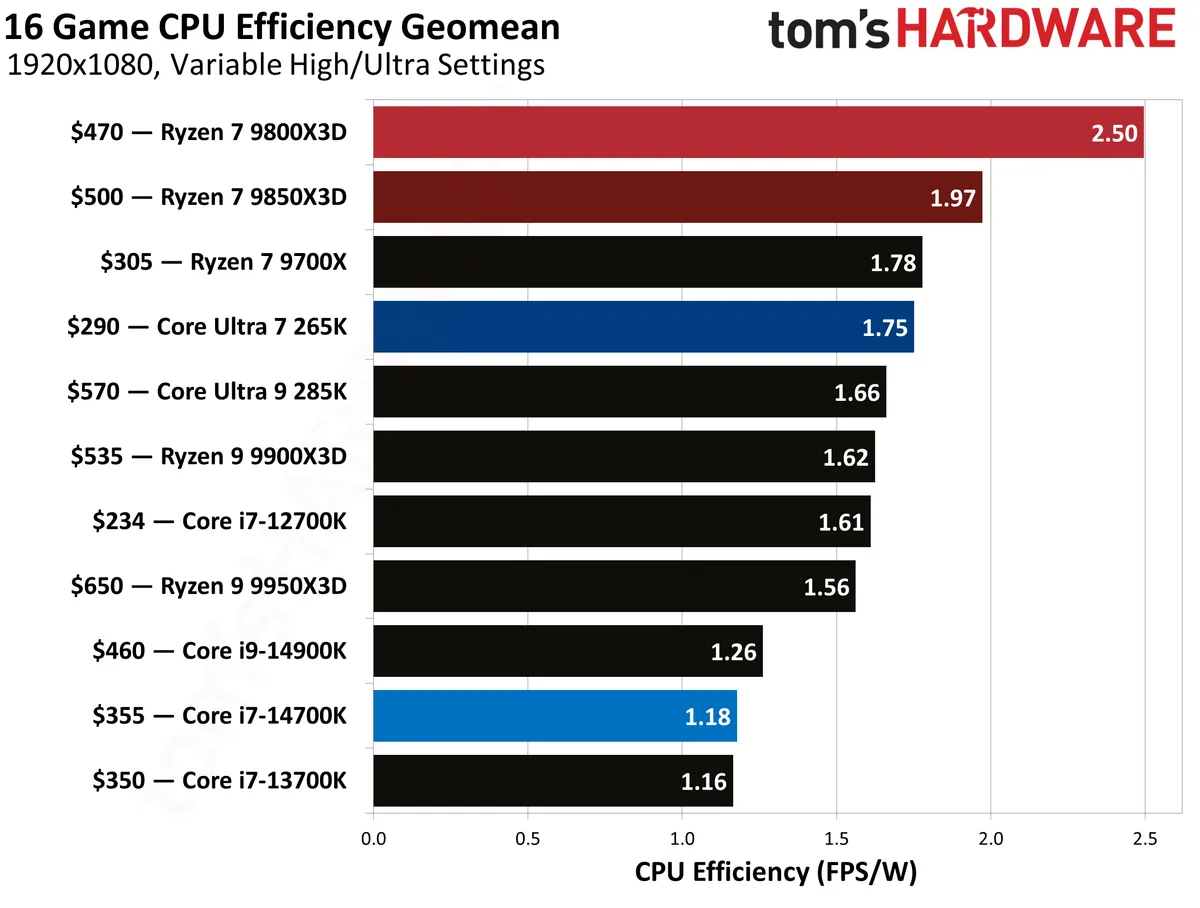
The more interesting dynamic is for new builders who have to choose between the Ryzen 7 9800X3D and Ryzen 7 9850X3D, and with prices how they currently are, that’s an easy choice. The Ryzen 7 9850X3D is 6.4% more expensive than the current price of the Ryzen 7 9800X3D (even more expensive compared to the sales price), and it offers a 3.3% uplift on average. From a value perspective, the Ryzen 7 9800X3D still clearly wins the day.
View Original

View Original

View Original

View Original

View Original

View Original

We’re testing with the Nvidia GeForce RTX 5090 FE to isolate CPU performance as much as possible and skirt GPU-imposed bottlenecks. With less powerful GPUs and higher resolutions, the performance gap between each CPU will shrink.
Focused purely on gaming, there really isn’t another CPU in the conversation. The Ryzen 9 9950X3D gets close, but the cheaper eight-core X3D chip still comes out ahead. You’ll spend around the same price on the Ryzen 7 9800X3D as Intel’s closest competitor, the Core i9-14900K, and AMD still comes out over 20% ahead. The comparison to Arrow Lake is even worse, with the flagship Core Ultra 9 285K still managing less performance than the lowly eight-core Ryzen 7 9700X.
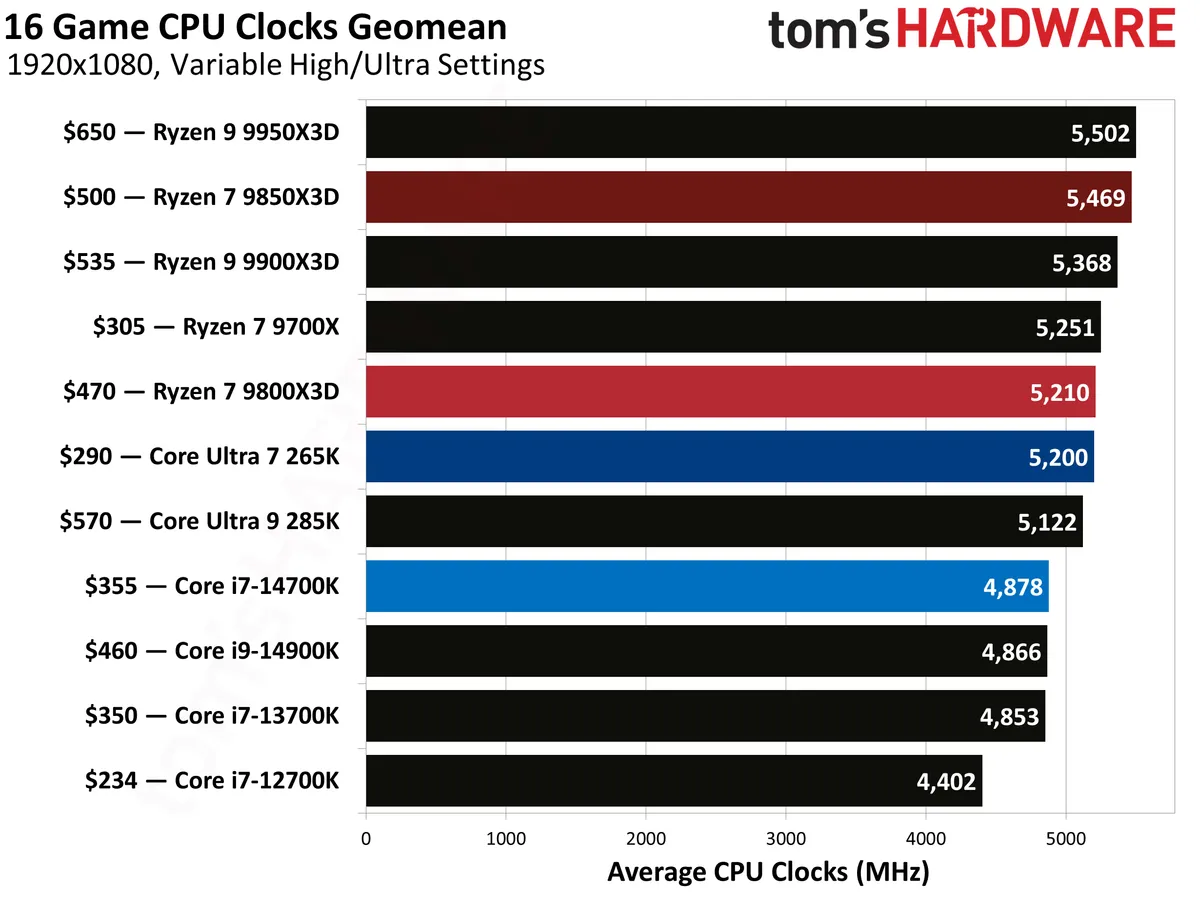
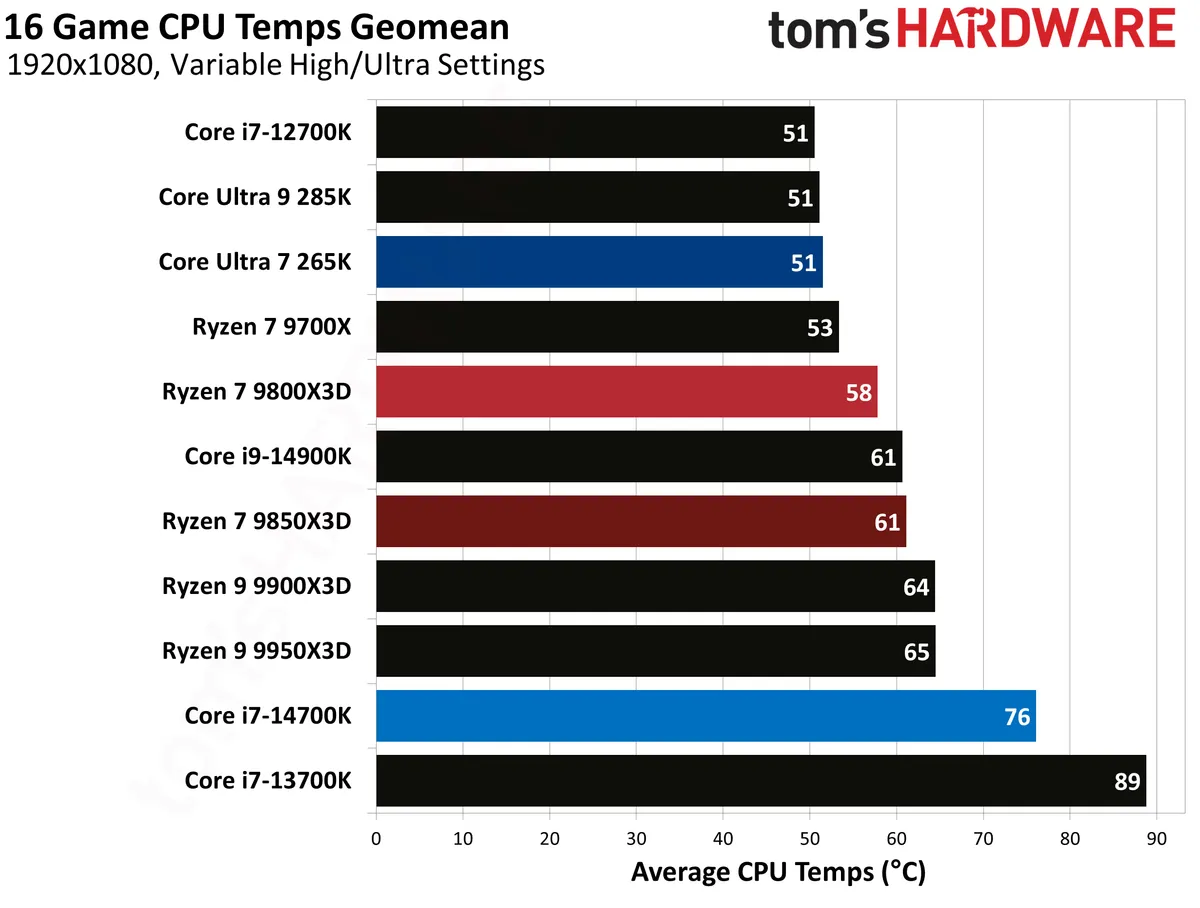
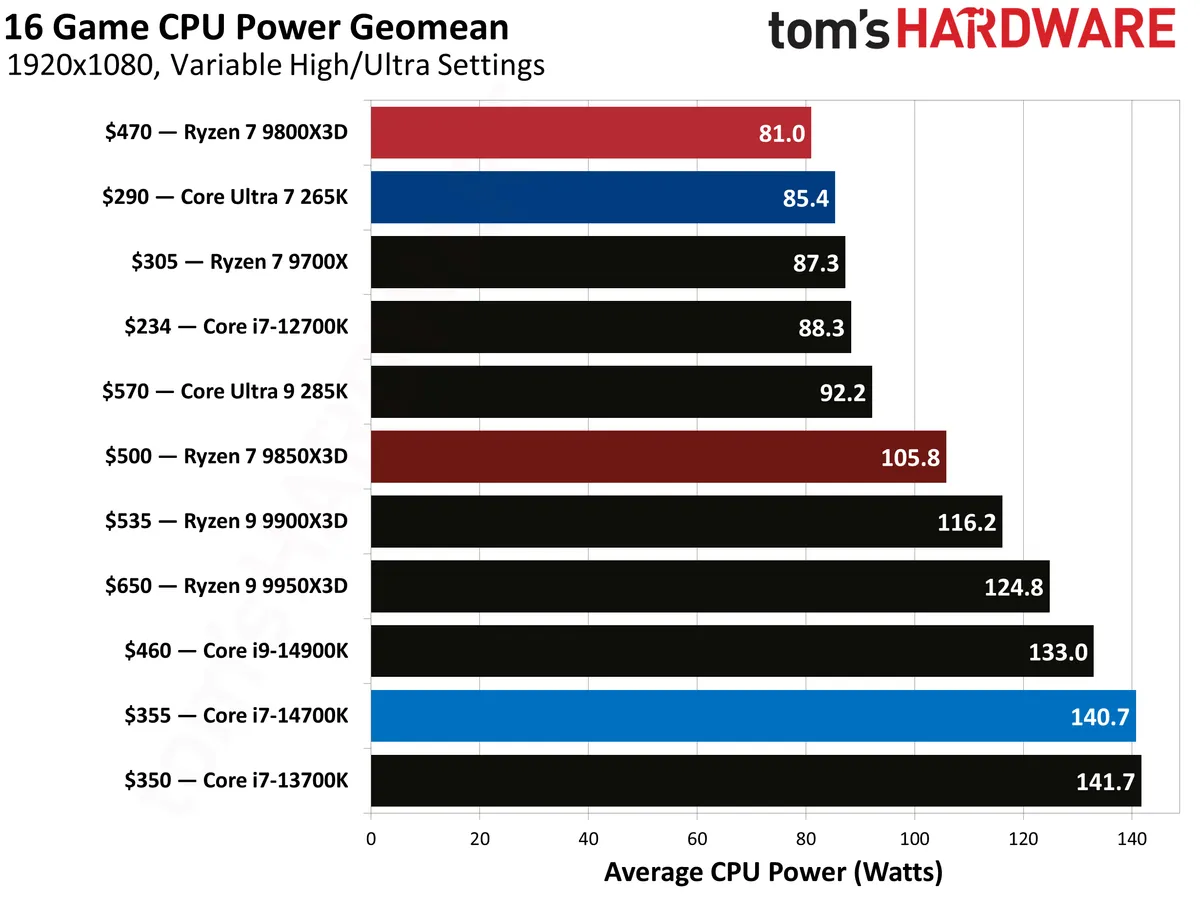
The real battle is between the Ryzen 7 9850X3D and Ryzen 7 9800X3D, and there’s more working in favor of the Ryzen 7 9800X3D than just price. With its 400MHz clock boost, the Ryzen 7 9850X3D consumes much more power. In our test suite, it consumed nearly 31% more power, ran hotter as a result, and was only marginally more efficient than the Ryzen 7 9700X; the Ryzen 7 9800X3D is still the most efficient offering in our test pool.
As we’ll get to with our bespoke power and efficiency tests, peak and idle power between the Ryzen 7 9850X3D and Ryzen 7 9800X3D doesn’t show such a stark gap. These power numbers in games are telling, however. You’ll most likely use this chip for gaming most of the time, and the extra power consumption just doesn’t translate into meaningful performance gains.
When looking at our geomeans above, note that the Ryzen 7 5800X3D isn’t included. We tested this chip as part of our test pool, and you’ll see it in individual game benchmark charts below. However, it’s not available for sale, the secondhand market demands upwards of $500 for one, and it posted odd results in Minecraft RTX (which we’re troubleshooting), so for now, we excluded it from the overall measurements.
Get Tom's Hardware's best news and in-depth reviews, straight to your inbox.
A Plague Tale: Requiem Benchmarks — AMD Ryzen 7 9850X3D


View Original

View Original

View Original

View Original

View Original

A Plague Tale: Requiem is one of the few games I was surprised to see a performance uplift in. The Ryzen 7 9850X3D manages a minor 2.8% improvement, which you wouldn’t expect out of a modern, GPU-intensive, and story-driven game. Unfortunately, that boost comes at the cost of a 28.6% increase in power consumption and a 5-degree Celsius increase in thermals, despite the Ryzen 7 9850X3D running 200MHz below its maximum boost clock.
Baldur's Gate 3 Benchmarks — AMD Ryzen 7 9850X3D


View Original

View Original

View Original

View Original

Baldur’s Gate 3 shows a more favorable side of the Ryzen 7 9850X3D, with it outperforming its predecessor by nearly 6%. That’s a solid improvement, and it’s even more impressive compared to the Ryzen 7 7800X3D, where AMD’s latest eight-core X3D is 29% ahead. The Ryzen 7 9850X3D managed to get closer to its maximum boost clock at 5.5GHz in this title, but it also consumed 29% more power than the Ryzen 7 9800X3D.
Counter-Strike 2 Benchmarks — AMD Ryzen 7 9850X3D


View Original

View Original

View Original

View Original

View Original

Counter-Strike 2 is a new addition to our test suite, and it’s a game that should love the 400MHz boost on the Ryzen 7 9850X3D. It only loves that boost by about 1.5%, however. That’s despite the Ryzen 7 9850X3D boosting to 5.55GHz (the highest clock speed for the chip we recorded in game testing) and consuming just shy of 100W; something that only chips with monstrous core arrays mirror.
Cyberpunk 2077 Benchmarks — AMD Ryzen 7 9850X3D


View Original

View Original

View Original

View Original

View Original

Cyberpunk 2077 scales well on CPUs due to the huge amount of work the RED Engine has seen over the years, but it is still ultimately a GPU-bound game. As evidence, the Ryzen 7 9800X3D actually posted higher performance than the Ryzen 7 9850X3D, though they’re exactly one frame apart from each other. The devil here comes in power and thermals. Despite offering identical performance, the Ryzen 7 9850X3D ran hotter and consumed more power.
Doom: The Dark Ages Benchmarks — AMD Ryzen 7 9850X3D


View Original

View Original

View Original

View Original

View Original

Doom: The Dark Ages is another new addition to our games list, showing how CPUs scale not only with the Vulkan graphics API, but also with a game that has always-on ray tracing. The Ryzen 7 9850X3D is the least interesting aspect of these charts; it offers similar performance and consumes more power compared to the Ryzen 7 9800X3D.
What’s interesting is how X3D chips dominate this chart, and how the Core Ultra 7 265K earns a lead over the Core i7-14700K. With the randomness involved in BVH construction and traversal, additional cache does a lot to speed render time.
F1 2024 Benchmarks — AMD Ryzen 7 9850X3D


View Original

View Original

View Original

View Original

View Original

Like Baldur’s Gate 3, F1 2024 favors the higher clock speed of the Ryzen 7 9850X3D, with the chip posting a 4.7% lead over the Ryzen 7 9800X3D and a sizable 12.9% jump over the Ryzen 9 9950X3D. The story writes itself at this point, however. That single-digit jump over the Ryzen 7 9800X3D came at the cost of 44.4% higher power consumption and a 14% increase in temperatures.
Far Cry 6 Benchmarks — AMD Ryzen 7 9850X3D


View Original

View Original

View Original

View Original

View Original

Final Fantasy XIV Benchmarks — AMD Ryzen 7 9850X3D


View Original

View Original

View Original

View Original

View Original

Flight Simulator 24 Benchmarks — AMD Ryzen 7 9850X3D


View Original

View Original

View Original

View Original

View Original

Flight Simulator 24 is notoriously heavy on the CPU, and it’s one of the few titles that benefits more from cores and clocks than it does from the addition of extra L3 cache. This is one of the few titles where the flagship Ryzen 9 9950X3D offers a lead over its cut-down, eight-core sibling, but the Ryzen 7 9850X3D manages to set a new bar 6.2% ahead of the Ryzen 7 9800X3D. That comes with a large increase in power consumption, mind you, but it’s still one of the clearer wins we saw for the Ryzen 7 9850X3D out of our testing.
Hitman 3 Benchmarks — AMD Ryzen 7 9850X3D


View Original

View Original

View Original

View Original

View Original

Hogwarts Legacy Benchmarks — AMD Ryzen 7 9850X3D


View Original

View Original

View Original

View Original

View Original

Minecraft Benchmarks — AMD Ryzen 7 9850X3D


View Original

View Original

View Original

View Original

View Original

Although Minecraft isn’t the first game that comes to mind for CPU benchmarking, it actually can pose a significant performance challenge to modern CPUs. For our test, we use the Portal Pioneers RTX map, which runs our character though a short track that’s easily repeatable. Critically, we set the render chunk distance at its maximum of 96, which is more taxing than most of the other tests in our suite.
Monster Hunter Wilds Benchmarks — AMD Ryzen 7 9850X3D


View Original

View Original

View Original

View Original

View Original

Spider-Man 2 Benchmarks — AMD Ryzen 7 9850X3D


View Original

View Original

View Original

View Original

View Original

Starfield Benchmarks — AMD Ryzen 7 9850X3D


View Original

View Original

View Original

View Original

View Original

The Last of Us Part One Benchmarks — AMD Ryzen 7 9850X3D


View Original

View Original

View Original

View Original

View Original

MORE: CPU Benchmark Hierarchy
MORE: AMD vs. Intel
MORE: AMD Ryzen 7 9800X3D review
Current page: AMD Ryzen 7 9850X3D Gaming Benchmarks
Prev Page A case of déjà vu Next Page AMD Ryzen 7 9850X3D productivity benchmarks
Jake Roach is the Senior CPU Analyst at Tom’s Hardware, writing reviews, news, and features about the latest consumer and workstation processors.
-
-Fran- Yeah... If this was replacing the 9800X3D at its MSRP, then it would've been a nice "plus" for it, but charging more?Reply
Nah. Big pass. Given the age and all that, this CPU should have slotted at $450 MSRP and bring the 9800X3D to $420 MSRP.
EDIT: I forgot to mention/ask, isn't the current street median price of the 9800X3D like $450?
Like Leo from KitGuru's review succintly summarised: "WHY?".
Regards. -
JakeRoach Reply
You can find it for $450, certainly. I stuck with $470 as the price because that's what you can find it for on just about any day at just about any retailer. But yes, the value dynamic is already rough at $470, and even worse at $450 for the 9850X3D.-Fran- said:Yeah... If this was replacing the 9800X3D at its MSRP, then it would've been a nice "plus" for it, but charging more?
Nah. Big pass. Given the age and all that, this CPU should have slotted at $450 MSRP and bring the 9800X3D to $420 MSRP.
EDIT: I forgot to mention/ask, isn't the current street median price of the 9800X3D like $450?
Like Leo from KitGuru's review succintly summarised: "WHY?".
Regards. -
Roland Of Gilead In the pricing and specs table you have the 9850x as 12 core and 140mb cache.Reply -
-Fran- Reply
For sure!JakeRoach said:You can find it for $450, certainly. I stuck with $470 as the price because that's what you can find it for on just about any day at just about any retailer. But yes, the value dynamic is already rough at $470, and even worse at $450 for the 9850X3D.
Also, as it's under-mentioned in every CPU review here at Tom's: thanks for testing with JEDEC specc'd RAM! I am one of the biggest fans of your strictness for that.
Regards. -
gggplaya Reply
This is no different than the Intel KS series, like the 14900ks. It's just the highest binned chips that people want, instead of trying to win the silicon lottery. These will likely be capable of the best overclocks. The price difference is negligible if you're chasing the best clocks.-Fran- said:Yeah... If this was replacing the 9800X3D at its MSRP, then it would've been a nice "plus" for it, but charging more?
Nah. Big pass. Given the age and all that, this CPU should have slotted at $450 MSRP and bring the 9800X3D to $420 MSRP.
EDIT: I forgot to mention/ask, isn't the current street median price of the 9800X3D like $450?
Like Leo from KitGuru's review succintly summarised: "WHY?".
Regards. -
abufrejoval While I understand the need to evaluate the changes at the leading edge for TH, in these days I'd say there is more value in trying to gauge what can be done with the material available at economical prices.Reply
1080p gaming benchmarks in the 400-800FPS range may differentiate that leading edge, but there is next to zero value for most gamers between those two marks: 90FPS rendered is quite acceptable, I'd say, a mark constantly passed even by your lowest entrants.
Today there may now much more value in trying to evaluate how low and old you can get on the CPU/RAM side, without dropping below acceptable gaming performance.
And while I was lucky enough to score two RTX 5070ti as well as various Ryzen 7000 16-cores, with and without V-cache last year, I fail to see a significant difference in how one 5070ti games on an older 5950X vs another on a 7945X3D at the resolutions I actually use, not 1080p, but 4k@144 max or 3440x1440@165 max, depending on the screen.
And that 5950X still sells for less than €300, while a 5800X3D sells for way more than it delivers in extra gaming performance at those resolutions. And if you happen to still have DDR4-3200 lying around or within your economical reach, that's perhaps the better choice.
Going with V-cache is rarely wrong, when the price difference is modest. Selling a kidney for that leading edge, just doesn't seem to pay enough in real-life gaming return.
Now I know that 16-core Zens aren't the best gaming CPUs. But much of that is really just based on some OS making bad scheduling decisions, because 16-core Zens always have at least one CCD of a much better bin than any 8-core Zen. That means higher max clocks and lower power consumption if you stick with that CCD.
The challenge is to ensure that games that suffer from intra-CCD latencies more than they profit from additinal cores are kept on a single CCD. On Windows you can perhaps most easily do that with Project Lasso.
And at €100 difference between a worse binned 5800X (<€200) and a 5950X (<€300), I'd say it becomes an easy choice to simply go for the extra cores and higher top clocks: some games still like clocks more than cache and then gaming may not be all you do on your PC. Cores not used may require less power than worse bins, just in case you worry about that.
A 9850X3D is really just the 9950X3D without the non-V-cache CCD in terms of binning. And the small performance differences show the diminishing returns when GPUs are the bottleneck in many, not all cases. -
logainofhades NGL I kinda want one, only because the extra clock speed and the x3d v-cache should prove useful for WoW, in cpu limited situations.Reply -
-Fran- Reply
I'm not saying they shouldn't do that.gggplaya said:This is no different than the Intel KS series, like the 14900ks. It's just the highest binned chips that people want, instead of trying to win the silicon lottery. These will likely be capable of the best overclocks. The price difference is negligible if you're chasing the best clocks.
At the end of the day, it comes down to price. In this case, AMD failed the "value" proposition since they think a ~4% improvement is worth an extra $20 (MSRP) and ~$50 (street prices).
Also, we're all collectively assuming this is "higher binned", but in reality the increase in power correlates very negatively to the increase in performance, so I'm not even sure if this is a "better bin" or just a re-skin of the same exact dies. A rebrand, if you like.
Regards. -
abufrejoval Reply
Somewhere between those, I'd say, both high above the CMOS knee at top clocks, dictated by what comes off the line and they can't sell for more as EPYCs, perhaps also with some tuning in processes and masks.-Fran- said:Also, we're all collectively assuming this is "higher binned", but in reality the increase in power correlates very negatively to the increase in performance, so I'm not even sure if this is a "better bin" or just a re-skin of the same exact dies. A rebrand, if you like. -
adamXpeter OK, but what's about overclocking? Potential, results? Who buys this CPU for stock clock, stock JEDEC RAM?Reply
Also, no full screen for the diagrams? Or it is a Firefox thing?