









Why you can trust Tom's Hardware Our expert reviewers spend hours testing and comparing products and services so you can choose the best for you. Find out more about how we test.
AMD has billed the Ryzen 9 9950X3D2 as a workstation-class processor, and for good reason. As we’ve already covered, there isn’t much here for gamers that isn’t already delivered via the Ryzen 9 9950X3D or Ryzen 7 9850X3D. Performance differences show up in applications, for better and worse. On the plus side, the additional cache helps heavily-threaded workloads run a touch faster, as cores 9 through 16 don’t need to cross over to the other CCD to access the large shared L3. In single-threaded tasks, however, there are slight regressions due to the 9950X3D2’s stunted peak clocks.
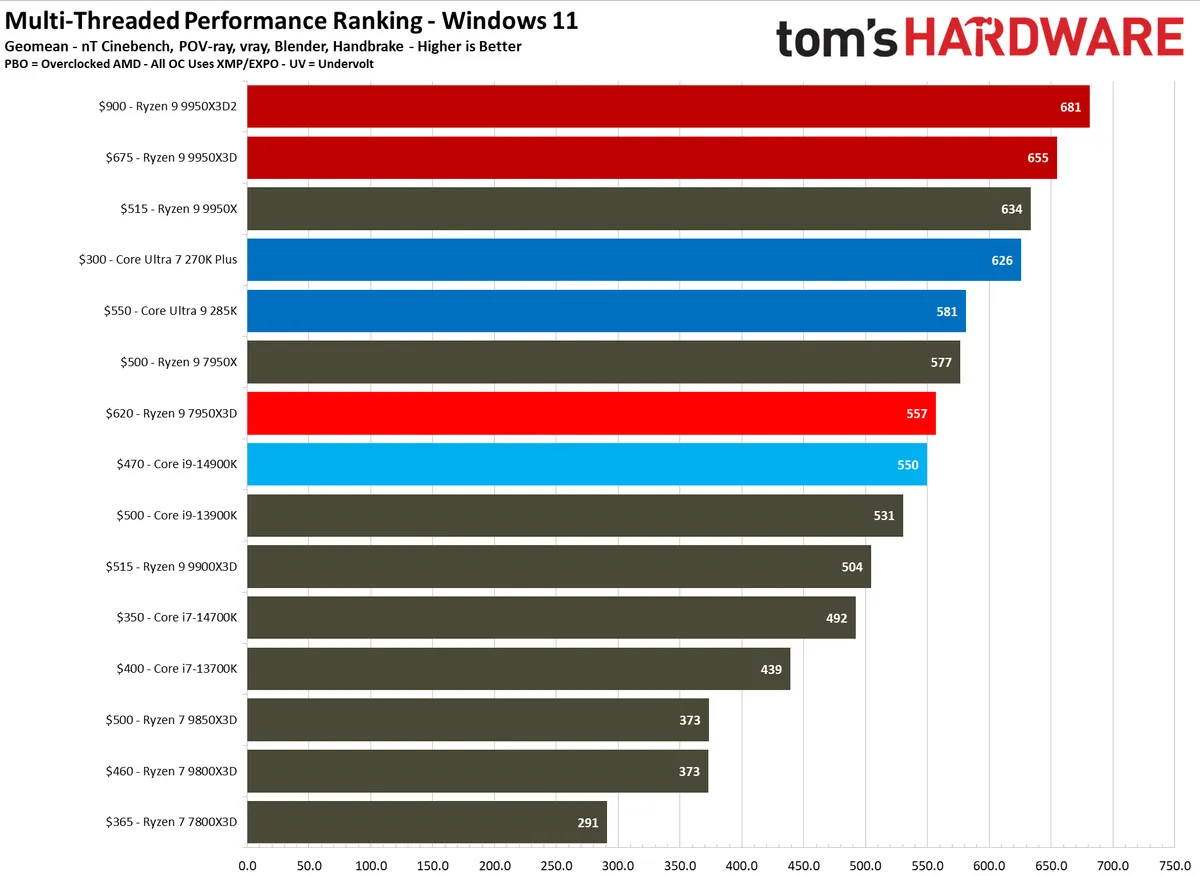
On the multithreaded front, AMD has bested itself once again, with the 9950X3D2 earning the top slot in our performance rankings. Now, AMD occupies the top three slots, all with variations of the 16-core 9950X. The 9950X3D2 is just shy of 4% faster than the Ryzen 9 9950X3D and 7.4% faster than the base Ryzen 9 9950X. AMD may top the charts, but Intel isn’t far behind in multithreaded performance. The 9950X3D2 is just 9% faster than the recent Core Ultra 7 270K Plus, despite costing three times as much.
This slight acceleration in heavily-threaded workloads is par for the course with the 9950X3D2. In tasks like rendering and encoding, you get a small bump that alone isn’t worth the price of admission. As we’ll get to throughout our benchmarks below, there are specific workloads that see double-digit performance improvements. Those workloads aren’t represented in our geomean because, frankly, they only apply to a small subset of users.

In single-threaded workloads, there’s a slight regression, which makes sense due to the 9950X3D2’s slightly lower peak clock speeds. Intel still leads in our overall single-threaded rankings, occupying the top three slots, one of which is filled by the Core i9-14900K. AMD is in the middle of the pack with its higher-end Zen 5 offerings, with the Ryzen 7 9850X3D being the big standout due to its massively boosted clock speeds.
Although the Ryzen 9 9950X3D2 is technically slower than the 9950X3D and 9950X in our single-threaded rankings, it loses on a technicality. We’re looking at less than a 1% drop in single-threaded performance; about 0.77% compared to the 9950X3D. Any less distance between these three processors, and you could easily chalk it up to run-to-run variation.
The margins in the majority of tests here are tight, often falling below 5%. Again, there are exceptions in specific workloads (mainly via SPEC Workstation) where we can see double-digit improvements. Due to how close these three chips are, I reran our test suite on the 9950X3D2 and 9950X3D to sanity-check my results — a non-trivial task with around a 10-hour test pass per chip — and came away with the same data.
Rendering Benchmarks


View Original
View Original
View Original
View Original
View Original
View Original
View Original
View Original
View Original
View Original
View Original
View Original
View Original
View Original
View Original
View Original
View Original
View Original
You can largely see a mirror of our geomean in rendering benchmarks, with the 9950X3D2 consistently leading the 9950X3D by around 5%. In Cinebench 2024, the dual-cache version is 4% ahead in the multithreaded test and 1.7% ahead in the single-threaded test. Intel spoils AMD’s fun here, however, with the Core Ultra 7 270K Plus claiming the top single-threaded place and nearly matching the 9950X3D2 in multithreaded.
Get Tom's Hardware's best news and in-depth reviews, straight to your inbox.
POV-Ray, LuxMark, and C-Ray all show big leads for Intel, with only marginal differences between the 9950X3D2 and 9950X3D. In LuxMark, the dual-cache chip is 2.9% ahead, while in POV-Ray single-core, it’s 1.9% behind. The differences don’t matter much in these benchmarks, frankly. The Core Ultra 7 270K Plus is leagues faster in these apps and significantly less expensive.
AMD claims some big leads in our other apps, however, most notably in Blender. This is an important benchmark given the popularity of Blender, and the 9950X3D2 leads the 9950X3D by between 3% and 4%, depending on the scene. Compared to the 270K Plus, the 9950X3D2 is between 13% and 18% faster. AMD also claims the top slot in Embree, improving upon the 9950X3D by 7% and the base 9950X by 15%.
In ray-traced and path-traced benchmarks, the 9950X3D2 also holds an edge. It’s 4% faster than the 9950X3D in V-Ray 6 and 5% faster in OSPray Studio. The differences are small, but they’re important when you’re looking at a halo product like the 9950X3D2. The 9950X3D or Core Ultra 7 270K Plus both represent a much better value, but if you’re chasing peak performance at any cost, the 9950X3D2 is delivering it.
Encoding Benchmarks


View Original
View Original
View Original
View Original
View Original
View Original
View Original
View Original
View Original
View Original
View Original
View Original
View Original
View Original
View Original
View Original
View Original
In all-out multithreaded encoding workloads, the Ryzen 9 9950X3D2 offers a similar improvement to what we saw in rendering tests, though with a slight regression in single-threaded encoders. In a 10-bit x265 encode via Handbrake, the Ryzen 9 9950X3D2 completed the task 2.3% faster than the single-cache version. In our AV1 test, it had 6.4% higher FPS, and with x264, the 9950X3D2 saw 8.7% higher performance than its single-cache counterpart.
On the decoding front via the DAV1D decoder, the Ryzen 9 9950X3D2 was 5% faster at 4K and 1080p compared to the Ryzen 9 9950X3D, both using AV1. Outside of video, we also can see a benefit in our NASA Curiosity image encode from TIFF to JPEG, with the Ryzen 9 9950X3D2 completing the task 3.9% faster than the 9950X3D.
In single-threaded encoding tasks, the 9950X3D2 falls slightly behind the 9950X3D. It was 0.7% slower in a standard LAME pass, with Intel’s Core i9-14900K taking the top slot. Taking this test further with the extended pass, you can see the competition level off. In a single-threaded JPEG-XL decode, AMD manages to beat the Intel competition, but the 9950X3D2 falls 1.8% behind the Ryzen 9 9950X3D and 2.3% behind the 9950X.
Creator App Benchmarks


View Original
View Original
View Original
View Original
View Original
View Original
View Original
View Original
View Original
View Original
Contextualizing rendering and encoding tasks in broader applications like the Adobe suite, the 9950X3D2 still provides some marginal advantages. Starting in Photoshop, the Ryzen 9 9950X3D2 is 1.7% ahead of the single-cache version and 3.1% ahead of the base 9950X. Photoshop heavily favors AMD CPUs and sees a nice speed-up from 3D V-Cache, so it’s not a surprise to see a bit of acceleration here.
Premiere Pro flips the script, not only with Intel taking a more dominant position, but also with the dynamic between the 9950X3D2 and 9950X3D. Overall, the dual-cache version was actually slower in Premiere, though only by a marginal 0.7%. This firmly falls within run-to-run variation, as evidenced by the fact that the Core i9-13900K and 14900K, along with the Ryzen 9 7950X3D, are all competing for the space occupied by the 9950X3D and 9950X3D2.
In DaVinci Resolve, the 9950X3D2 claims the top slot in overall performance, outpacing the single-cache versions by 2.8%. In these creator apps, more specific workloads like rendering and encoding may see closer to that 5% to 7% margin that we saw in our benchmarks in the above sections, but the overall performance advantage is tamped down a bit in the context of a multifaceted application.
Web and Office Benchmarks


View Original
View Original
View Original
View Original
View Original
View Original
View Original
View Original
View Original
View Original
Our web and office benchmarks look at lighter-weight applications that shouldn’t stress your CPU as much as, for example, rendering and encoding workloads. At the high-end, we typically don’t see large differences in performance, but the Ryzen 9 9950X3D2 offers some advantages in key office applications over the 9950X3D – most notably in Excel and the rest of the Microsoft Office suite.
Starting with Excel, AMD already claimed the top slot with the 9950X3D, but the 9950X3D2 offers a 3.6% uplift, allowing AMD to keep its top position over the recent Core Ultra 7 270K Plus. In Word, Intel holds the top of the chart, but the 9950X3D2 is able to close in on the Core Ultra 9 285K, offering a 6.6% improvement over the 9950X3D. We also see some clear advantages in PCMark 10’s application start-up test, with the 9950X3D2 leading the 9950X3D by 10% and beating out Intel’s Raptor Lake stack.
Still, we’re dealing with a $900 CPU here. Every CPU in our test suite is competent enough to handle these lightweight web and office workloads, and although we see some acceleration with the 9950X3D2, that’s not the main reason to buy this chip.
Chess Engines, Compilation, Compression, AVX, and Other Benchmarks


View Original
View Original
View Original
View Original
View Original
View Original
View Original
View Original
View Original
View Original
View Original
View Original
View Original
View Original
View Original
View Original
View Original
View Original
View Original
View Original
View Original
View Original
View Original
View Original
View Original
View Original
View Original
View Original
View Original
View Original
View Original
View Original
View Original
View Original
View Original
View Original
View Original
View Original
View Original
View Original
View Original
View Original
View Original
View Original
View Original
View Original
View Original
View Original
View Original
View Original
View Original
Outside of our main single-threaded and multithreaded benchmarks, we run a wide range of workloads that don’t fall neatly into either bucket, including chess engines, code compilation, scientific simulations, and more. Here, we can see some of the larger advantages of the 9950X3D2 more clearly, even if they apply mainly to niche workloads.
Starting with chess engines, the 9950X3D2 leads the single-cache version by 9.5% in StockFish 9, claiming a new top slot. Leela Chess Zero sees the two chips in lockstep, while in asmFish, the dual-cache version leads by 3.1%. We can see a slight regression in our TSCP Simple Chess Program benchmark, though this workload is far less robust than the bigger chess engines like StockFish.
In data science workloads, we can also see some acceleration. In Linpack, which serves as a stress test with linear algebra, the 9950X3D2 leads the single-cache version by a wide 18.9% margin. However, Intel still claims the top slot in this test with the Core Ultra 7 270K Plus.
The biggest jump here comes from the FFTE package, which computes discrete Fourier transforms in three dimensions. Here, the 9950X3D2 leads the 9950X3D by 26%, and manages to beat out Intel’s fastest offering by 24%, establishing a new performance threshold.
There are also advantages in compression workloads, with the 9950X3D2 leading the 9950X3D by 7.7% in 7-Zip compression and by 4.6% in decompression. In other compression/decompression benchmarks, however, the two CPUs mostly matched each other.
Although there are some workloads that see a big boost from the dual-cache 9950X3D2, there are plenty of tasks where it offers no benefit. We don’t see much of a boost in security workloads, for example, nor a clear advantage in programming workloads outside of a small boost in code compilation.
SPEC Workstation 4 Benchmarks


View Original
View Original
View Original
View Original
View Original
View Original
View Original
View Original
View Original
View Original
View Original
View Original
View Original
View Original
View Original
View Original
View Original
View Original
View Original
View Original
View Original
View Original
View Original
View Original
View Original
View Original
View Original
View Original
View Original
View Original
View Original
View Original
View Original
View Original
View Original
View Original
View Original
View Original
View Original
View Original
View Original
View Original
View Original
View Original
View Original
View Original
View Original
View Original
View Original
View Original
View Original
We don’t always highlight our SPEC Workstation 4 benchmarks, but they’re important for the 9950X3D2. These workstation-level tests are where we can see additional signs of acceleration across specialized workloads. There isn’t much of a boost in AutoDesk Inventor, but there’s still some advantage in product and design workloads. We can see a jump of 10.8% in the hidden line removal test.
Once again, there’s acceleration in data science workloads. Looking at computational fluid dynamics via OpenFOAM, the 9950X3D2 offers an 18% boost in performance over the 9950X3D, allowing AMD to claim the top slot in this benchmark. We can see a big boost in machine learning through the Scikit-learn library, too, with the 9950X3D2 offering a 32.8% boost in performance.
In AI inference, the 9950X3D2 offers a large boost in overall throughput, beating the 9950X3D by 24% with int8 instructions and 18.6% with FP32 using ResNet50. Latency is unsurprisingly not great for any of the X3D chips.
In energy and life sciences, we also see some decent acceleration, though little to no boost from SPEC’s financial benchmarks. These specialized, workstation-class workloads are where the 9950X3D2 really shines. There are some minor advantages in overall multithreaded performance, but it’s workloads that can stress the cache and expose the latency benefits of having L3 on both CCDs where the performance gains really come through.
- MORE: CPU Benchmark Hierarchy
- MORE: AMD vs. Intel
- MORE: AMD Ryzen 7 9800X3D review
Current page: AMD Ryzen 9 9950X3D2 productivity benchmarks
Prev Page AMD Ryzen 9 9950X3D2 Gaming Benchmarks Next Page AMD Ryzen 9 9950X3D2 power consumption, efficiency, test setup
Jake Roach is the Senior CPU Analyst at Tom’s Hardware, writing reviews, news, and features about the latest consumer and workstation processors.
-
Gururu How was it decided to find a bunch of obscure benchmarks that are rarely used in CPU testing? Seems like a little voice whispered in someone's ear...Reply -
Marlin1975 Seems like a chip that with the right software will be a beast. I'm assuming since most is not written for this much cache its left spinning its wheels when it has more to go.Reply -
yznc Reply
Very nice and informative article! Can I get a clean pdf version for education use? Thank you!Admin said:The Ryzen 9 9950X3D2 is one of the most unique CPUs we’ve ever reviewed, and although its price feels like a kick in the gut, it offers some interesting, highly specialized improvements in certain workloads based on our testing.
AMD Ryzen 9 9950X3D2 review: More cache, more cash : Read more -
JakeRoach Reply
It's the same list of benchmarks we use in every review, AMD and Intel.Gururu said:How was it decided to find a bunch of obscure benchmarks that are rarely used in CPU testing? Seems like a little voice whispered in someone's ear... -
Gururu Reply
Yes, I don't see anything wrong. It's just a little confusing on the SPECWorkstation 4 Benchmarks where if you compare the 270K review to this review, some tests seem different. Maybe they are just listed in a different order.JakeRoach said:It's the same list of benchmarks we use in every review, AMD and Intel. -
TerryLaze Reply
Cache is completely transparent (invisible) to apps, they either have enough data to fill the cache or they don't.Marlin1975 said:Seems like a chip that with the right software will be a beast. I'm assuming since most is not written for this much cache its left spinning its wheels when it has more to go.
You would need to invent an app that causes the problem of needing that much cache for it to use that much cache. (Which is what a lot of the benchmarks do, they use a lot more data (or at least coherent/fixed amount of data that never needs to change) than what a normal real world usage would be) -
zworykin Not "one of the most unique" CPUs you've reviewed. It's unique, or it isn't. There are no degrees of "more unique" or "less unique" - it's a binary concept.Reply -
drea.drechsler "A terrible value, but one of the most unique...isn’t worth the money for the vast majority of people, but it was never meant to be. It’s a halo product.....one of the most unique .... ever reviewed, and although its price feels like a kick in the gut...."Reply
Sounds like summary statements appropriate to an Nvidia GPU reviews. -
qxp Reply
No need to invent anything. If you just consider an app that at its core does FFT or vector arithmetic then as soon as the size of the data is larger than cache of 9950 but smaller than 9950X3D2 you will see a big difference in speed.TerryLaze said:Cache is completely transparent (invisible) to apps, they either have enough data to fill the cache or they don't.
You would need to invent an app that causes the problem of needing that much cache for it to use that much cache. (Which is what a lot of the benchmarks do, they use a lot more data (or at least coherent/fixed amount of data that never needs to change) than what a normal real world usage would be)
The reason you don't quite see this in charts of this article is because most apps are in two categories - either they are written without much attention to performance, in which case they spend most time in CPU executing some byte code or inefficient loops and the extra cache does not matter.
Or they have been well optimized and part of that optimization was to fit them into the cache of the CPUs they were designed for, and the case of my data is larger than cache was treated as a slow path. -
bit_user Thanks for the comprehensive benchmarks! I had always wondered how such a product would perform - now I know!Reply
In your intro, I didn't notice a reference to why AMD said they didn't offer this before. I'd have to go searching for it, but they've previously said they didn't think it would be cost-effective. It seems they were right.
I'm glad to see very few regressions vs. the 9950X and 9950X3D, however. That means it's a safe buy for someone who wants the top AM5 multithreaded performer, if money is no object.