









Tom's Hardware Verdict
LaCie’s 2big RAID is a high capacity workhorse of an external. Creative pros can purchase the 2big RAID in confidence knowing it features two enterprise-class HDDs and comes backed by a five-year warranty and data recovery coverage. While it is pricey for the average consumer, it is quite the bang for the buck for prosumers.
Reasons to buy
- +
Solid sequential performanc
- +
Sleek Aesthetics
- +
Free data recovery service during the warranty period
- +
Easy to use and effective software suite
Reasons to avoid
- -
Noisy
- -
Uses wall power
- -
Blue light is too intense
Why you can trust Tom's Hardware Our expert reviewers spend hours testing and comparing products and services so you can choose the best for you. Find out more about how we test.
Professional RAID Made Easy
With spacious capacities and a 10Gb/s USB 3.1 Type-C interface, LaCie’s got a new professional desktop RAID device that is ideal for the creative pro looking to up their storage game. LaCie’s 2big RAID, armed with two enterprise-class 7200RPM Seagate IronWolf Pro HDDs, is capable of delivering speeds of up to 440MB/s read/write.
But, while it is ~$150 cheaper than the 2big Dock and some of its competition, the 16TB 2big RAID is still quite pricey with a street price of about $700 bucks. With a price like that, it does have some perks, although it is missing some, too.
Recently, we took a look at a mobile RAID solution from LaCie, the Rugged RAID Pro. In essence, the device takes two HDDs and enables the end user to configure either RAID 0, 1, or simply set the two HDDs accessible in JBOD mode. It delivered decent performance and flexibility, but for those seeking larger capacity and higher performance, this little device won’t cut it.
For those of you in need of more space for your ever-growing media collection or those who want a faster scratch space for your workflow and are not yet ready to plunge into the expensive flash abyss, LaCie’s 2big RAID might be just for you.
Specifications
| Product | LaCie 2big RAID 4TB | LaCie 2big RAID 8TB | LaCie 2big RAID 16TB |
| Pricing | $399.00 | $499.00 | $699.00 |
| Capacity | RAID 0: 16 TB, RAID 1: 8 TB, JBOD: 2x 8 TB | RAID 0: 16 TB, RAID 1: 8 TB, JBOD: 2x 8 TB | RAID 0: 16 TB, RAID 1: 8 TB, JBOD: 2x 8 TB |
| Interface / Protocol | USB-C / USB 3.1 Gen 2 | USB-C / USB 3.1 Gen 3 | USB-C / USB 3.1 Gen 4 |
| Sequential Read | 440 MB/s | 440 MB/s | 440 MB/s |
| Sequential Write | 440 MB/s | 440 MB/s | 440 MB/s |
| Storage Media | 2x 2.5" 7200RPM Hard Disk Drives | 2x 2.5" 7200RPM Hard Disk Drives | 2x 2.5" 7200RPM Hard Disk Drives |
| Supported File System | exFAT (Default), HSF+, NTFS | exFAT (Default), HSF+, NTFS | exFAT (Default), HSF+, NTFS |
| Aux. Ports/Slots | N/A | N/A | N/A |
| Power | Power adapter brick | Power adapter brick | Power adapter brick |
| Encryption | N/A | N/A | N/A |
| Dimensions (L x W x H) | 8.5 x 4.7 x 3.7" / 215.9 x 119.4 x 94.0 mm | 8.5 x 4.7 x 3.7" / 215.9 x 119.4 x 94.0 mm | 8.5 x 4.7 x 3.7" / 215.9 x 119.4 x 94.0 mm |
| Weight | 6.2 lbs. / 2.8 kg | 6.2 lbs. / 2.8 kg | 6.2 lbs. / 2.8 kg |
| Part Number | STHJ4000800 | STHJ8000800 | STHJ16000800 |
| Warranty | 5-Years | 5-Years | 5-Years |
The 2big RAID comes in capacities of 4TB, 8TB, and 16TB. Prices start at $399.00 for the 4TB model, making it the least bang for your buck. The 8TB model is just $100 more for twice the capacity, but it doesn’t touch the value of the 16TB model if you need big capacity. While coming in at a hefty $700, it comes with the best price-per-GB of the family.
Pros demand and expect higher reliability out of their tools, and LaCie aims to give them exactly what they want. The 2big is similar to the Rugged RAID Pro, in that LaCie packs two HDDs into it and lets you configure them in RAID 0, 1, or JBOD mode. But the unit doesn't have ordinary HDDs inside.
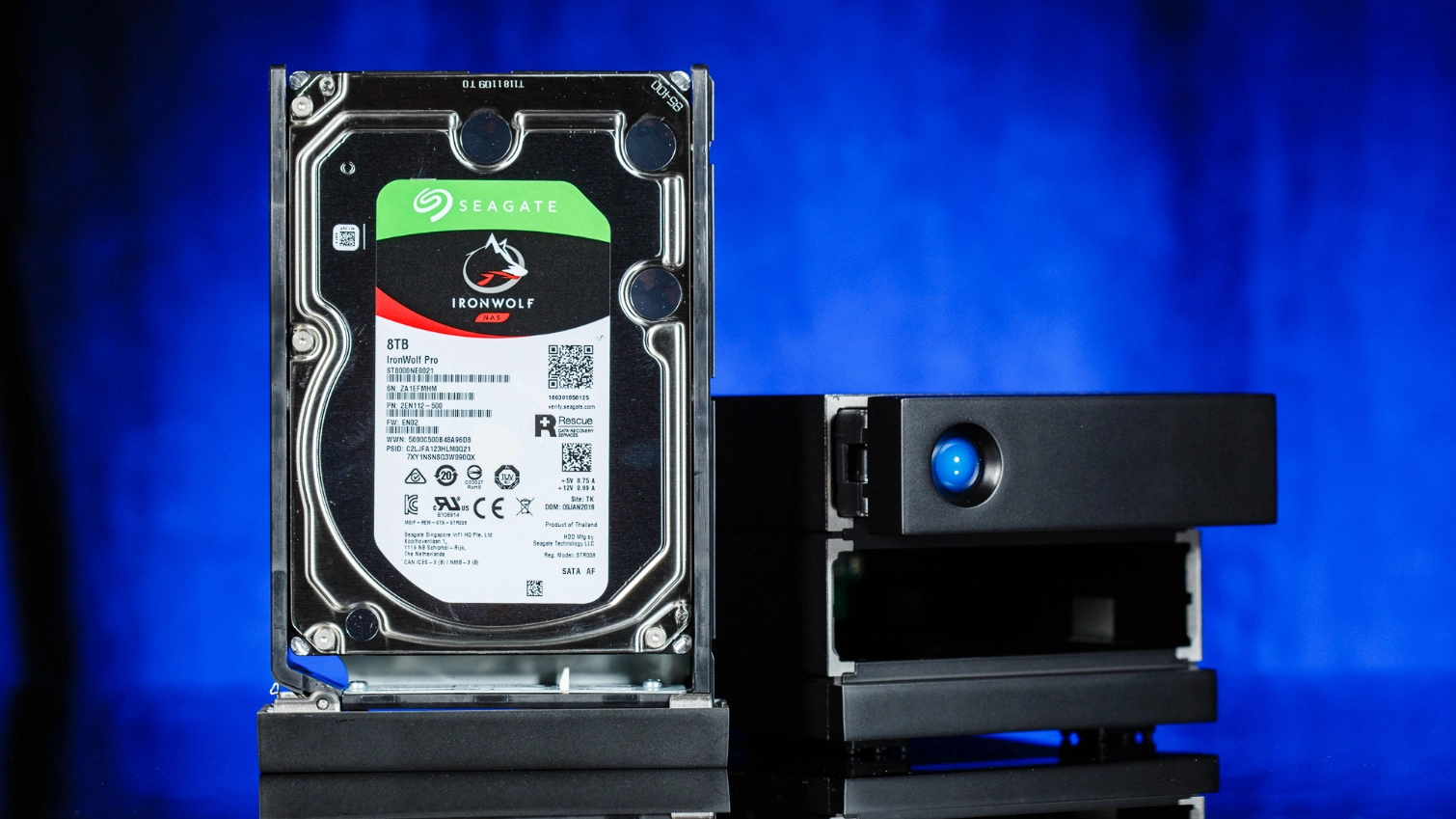
Instead, the unit come with two of Seagate’s enterprise-class 7200RPM IronWolf Pro NAS HDDs, optimized for RAID and tuned to run 24/7. LaCie’s 2big RAID comes pre-configured in RAID 0 and is pre-formatted with the exFAT file system for the fastest speed and broadest compatibility. The company rates the unit for speeds of up to 440MB/s of sequential read/write throughput.
Get Tom's Hardware's best news and in-depth reviews, straight to your inbox.
LaCie has even turned to world-renowned computer fan designer and manufacturer, Noctua, to help keep these drives cool through any workload. A 60mm Noctua A6x25 FLX fan that is whisper quiet from just two feet away resides at the rear of the all-black aluminum enclosure.
The 2big is compatible with both macOS 10.12+ and Windows 10+ computers with Thunderbolt 3, USB-C, USB 3.0 and 2.0 ports. It even features hot-swapping capability so that you can easily remove and replace drives even while the unit is in operation.
Software and Accessories


View Original
View Original

View Original
View Original
LaCie’s 2big RAID comes with a 39.5” USB-C to USB-C cable, 39.5” USB-C to USB-A cable, a 36W (12V-3A) power supply with various adapters, and a quick install guide.
LaCie’s Toolkit and RAID Manager software makes configuring the unit a snap. Changing RAID modes requires you to press the power button on the rear of the device for confirmation. This helps to prevent accidental data loss from changing modes accidentally. LaCie RAID Manager can also send you email notifications about drive and system health. Furthermore, you can use Toolkit to manage backup plans (Windows only), create mirror folders, and automate memory card imports directly to the device.
Additionally, LaCie includes a month of membership to Adobe Creative Cloud All Apps plan, which enables you to use all of Adobe's Creative Cloud applications for free, a $79.49 value. And, to top things off, it comes backed by five years of Rescue Data Recovery Services in case disaster strikes. That's a big plus.
Closer Look


View Original

View Original

View Original

View Original

View Original

View Original

View Original

View Original

View Original

The 2big chassis is a blacked-out an all-aluminum unibody design that measures in at 8.5 x 4.7 x 3.7" and weighs in at 6.2lbs. There is an indicator light on each of the metal disk trays, and the faceplates are plastic. The top one also features the classic blue dome light as a status indicator; however, the light is a bit intense.
Four rubber feet do an excellent job at keeping the unit stable and the desk vibration free. The unit also has vents on the chassis back and underside to aid with airflow. There's also a power button, power input, a Kensington lock port, USB 3.1 Gen 2 type C port, and a firmware update button on the rear of the unit.
MORE: Best SSDs
MORE: How We Test HDDs And SSDs
MORE: Best External Hard Drives and SSDs

Sean is a Contributing Editor at Tom’s Hardware US, covering storage hardware.
-
eXPedient Demise Those "cons" are not cons.Reply
Noise - its running enterprise grade drives - you dont buy them for silence.
Blue LED - Tape/marker fixes that
Wall power - again, enterprise drives, speed, RAID - you really want all that at the mercy of a USB connection ? :) -
neoculture Just once, I'd like NAS companies to think about heavy-duty home users.Reply
I don't want a paltry "home"-level 2-disk RAID device. I need decent storage (4+ disks).
I don't want enterprise speed/throughput/reliability. This is a home device.
It got to the point that I built my own NAS using an old rack-mount chassis, 9 desktop HDDs, running on Linux software RAID-5. And it hasn't failed me since I turned it on back in 2003 (power outages notwithstanding). -
seanwebster Replyxpd.co.nz said:Those "cons" are not cons.
Noise - its running enterprise grade drives - you dont buy them for silence.
Blue LED - Tape/marker fixes that
Wall power - again, enterprise drives, speed, RAID - you really want all that at the mercy of a USB connection ? :)
Of course, acoustics don't really matter too much when you have thousands of high-speed fans blasting in an enterprise/datacenter setting. But, the thing is, that is not who this product is for. The device is for content creators. My mention of it was to bring attention to buyers that these are louder than normal drives. Using mostly SSD storage and various drives over the years, the noise level came as quite a shock. Imagine now you are using this device in your workflow with an Apple computer in a small office, hearing these things clink and clank and hum constantly can become quite distracting.
Blue LED: Yes, but I sit next to multiple Windows in sunny South Florida all day, this little blue light outshines the sun it seems and somehow manages to hurts my eyes when looking at it briefly. I went ahead and taped mine during the review, but it shouldn't be so bright and distracting to begin with...
The mercy of a USB connection? The USB-C standard can now offer more than enough juice and bandwidth nowadays to support it... Please, elaborate?
There are a lot of NAS solutions for home users that fit those requirements. I personally have a 4U, 27 drive, 100TB+ storage server. But, because of power consumption, I usually just run my main rig as my NAS for my other devices now.neoculture said:Just once, I'd like NAS companies to think about heavy-duty home users.
I don't want a paltry "home"-level 2-disk RAID device. I need decent storage (4+ disks).
I don't want enterprise speed/throughput/reliability. This is a home device.It got to the point that I built my own NAS using an old rack-mount chassis, 9 desktop HDDs, running on Linux software RAID-5. And it hasn't failed me since I turned it on back in 2003 (power outages notwithstanding).