






Firm quietly boosts H.264 streaming license fees from $100,000 up to staggering $4.5 million — backbone codec of the internet gets meteoric increase, AVC hikes follow disastrous H.265 licensing increases

Reddit GTA IV AI-generated video remaster
(Image credit: Reddit)

Via Licensing Alliance (Via LA), the patent pool administrator for H.264/AVC, quietly restructured its streaming license fees recently, replacing a flat $100,000 annual cap with a tiered system that tops out at $4,500,000 per year for the largest platforms, according to a Streaming Media report published on March 17. The change applies only to previously unlicensed implementers seeking a new license in 2026 or later, with all companies that held an active AVC license as of the end of 2025 retaining their original terms. The new hike for H.264 comes in the wake of disastrous increases in HEVC/H.265 fees that led to widespread issues spanning the globe, including Asus and MSI laptops being banned in Germany.

Via LA told Streaming Media that it contacted unlicensed media companies during 2025 to give them “a window to secure a license” under the previous terms, but the company didn’t go to the trouble of issuing a press release or public announcement, opting instead for direct outreach. Any company that didn’t respond or wasn't contacted now faces the new rate structure as its starting point for negotiations.
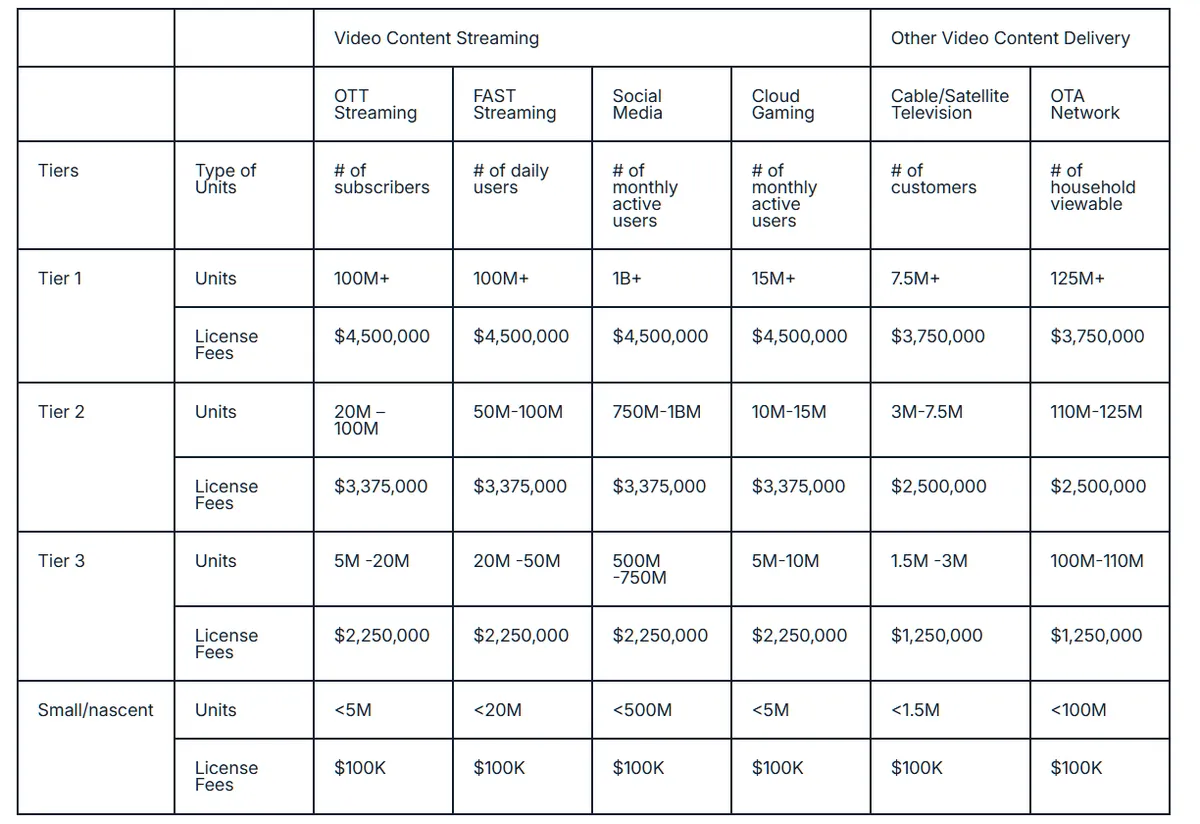
VIA table

(Image credit: VIA)

H.264 is the most widely deployed video codec on the internet, used as a baseline or fallback by virtually every streaming platform, hardware encoder, and browser. Many of its patents have expired, but patent licensing attorney Jim Harlan told Streaming Media that the expiration of a large share of a portfolio doesn’t automatically eliminate licensing obligations. Courts evaluating fair, reasonable, and non-discriminatory (FRAND) rates still consider the strength and remaining life of active patents, not just their quantity, Harlan said.

The new fee schedule divides the market by platform type and size. Tier 1 OTT services with 100 million or more subscribers pay the full $4.5 million annual fee. The same rate applies to Tier 1 FAST services (100 million-plus daily users), Tier 1 social media platforms (1 billion-plus monthly active users), and Tier 1 cloud gaming platforms (15 million-plus monthly active users). Tier 2 and Tier 3 fees are $3,375,000 and $2,250,000, respectively, and only platforms Via LA classifies as small or nascent retain the old $100,000 cap.

Article continues below

The Via LA fee restructuring adds to a broader escalation in codec licensing costs. Avanci's Video pool and Access Advance's Video Distribution Patent pool are both now seeking content royalties from streaming services for the use of HEVC, VVC, VP9, and AV1. Access Advance's rates are capped at roughly $63 million per year, and Avanci has published rates of 1.6% to 2.0% of revenue or $0.12 to $0.15 per user per month. Combined, these pools could push major streaming platforms toward nine-figure annual codec licensing costs.

We’ve already seen these patent escalations trickle down into consumer PCs and laptops. Nokia won a patent ruling in Germany that forced Acer and Asus to halt PC and laptop sales in the country, and Dell and HP disabled H.265 decoding in select PCs to dodge royalty costs. But H.264 has a much, much larger footprint across devices and services, meaning that the new Via LA fee structure, while currently limited to unlicensed implementers, could cause similar issues across the wider industry if Via LA chooses to extend its scope.

Google Preferred Source

Follow Tom's Hardware on Google News, or add us as a preferred source, to get our latest news, analysis, & reviews in your feeds.

Luke James
Contributor

Luke James is a freelance writer and journalist.  Although his background is in legal, he has a personal interest in all things tech, especially hardware and microelectronics, and anything regulatory. 

  • usertests
    https://en.wikipedia.org/wiki/Advanced_Video_Coding#Versions
    Version 20 (Edition 8): (April 13, 2013) Amendment to specify additional color space identifiers (including support of ITU-R Recommendation BT.2020 for UHDTV) and an additional model type in the tone mapping information SEI message.
    Version 25 (Edition 12): (April 13, 2017) Amendment to specify the Progressive High 10 profile, hybrid log–gamma (HLG), and additional color-related VUI code points and SEI messages.

    Must be why they kept updating H.264 from release in 2003 to 2024!
    Reply
  • chaos215bar2
    usertests said:
    https://en.wikipedia.org/wiki/Advanced_Video_Coding#Versions


    Must be why they kept updating H.264 from release in 2003 to 2024!
    Sure, but what portion if any of those updates is actually patentable? (In a way that holds up in court, anyway.) Simply adding metadata to cover new color space specifications isn't exactly much of an innovation.

    Seems to me all this move must be a reaction to Dolby suddenly deciding to assert patents over AV1 8 years after its release, but that only works if Dolby's claims actually survive a court case — which itself seems unlikely given the scrutiny AV1 was given during development. Otherwise all this does if push people away from H.264 even faster, while essentially guaranteeing that any companies not already licensed do not implement support until patents fully expire.
    Reply
  • Notton
    "Avanci's Video pool and Access Advance's Video Distribution Patent pool are both now seeking content royalties from streaming services for the use of HEVC, VVC, VP9, and AV1"

    I thought VP9 and AV1 were royalty-free?
    In fact, my next line was
    Bold choice, considering AV1 is royalty-free
    Reply
  • orbatos
    chaos215bar2 said:
    Sure, but what portion if any of those updates is actually patentable? (In a way that holds up in court, anyway.) Simply adding metadata to cover new color space specifications isn't exactly much of an innovation.

    Seems to me all this move must be a reaction to Dolby suddenly deciding to assert patents over AV1 8 years after its release, but that only works if Dolby's claims actually survive a court case — which itself seems unlikely given the scrutiny AV1 was given during development. Otherwise all this does if push people away from H.264 even faster, while essentially guaranteeing that any companies not already licensed do not implement support until patents fully expire.
    Exactly, this is just a cash grab as h264 looses market share, trying to piggyback on Dolby's patent trolling. Companies should be fined into the ground for this kind of behaviour.
    Reply
  • orbatos
    Notton said:
    "Avanci's Video pool and Access Advance's Video Distribution Patent pool are both now seeking content royalties from streaming services for the use of HEVC, VVC, VP9, and AV1"

    I thought VP9 and AV1 were royalty-free?
    In fact, my next line was
    Bold choice, considering AV1 is royalty-free
    Why can't people just pay them for the idea of using compression? Won't anyone think of the investors?
    Reply
  • usertests
    Notton said:
    I thought VP9 and AV1 were royalty-free?
    In fact, my next line was
    Bold choice, considering AV1 is royalty-free
    Sisvel and more recently Avanci have gone after AV1 use: https://en.wikipedia.org/wiki/AV1#Patent_claims
    Reply
  • chaos215bar2
    usertests said:
    Sisvel and more recently Avanci have gone after AV1 use: https://en.wikipedia.org/wiki/AV1#Patent_claims
    And that's the problem with software patents. Rather than incentivizing innovation, all they really do is make it impossible for smaller players to enter the market, because even if you're not actually infringing, it may easily cost tens of millions to defend against a case like this.

    Not to mention that a significant portion of software patents just cover obvious developments anyone trying to implement some given tech would have come up with. Think the whole Apple Watch blood oxygen fiasco, where the workaround ended up being simply to not show the results on the watch. Why is the idea of "do this thing we already know how to do, but on a watch" worth granting a 20-year monopoly over?
    Reply
  • cemkalyoncu
    This is why open source systems are important. Instead of paying billions, pay a fraction of it to support opensource ecosystem.
    Reply
  • Beltrano
    Admin said:
    Via LA, the patent pool administrator for H.264/AVC, restructured its streaming license fees earlier this year, replacing a flat $100,000 annual cap with a tiered system.

    Firm quietly boosts H.264 streaming license fees from $100,000 up to staggering $4.5 million — backbone codec of the internet gets meteoric increas... : Read more
    So ACER is now MSI? I'm intrigued to know their relation.
    Reply
  • d0x360
    This is genuinely crazy and quite honestly at this point everybody should be switching to Av1 anyways.
    Reply