Linux 7.1 is bringing what might be the biggest under-the-radar storage change in years: a new in-kernel NTFS driver that finally treats Microsoft's filesystem like a native citizen instead of a tolerated guest. After years of half-solutions, including slow FUSE drivers and under-maintained kernel code, Linux users will finally get fast, reliable, and fully integrated NTFS support out of the box.
The headline feature under discussion here is a ground-up rework of NTFS support built directly into the kernel. Unlike the long-standing NTFS-3G driver, which runs in userspace via the "Filesystem in Userspace" (FUSE) module, or the more recent but somewhat neglected NTFS3 driver, this new implementation is designed around modern Linux filesystem infrastructure from day one.
That includes support for native in-kernel read/write operations, iomap (the same high-performance I/O path used by filesystems like XFS), folio-based memory management, removal of legacy buffer_head code, and delayed allocation for improved write efficiency. In practical terms, this isn't just "NTFS, but working again"; instead, it's Linux NTFS support rebuilt to behave like a contemporary Linux filesystem internally. It's a big philosophical shift from previous approaches that mostly treated NTFS support as a compatibility layer.
Microsoft's filesystem has always been unavoidable for Linux users in mixed environments; whether it's dual-boot setups, external drives, or just moving data between machines, support has existed, but it's never felt first-class. Historically, your options were the NTFS-3G driver, the newer NTFS3 driver, or the ancient kernel NTFS that was only capable of reading NTFS volumes, not writing them. NTFS-3G is stable, but it's slow due to userspace overhead, and the newer NTFS3 driver is faster, but has been largely unmaintained since it was added way back in Linux 5.15 in 2021.
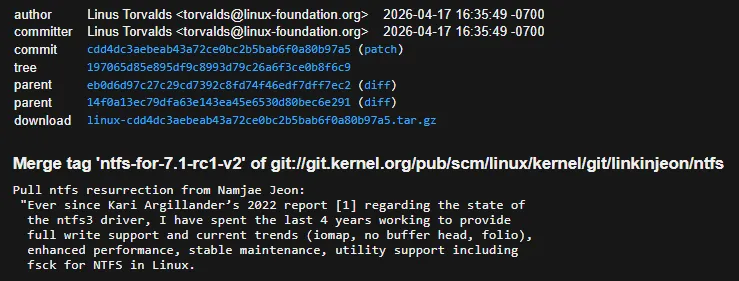
The new driver in Linux 7.1 is actually based on that ancient NTFS kernel driver, but it's been fully rewritten from the ground up by developer Namjae Jeon, the very same genius behind the Linux exFAT driver. The original work was done under the name NTFSPlus before being merged simply as "ntfs" to replace the old driver. Thus, Linus Torvalds referred to the new driver as "NTFS resurrection" when announcing the merge.
If the new NTFS delivers, it removes one of the longest-standing friction points between Linux and Windows ecosystems. On paper, performance should improve, especially compared to NTFS-3G. Running in kernel space alone eliminates a lot of overhead from context switching, which has always been the Achilles' heel of FUSE-based filesystems. Add in iomap and newer memory handling, and the new driver should be noticeably better at large sequential reads and writes, with lower CPU overhead during file operations and more consistent throughput under load.
Compared to NTFS3, things are less clear-cut. The new driver is architecturally cleaner and more future-proof, but it's also new code, which means early releases may not immediately outperform NTFS3 in every scenario. However, the developer says single-threaded writes are 3-5% faster, while multi-threaded writes are between 35% and 110% faster. Mounting a 4TB drive apparently goes four times faster, too, which is promising.
Stay On the Cutting Edge: Get the Tom's Hardware Newsletter
Get Tom's Hardware's best news and in-depth reviews, straight to your inbox.
Of course, because it's new code, it comes with the usual risks. Edge cases, especially around less-commonly used NTFS features like advanced permissions, compression, or journaling quirks, may take time to fully stabilize. It's also worth noting that even with a perfect driver, NTFS itself isn't designed around Linux semantics, so while compatibility improves, it's not suddenly going to behave exactly like ext4 or XFS in every case. The new driver passes 326 xfstests, though, which is better than NTFS3's 273 passing results, so it's already more than reliable enough for most users.
Still, for years, NTFS on Linux has been in that awkward "good enough, but..." category. It worked, but it never felt clean. Linux 7.1 is the first time it looks like the kernel is taking NTFS seriously as something worth doing properly, rather than just supporting it out of necessity. If the new driver holds up and gets consistent maintenance, it could finally make NTFS a genuinely seamless bridge between Linux and Windows. If not, it risks becoming just another entry in the long history of "almost there" NTFS support on Linux.
Zak is a freelance contributor to Tom's Hardware with decades of PC benchmarking experience who has also written for HotHardware and The Tech Report. A modern-day Renaissance man, he may not be an expert on anything, but he knows just a little about nearly everything.
It really is incredible the standards Linux has to live up to that nobody else has to. Even more incredible is when those standards are actually met; overcome.