US Army tests 20,000W vehicle-mounted laser systems for drone defense — updated LOCUST device is now more lethal against drones
LOCUST now being integrated with Oshkosh vehicles for rapid maneuverability.
Get Tom's Hardware's best news and in-depth reviews, straight to your inbox.
You are now subscribed
Your newsletter sign-up was successful
The U.S. Army is now testing the second gen vehicle-mounted LOCUST laser weapon system from AeroVironment (AV) Inc. It is hoped the new LOCUST Laser Weapon System (LWS) will be able to be rapidly deployed where required to protect soldiers and assets in a wide range of missions and environments where drones swarm in the skies. AV says that this updated LWS builds upon a system that has already seen over three years of operational use outside the U.S.
Laser weapons have a reputation for being bulky and heavy, thus hard to reposition where they are required. Earlier in 2025, AV worked with the U.S. Army to integrate its new mobile C-UAS Laser Weapon Systems (LWS) with the General Motors Defense Infantry Squad Vehicle (ISV) platform. However, at the end of the year, it announced that LOCUST would be added to the Oshkosh Joint Light Tactical Vehicle (JLTV) platform. As a reminder, the Oshkosh is the U.S. Military’s modern replacement for the Humvee.

LOCUST features
Of course, AV doesn’t spill the full specs of its LOCUST, but there are some interesting features shared on its product pages. In essence, this is a 20kW-class laser weapon, but it has been improved with “a larger aperture beam director, improving lethality performance” in this iteration.

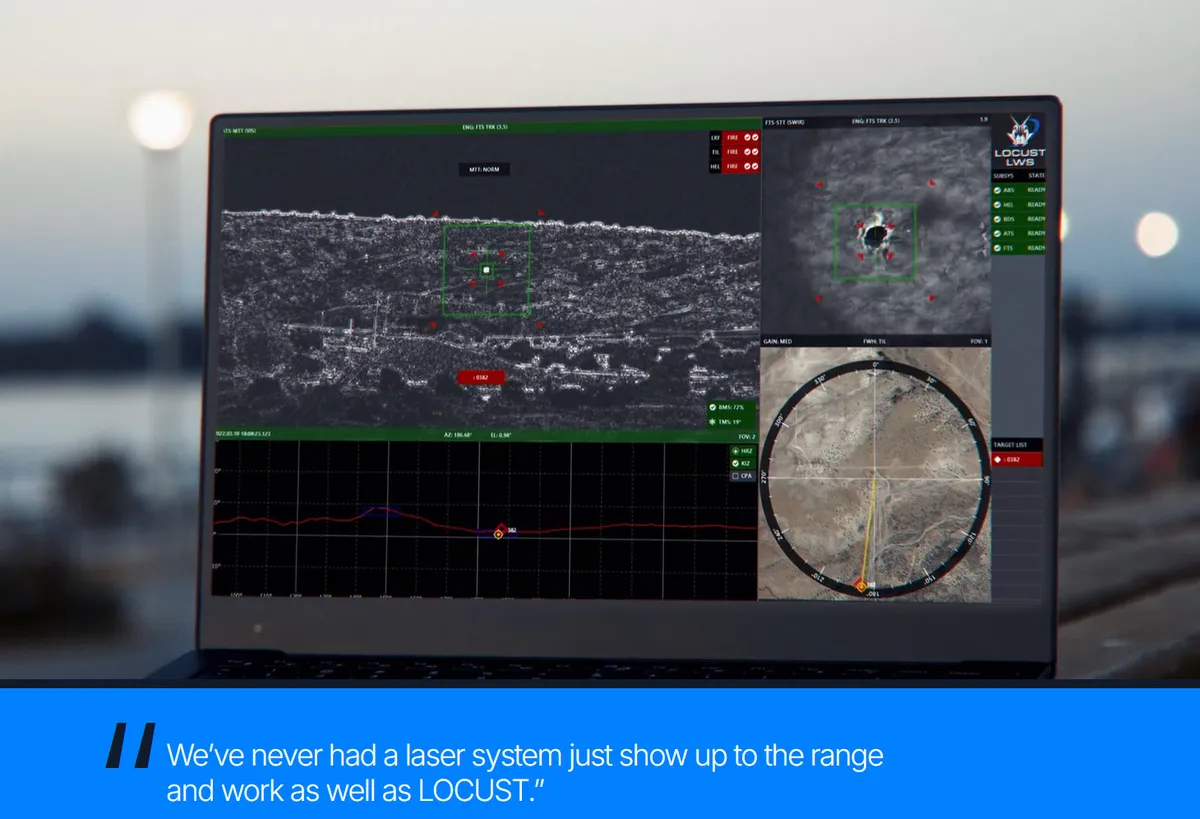
Article continues belowThe system is also highly adaptable and can be directed using a mix of automated and manual controls. On the automated side, it has multi-target IR search and track modes, advanced gimbaled electro-optical tracking, and an architecture open to a wide variety of sensors. Alternatively, it can be guided by an operator using “a common game controller.” We guess the operator would be assisted by some of the smart features like “fine tracking system (FTS), powerful telescope, laser rangefinder, acquisition tracking system (ATS), and targeting laser.”


Operationally deployed?
Earlier this week, we wrote about the 100kW Iron Beam laser, which Israel’s MoD claimed to be the first drone defense zapper to be operationally deployed. However, AV’s press release strongly suggests that earlier versions of the LOCUST have been battle-tested for the last three years.
John Garrity, Vice President of AV’s Directed Energy business unit, described the firm’s laser systems as “a proven force protection capability.” Moreover, he boasted that “Since deployed, LOCUST-equipped P-HEL systems have actively protected warfighters, allies, and critical infrastructure against aerial threats.”
Thus, these laser weapons and supporting technologies have been tuned from lessons learned in real-world combat. Having them available and mounted on JLTVs for increased mobility and rapid deployment, with the latest LOCUST refinements, will hopefully make them more useful than ever across a wide range of missions and environments.

Get Tom's Hardware's best news and in-depth reviews, straight to your inbox.
Follow Tom's Hardware on Google News, or add us as a preferred source, to get our latest news, analysis, & reviews in your feeds.

Mark Tyson is a news editor at Tom's Hardware. He enjoys covering the full breadth of PC tech; from business and semiconductor design to products approaching the edge of reason.
-
JohnyFin With bad weather conditions this weapon is useless. On desert in Arizona of course will be 100% effective....Reply -
bolweval Reply
most small drones need line of site to operate and don't do well in bad weather either...JohnyFin said:With bad weather conditions this weapon is useless. On desert in Arizona of course will be 100% effective.... -
USAFRet Reply
Drones also don't like bad weather conditions.JohnyFin said:With bad weather conditions this weapon is useless. On desert in Arizona of course will be 100% effective....
Just because something is not usable 100% of the time, does not make it useless. -
razor512 A good upgrade would be to allow for aiming at ground level targets as well. E.g., getting chased by someone, it would help keep whoever is chasing you warm.Reply -
hushnecampus How many shots can the battery/generator on the vehicle power? Curious to know how this compares to projectile based systems of the same size and weight.Reply -
BFG-9000 As pointed out in the other laser thread, 20kW continuous is not a lot, and could easily be supplied with a 30HP generator. That would use 15lbs/hr of fuel which is 2.5gphReply
If you think this setup would be around 30% efficient though, it's closer to 60kW input for 20kW out -
EzzyB Reply
The details really aren't there. Projectile solutions have their own issues as drones are pretty small and generally those systems have to have a fragmentation warhead that needs to know when to explode. Meaning you literally have to program the round to explode when you want it at the time its fired. So, not much, if any less complicated.hushnecampus said:How many shots can the battery/generator on the vehicle power? Curious to know how this compares to projectile based systems of the same size and weight. -
hushnecampus Reply
Call me a massive nerd, but I kinda hope the directed energy solution really is the best. It just feels so sci-fi living in a world where laser weapons are a normal, genuinely useful thing! And if we're gonna have war, it might as well be *cool* war! On the other hand, a world where we're desperately trying to make laser weapons a thing, just for the sake of it when other solutions are better, just feels kinda embarrassing...EzzyB said:The details really aren't there. Projectile solutions have their own issues as drones are pretty small and generally those systems have to have a fragmentation warhead that needs to know when to explode. Meaning you literally have to program the round to explode when you want it at the time its fired. So, not much, if any less complicated. -
frogr Reply
While not actively firing, the system would not be drawing 20kW (or 60kW.) The generator would be turning full RPM but lightly loaded. In fact, the system wouldn't be drawing any more power than a projectile-based system during the target detection and tracking phases.BFG-9000 said:As pointed out in the other laser thread, 20kW continuous is not a lot, and could easily be supplied with a 30HP generator. That would use 15lbs/hr of fuel which is 2.5gph
If you think this setup would be around 30% efficient though, it's closer to 60kW input for 20kW out
hushnecampus "How many shots can the battery/generator on the vehicle power? Curious to know how this compares to projectile based systems of the same size and weight."
Based on BFG-9000's estimate that 8 gallons of fuel could supply 1 hour's worth of " 20 kW laser shots," the question is how many seconds does it take to incapacitate a target? if it is 15 seconds -> 240 targets for 8 gallons of fuel. -
EzzyB Reply
The flip side is where does the 20KW come from? The manufacturer shows a truck with a beam weapon. Does it really get enough power from it's own engine for that? I mean that's probably something like a 200HP diesel V-8. Or, does it more likely have to be hooked up to some massive 60-100KW power plant?hushnecampus said:Call me a massive nerd, but I kinda hope the directed energy solution really is the best. It just feels so sci-fi living in a world where laser weapons are a normal, genuinely useful thing! And if we're gonna have war, it might as well be *cool* war! On the other hand, a world where we're desperately trying to make laser weapons a thing, just for the sake of it when other solutions are better, just feels kinda embarrassing...
I think the answer is the latter, the marketing jargon makes no mention of, for instance, shoot-on-the-move capability, only that the laser is "mounted on" a mobile chassis (I checked the manufacturers site and it doesn't say much more than the article does.)
The most I ever worked with in my time in the military was a jammer that could produce 1000 watts from it's prime mover (which started life as a tracked ammo carrier for artillery and was a much larger vehicle). I'll throw in as a caveat I'm pretty old and that was a couple of decades ago.
Anyways this thing probably isn't going to move along with the troops and provide air defense. It's going to drive up to a fix position and hook up to a pretty large generator of some kind. The whole tactical issue with beam weapons is always going to be "where's the power coming from?" The Navy has an advantage here, ships are pretty damn big, but in the Army it's got to come from a truck or generator and the Air Force from an aircraft powerplant.