Benchmark Results
MEMTIME
I ran this low-level memory benchmark from Intel just to show the theoretical numbers. Many memory performance numbers don't translate into real world applications, or only when seen in context with others. I picked four different memory operations and displayed for each platform the numbers with 'cold cache', source and target aligned, source unaligned, target aligned and source aligned, target unaligned.
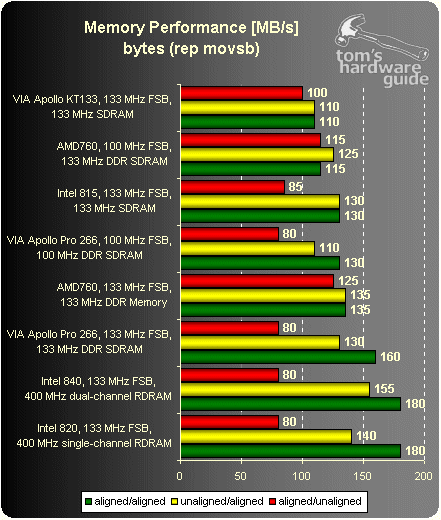
Here is a typical example showing the two-sided blade of RDRAM. If the source and the target are aligned (green bars), RDRAM is in this Byte-move operation even faster than DDR-SDRAM. However, once the target is unaligned (red bars), RDRAM drops down to the worst performance and DDR SDRAM on AMD760 leads. All in all this test shouldn't have a lot of importance, since Byte moves should by now be pretty much out of fashion in the software developer community.

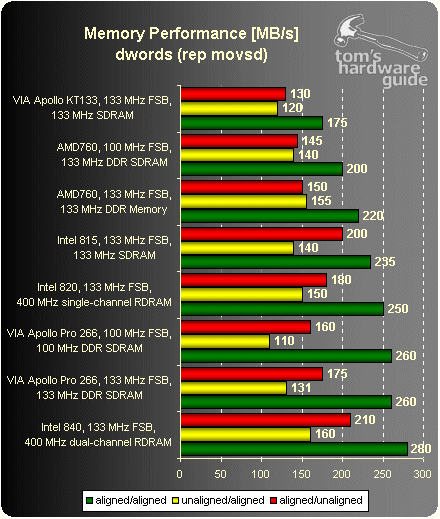
Moving double-words (32 bit of data) is a lot more common. Here VIA's DDR-chipset is very close behind the dual-channel RDRAM of i840. However, VIA's early VT8633-motherboard doesn't look very good once the source is unaligned. AMD's 760 doesn't make a good figure here at all, neither does VIA's Apollo KT133 plus SDRAM.