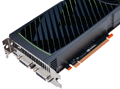
A month ago, Nvidia launched its GeForce GTX 580, and it was everything we wanted back in March. Now the company is introducing the GeForce GTX 570, also based on its GF110. Is it fast enough to make us forget the GF100-based 400-series ever existed?
Tom’s Hardware reader nevertell in response to my review of Nvidia’s GeForce GTX 580:
“So it's basically what the 480 should have been. Fair enough, I'll wait for the 470 version of the GF110 and buy that.”
If nevertell stuck to his guns, then he’s probably pretty happy right about now. After all, I’ve been playing with “the 470 version of the GF110” for three days now, and have to say I’m genuinely embarrassed for the GeForce GTX 480 cards selling for $450 online. Why? Well, here’s a bit of a spoiler alert: the GeForce GTX 570 is every bit as fast, and in some cases faster. Moreover, Nvidia’s pricing the thing at $349. As soon as I found out about this board, I tried to warn those of you following me on Twitter to abandon any plans to scoop up a discounted GTX 480 ahead of the holidays. The GTX 570 is far more attractive.

Then, before sitting down to write this piece up, I went back to read all 10 pages of feedback on the GeForce GTX 580 launch. The one theme that came up over and over was 6800-series cards in CrossFire. I didn’t have the boards to make that happen at the time (they were hanging out over at Don’s place in Canada), but I do now. And so this time around, you’ll see Nvidia’s GeForce GTX 570 compared to a pair of Radeon HD 6850s yoked together. The AMD cards are $30 more expensive, but if they can also manage to put down better performance, perhaps that’ll make for an even better value.
Not Every Flower Can Be A Rose
With GeForce GTX 580, Nvidia showed us what its Fermi architecture was intended to look like nine months ago.
All 16 Shader Multiprocessors are enabled, yielding 512 CUDA cores, 64 texture units, and 16 PolyMorph engines. And while the back-end still consists of six ROP partitions associated with six 64-bit memory controllers (384-bit aggregate), it runs at a slightly higher data rate, improving memory bandwidth. The graphics and shader clocks are also a fair bit quicker. Lo and behold, a more efficient heatsink and better fan design keep the thermals and noise in check too, even as the GeForce GTX 580 uses just about as much power as its predecessor.
Unfortunately, not every GF110 GPU cut from TSMC’s silicon can grow up to be a princess (that’s not to say the rest of them have to be GeForce GTX 465 toads either, though).
The GeForce GTX 570 is what you’d get if GeForce GTX 480 slept with GeForce GTX 470, and the offspring somehow ended up with GF110 DNA. That is to say, the card’s GPU features 15 Shader Multiprocessors, yielding 480 CUDA cores and 60 texture units. That’s GTX 480’s bosom. It also wields five ROP partitions, a 320-bit memory bus, and 1.25 GB of GDDR5 memory. That’s GTX 470’s derriere.
And of course you end up with the architectural enhancements made to GF110. Mainly, FP16 texture filtering happens in one clock cycle, just as it does on the GF104 found in GeForce GTX 460, and not the two cycles endured by GF100. Nvidia also made improvements to GF110’s Z-culling efficiency. This means the GPU is smarter about discarding pixels that don’t need to be rendered in a scene (because they’re behind other objects), conserving memory bandwidth and compute muscle.
- GeForce GTX 570: Now That's More Like It
- Meet Nvidia’s GeForce GTX 570
- Tessellation: Unigine Gives Us Synthetic Numbers
- Tessellation: HAWX 2 Gives Us Real-World Numbers
- The BS Of Benchmarking
- Test Hardware And Software
- Benchmark Results: 3DMark Vantage
- Benchmark Results: Metro 2033 (DX 11)
- Benchmark Results: Lost Planet 2 (DX 11)
- Benchmark Results: Aliens Vs. Predator (DX 11)
- Benchmark Results: Battlefield: Bad Company 2 (DX 11)
- Benchmark Results: DiRT 2 (DX 11)
- Benchmark Results: Just Cause 2 (DX 11)
- Power Consumption And Noise
- Conclusion


There is no need to root for either one. What you really want is a healthy and competitive Nvidia to drive prices down. With Intel shutting them off the chipset market and AMD beating them on their turf with the 5XXX cards, the future looked grim for NVidia.
It looks like they still got it, and that's what counts for consumers. Let's leave fanboyism to 12 year old console owners.
There is no need to root for either one. What you really want is a healthy and competitive Nvidia to drive prices down. With Intel shutting them off the chipset market and AMD beating them on their turf with the 5XXX cards, the future looked grim for NVidia.
It looks like they still got it, and that's what counts for consumers. Let's leave fanboyism to 12 year old console owners.
Or am I missing something?
EDIT:
Love this gem:
Before we shift away from HAWX 2 and onto another bit of laboratory drama, let me just say that Ubisoft’s mechanism for playing this game is perhaps the most invasive I’ve ever seen. If you’re going to require your customers to log in to a service every time they play a game, at least make that service somewhat responsive. Waiting a minute to authenticate over a 24 Mb/s connection is ridiculous, as is waiting another 45 seconds once the game shuts down for a sync. Ubi’s own version of Steam, this is not.
When a reviewer of not your game, but of some hardware using your game comments on how bad it is for the DRM, you know it's time to not do that, or get your game else where warning.
So you gonna buy it? Huh huh huh?
Also, it would have been interesting to see Metro 2033 tested with max instead of medium settings. All the cards are able to play medium at all resolutions with no AA... push them to their limits?
Thoroughly enjoyable review though. Thanks, Chris!
http://benchmarkreviews.com/index.php?option=com_content&task=view&id=614&Itemid=72
But yeah, this review NEEDS 460's 1GB in SLI to be fair, as they are definitely an alternative to a 580, even a 570. There are quite a few cards at or below $199
Dual Hawks for $320 AFTER MIR:
http://www.newegg.com/Product/Product.aspx?Item=N82E16814127518
And these cards will overclock well.
noticed that too. i really can't think of any reason other than the language support for the Tom's engineers. 99% of the gamer market would be better off with home premium 64 bit. the other 1% that actually runs and maintains a domain in their house should get professional or the bloated "ultimate". i mean, who really uses bitlocker on their gaming machine anyway? great article though! i jumped on the 580 and haven't looked back. used to run on a 5850 but now that i've seen fermi in all of it's glory i'm really interested in nvidia's future "vision".
Wait, innuendo? Where?