Mobile CPU Mania
-
Page 1:Introduction
-
Page 2:Thermal Design Power
-
Page 3:Cooling A Mobile CPU
-
Page 4:Heat Pipes, Heat Sinks, Heat Spreaders And Remote Heat Exchange, Continued
-
Page 5:Desktop Vs. Mobile CPU
-
Page 6:Speedstep, Continued
-
Page 7:Mobile Module 1
-
Page 8:Mobile Module 1, Continued
-
Page 9:Mobile Module 1, Continued
-
Page 10:Mobile Module 2
-
Page 11:Mobile Module 2, Continued
-
Page 12:Mini-Cartridge
-
Page 13:Mini-Cartridge, Continued
-
Page 14:BGA-1
-
Page 15:BGA-1, Continued
-
Page 16:Micro-PGA1
-
Page 17:Micro-PGA1, Continued
-
Page 18:BGA-2
-
Page 19:Micro-PGA2
-
Page 20:BGA-2, Continued
-
Page 21:Mobile CPU Matrix
-
Page 22:Conclusion
Mobile Module 2
While the MMC-1 Module used a PCI Interface to connect to the Notebook Motherboard the MMC-2 (Mobile Module Connector 2) used an AGP/PCI Interface.

MMC-2 Connector View
The MMC-2 has 10 rows and 400 pins. It is not possible to use an MMC-1 Module in an MMC-2 slot or vice versa. The BX chipset used with the mobile modules always supports AGP, but the connector of the MMC-1 doesn't allow it's use. The MMC-2 processors kicked-off AGP graphics inside of a notebook for 3D graphics and better DVD playback.

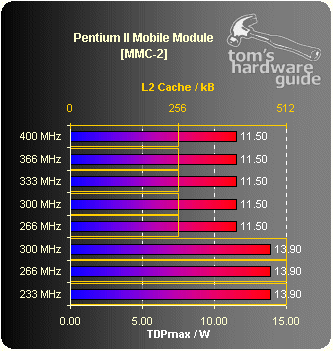
Like the Pentium II MMC-1 Module the Pentium II MMC-2 module uses 1.6V.
Also the advantage of the on-die cache is obvious. On-die level two cache not only reduces the weight of the module by ~4g, but also saves valuable power.
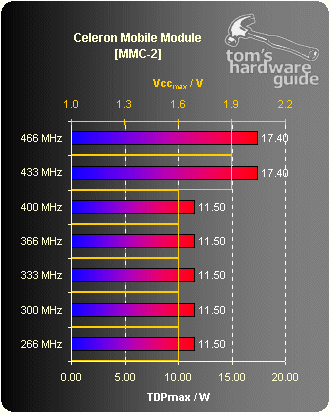
The MMC-2 Celeron is a bridge to the next step in the evolution of mobile CPUs.
- Introduction
- Thermal Design Power
- Cooling A Mobile CPU
- Heat Pipes, Heat Sinks, Heat Spreaders And Remote Heat Exchange, Continued
- Desktop Vs. Mobile CPU
- Speedstep, Continued
- Mobile Module 1
- Mobile Module 1, Continued
- Mobile Module 2
- Mobile Module 2, Continued
- Mini-Cartridge
- Mini-Cartridge, Continued
- BGA-1
- BGA-1, Continued
- Micro-PGA1
- Micro-PGA1, Continued
- BGA-2
- Micro-PGA2
- BGA-2, Continued
- Mobile CPU Matrix
- Conclusion