Enermax Noisetaker EG701AX-VE(W): Perfect Connections And Quiet

Good quality workmanship, but little of note otherwise - the Enermax Noisetaker is also very quiet.
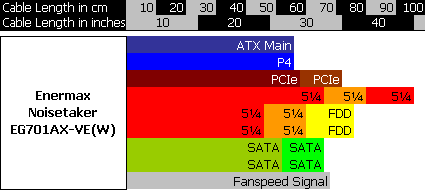
The graphic above shows the power supply connections and their length in centimeters. Exemplary: the "big" Enermax offers all the connections.
Features

The Enermax Noisetaker EG701AX-VE(W) is the second device from this manufacturer in the stress test and has 600 watts of total power. In contrast to the Coolergiant from the same company, this power supply unit has a traditional design with two fans: One transports the heat from the CPU cooler away and the second fan provides cooling for the power supply components.

Already known from the other Enermax model: Cable routing with EMI ferrite core. Positive side effect: The cables are well protected and can't be damaged by the power supply casing.

The power supply can work with voltage from 110 to 230 volts - manual switch-over is not necessary.
The casing could do with a design update so that the switch recesses from older models disappear. Another traditional feature of Enermax is the integrated ventilation control: Enermax was one of the first manufacturers to establish manual fan control in the market. With it, the speed of the fan can be set by hand - electronics monitor the temperature. If a user has set the speed too low, nothing can be damaged.

Enermax embosses its logo on the casing itself.

The power supply is equipped with a fan servo control that cools the components of the power supply and the computer after being switched off until the temperature is below 104°F. (40°C). This feature also has a negative effect: If the computer is switched off, then the noise of the fan can still be heard. In this case, the power switch of the power supply can switch off the fan without further ado.

Identification plate of the Enermax power supply with all the necessary information.
Test Results - Quiet Operating Noise, Top Values Under Maximum Load
24 hours of continuous stress passed by the Enermax without a trace. All measurements and also the specification of a combined load coincided with the specification. Consequently, the Enermax Noisetaker EG701AX-VE(W)emerges from the test once again with good values - during the last comparative test there were similarly good results. Here, the competition should learn from the example, above all from the voltage values of the individual lines. Here, the 12 volt bar should be mentioned, which was determined to be exactly 12 volts and consequently right in the middle of the tolerance range. The very high efficiency of 80.2 percent and the quiet operating noise were noticeable.
After 24 hours under high load, the power supply unit from Enermax seems to be as fresh as when it started: The measurement results are within the specification and the power ratings coincide with those of the manufacturer. Also as a result of past tests, the Enermax Noisetaker EG701AX-VE(W) is known for its outstanding performance.
| Enermax Noisetaker EG701AX-VE(W) (600 watts) | |||
|---|---|---|---|
| Test Phase 1 | |||
| Test Description | Lower Limit | Upper Limit | Result |
| Increase load from 20% to 100% of nominal load limit | 120 watts | 600 watts | Passed |
| Test Phase 2 | |||
| Test Description | Row 4 - Cell 1 | Load | Result |
| Steady load at 100% nominal load | Row 5 - Cell 1 | 600 watts | Passed |
| Test Phase 3 | |||
| Voltage Stability | |||
| Power Rail | Measurement | Min/Max according to ATX Spec. | Result |
| + 3.3 V | + 3.15 V | +/- 5% (+3.14 to +3.46 V) | Passed |
| + 5 V | + 4.95 V | +/- 5% (+4.76 to +5.25 V) | Passed |
| + 12 V | + 12.00 V | +/- 5% (+11.4 to +12.6 V) | Passed |
| + 12 V CPU | + 11.82 V | +/- 5% (+11.4 to +12.6 V) | Passed |
| + 5 V Standby | + 4.99 V | +/- 5% (+4.76 to +5.25 V) | Passed |
| - 12 V | - 12.35 V | +/- 10% (-10.8 to -13.2 V) | Passed |
| Ripple | |||
| Power Rail | Measurement | Min/Max according to ATX Spec. | Result |
| +3.3 V | 45 mV | 50 mV (Peak-Peak) | Passed |
| +12 V CPU | 58 mV | 120 mV (Peak-Peak) | Passed |
| Further Data | |||
| Value | Measurement | Row 20 - Cell 2 | Row 20 - Cell 3 |
| Noise Level (max.) | 58.6 dB(A) | Row 21 - Cell 2 | Row 21 - Cell 3 |
| Voltage | 213 V | Row 22 - Cell 2 | Row 22 - Cell 3 |
| Current | 3.53 A | Row 23 - Cell 2 | Row 23 - Cell 3 |
| Cos Phi (Distorsion of Phase) | 0.99 | Row 24 - Cell 2 | Row 24 - Cell 3 |
| Efficiency | 80.2% | Row 25 - Cell 2 | Row 25 - Cell 3 |