Join for quick access. Enter your email below and we'll send confirmation plus sign you up to our newsletter.
By submitting your information, you confirm you are aged 16 or over,
have read our
Privacy Policy
and agree to the
Terms & Conditions. Geographical rules apply.
Join for quick access. Enter your email below and we'll send confirmation plus sign you up to our newsletter.
By submitting your information, you confirm you are aged 16 or over,
have read our
Privacy Policy
and agree to the
Terms & Conditions. Geographical rules apply.
Stay On the Cutting Edge: Get the Tom's Hardware Newsletter
Get Tom's Hardware's best news and in-depth reviews, straight to your inbox.
You are now subscribed
Your newsletter sign-up was successful
Join the club
Get full access to premium articles, exclusive features and a growing list of member rewards.
An account already exists for this email address, please log in.
Cornell research shows that underwater 3D printing can be used to build or repair ocean structures in place — DARPA-funded project aims to make underwater construction faster, cheaper, and safer
Researchers based at Cornell University have developed a method for the 3D printing of structures on the seafloor. Traditional methods of underwater construction and repair are slow, expensive, and can disrupt ecosystems. Using robot-based 3D printers and a specially formulated anti-washout concrete mix (using mostly seafloor sediment) represents a breakthrough in subsea construction technology.
The Cornell Chronicle blog mentions that the interdisciplinary group, led by Sriramya Nair, assistant professor of civil and environmental engineering in the David A. Duffield College of Engineering, was already working with a 6,000-pound industrial robot for large-scale 3D printing of concrete structures on Terra Firma.
This preassembled team spotted the Department of Defence’s Defense Advanced Research Projects Agency (DARPA) call for proposals, in search of 3D printing concrete construction tech which could be used several yards beneath the sea. “We said, ‘Hey, let’s just do this and see, so that we will at least understand what the challenges are,’” recalls Nair.
The researchers' hunch largely paid off, with an award of a $1.4m grant, contingent on meeting certain benchmarks, and promising early sub-sea results.
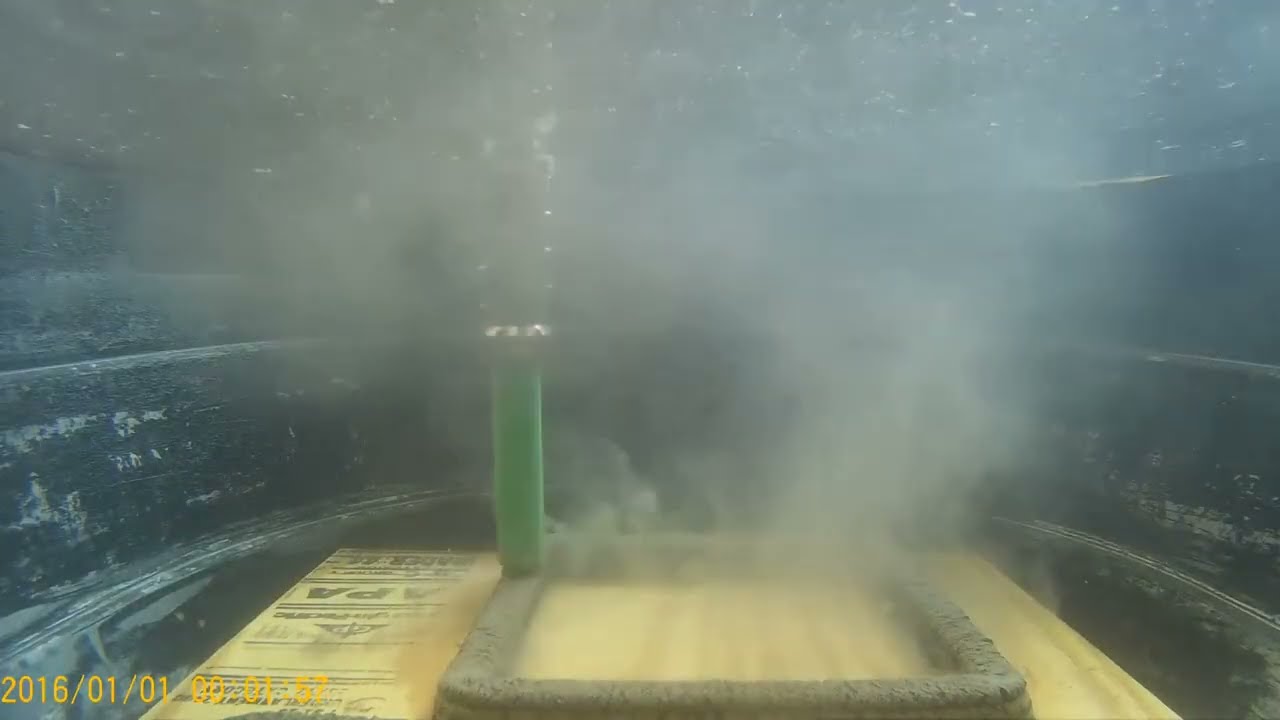
Among the major challenges of 3D printing concrete underwater is washout, where the cement washes away more than binds to itself or its intended location. The Cornell team managed to overcome this hurdle with an experimentally optimized balance between material viscosity and pumpabiliity. The video below shows the team testing their underwater 3D printing systems in large water tanks.
Cornell University team demonstrated underwater concrete printing with minimal ocean disturbance. - YouTube
DARPA also set out a specific challenge to overcome: the agency wanted the concrete mix to incorporate seafloor sediment as a major ingredient. This requirement was set for logistical purposes, but would also help minimize environmental impact – repurposing materials already present in the underwater area.
The researchers also had some work to do on new sensing systems so they could carefully monitor and adapt the underwater 3D printing process in low-visibility conditions.
Stay On the Cutting Edge: Get the Tom's Hardware Newsletter
Get Tom's Hardware's best news and in-depth reviews, straight to your inbox.
Overall, the Cornell group reckons that they have addressed the project goal. This means that traditional underwater construction, which is slow, expensive, and disruptive to the environment, could become a thing of the past.
This isn’t the ‘winning’ solution to subsea construction yet, though. The Cornell team will pitch and demonstrate their seafloor 3D printer-driven construction tech in a DARPA ‘bake-off’ in March this year. At the event, they will have to race against five other teams to 3D print an underwater arch, to spec.
Mark Tyson is a news editor at Tom's Hardware. He enjoys covering the full breadth of PC tech; from business and semiconductor design to products approaching the edge of reason.
Interesting. Also, MIT has designed a way to use acoustic signals (rather than radio waves) for underwater networking that uses the water (rather than air) as the medium. Though slow (10KB in deep water), it is effective over very long distances. It would take about 23 hours to send a 100 MB file at the bottom of the sea floor using acoustic networking through the water.