









Why you can trust Tom's Hardware Our expert reviewers spend hours testing and comparing products and services so you can choose the best for you. Find out more about how we test.
Native 1440p gaming actually makes a lot more sense on the RTX 4080 Super — and most other high-end / enthusiast GPUs. It also acts as a stand-in for 4K with Quality mode upscaling. There's a slight performance hit from the upscaling algorithms, but the relative positioning of the various GPUs should be pretty close to what we'll see here.
RTX 4080 Super 1440p Overall Performance
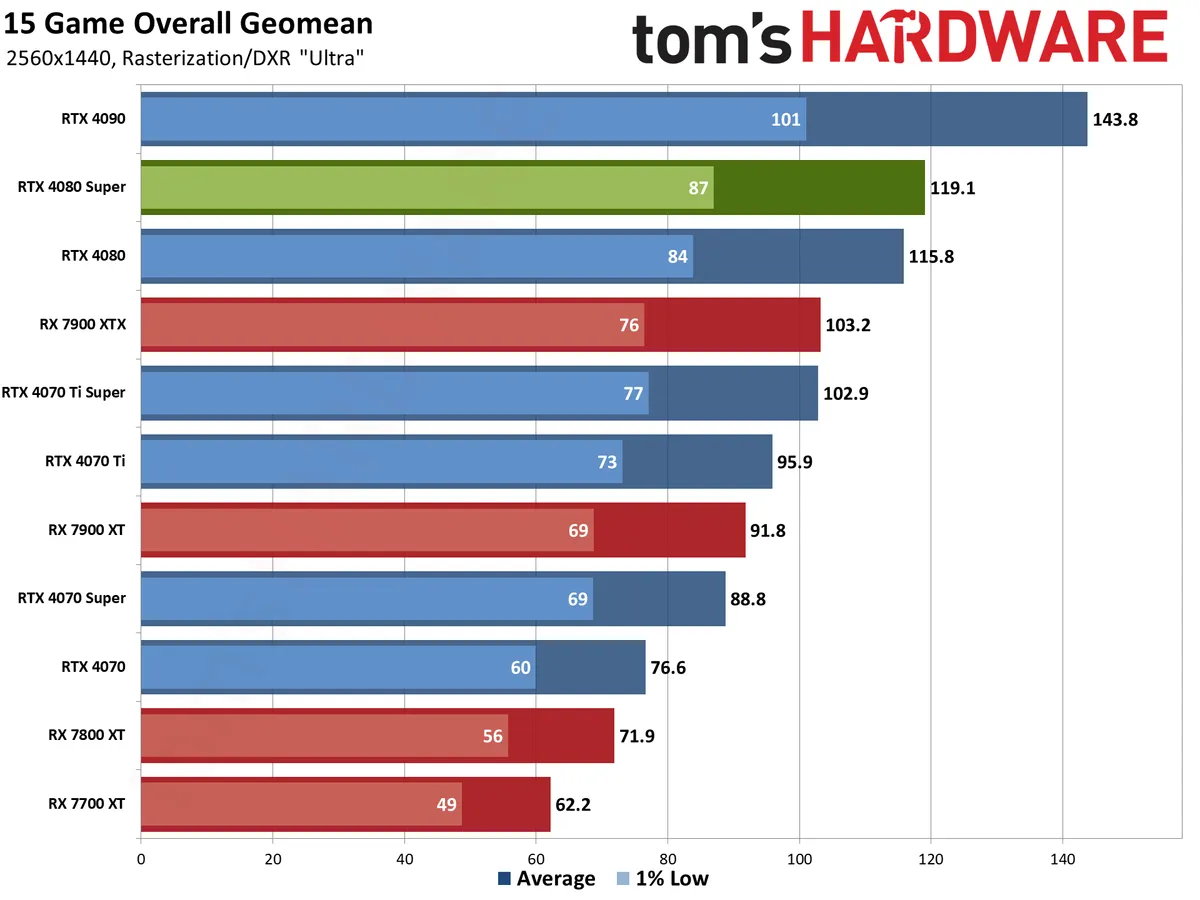
There's not much to add to the discussion from the previous page. 1440p ultra doesn't pound the GPUs as hard, and a few of the margins shrink a bit — like the 4090's 21% lead over the 4080 Super — but the gap between the vanilla 4080 and its replacement still sits at 3% overall.
Similarly, the 4080 Super also leads the 7900 XTX by 15% overall, with a slightly larger lead than at 4K. That's because all the extra bandwidth of the 7900 XTX does help it more at 4K. But it's only a 1% change, so not really anything to discuss.
Nvidia's RTX 4090 still claims top honors, naturally. Where it was 32% faster than the 4080 Super at 4K, the lead drops a bit to 21% at 1440p — even including games like Flight Simulator where we're fully CPU limited on both GPUs. As we noted back when the 4090 launched in October 2022, CPU bottlenecks can be a factor on that GPU, even at 1440p ultra.
RTX 4080 Super 1440p Rasterization Performance


View Original

View Original

View Original

View Original

View Original

View Original

View Original

View Original

View Original

View Original

As we noted above, 1440p doesn't benefit from AMD's extra bandwidth as much as 4K, and the result is that the 4080 Super takes the lead over the 7900 XTX in rasterization performance. It's not much of a lead at just 2%, though, and AMD does maintain a slight lead in a few of the games.
The 4080 Super ends up just 2.6% faster than the 4080 now, and 14% faster than the 4070 Ti Super. We're definitely not fully CPU limited, but it does show up as a factor in a couple games — Far Cry 6 and Flight Simulator being the two main culprits. In fact, the 4080 Super is barely any faster at 1440p than at 1080p in those two titles.
The 4090's lead also shrinks substantially at 1440p. Where it was 28% faster in the rasterization games at 4K, it's only 15% faster at 1440p. We'll really need faster CPUs to shift the bottleneck back toward the GPU at 1440p and lower resolutions, and that will be even more applicable when the next generation GPU architectures arrive, though that's still probably a year or more away. Alternatively, we need more demanding games, like our ray tracing suite.
RTX 4080 Super 1440p Ray Tracing Performance


View Original

View Original

View Original

View Original

View Original

View Original

View Original

DXR doesn't affect the Nvidia vs. Nvidia story much, except that because all the games become far more demanding, CPU bottlenecks aren't really a factor. The RTX 4090 leads the 4080 Super by 30% here, while the 4080 Super is only 3% faster than the vanilla 4080 — basically the same delta as we measured at 4K.
The 4080 Super also leads the 7900 XTX by 39%, nearly the same as at 4K. It's a big difference, with every game we tested breaking the 60 fps mark on the Nvidia card while a couple of the games land in the low 40s on the AMD GPU.
Upscaling can of course help at 1440p as well, so if you enable DLSS — or FSR 2/3 on AMD GPUs — you can typically boost performance by 30–50 percent without too much of a loss in image fidelity.
RTX 4080 Super 1440p Bonus Games


Our bonus games range from being slightly to significantly more demanding than our existing test suite. Alan Wake 2 shows how future path traced games might perform — the gap between Nvidia and AMD remains massive, though now the 4080 Super is 'only' 164% faster. The 4080 Super as usual barely beats the 4080.
The gap in Avatar is slightly larger between AMD and Nvidia at 1440p: 22% compared to 17%, as the demands on the memory subsystem favor Nvidia a bit more here. Both cards provide very playable performance, with Quality mode upscaling breaking 100 fps. Note that the native 1440p performance would be slightly higher than what we measured at 4K, since that used 1440p with upscaled to 4K.
The Last of Us ends up one of the few cases where AMD can still come out ahead of the 4080 Super, barely. It's 3.7% faster, so not something you'd actually notice in practice.
As we've said before, our main takeaway is that Nvidia's hardware provides access to potentially new experiences — like the full path tracing in Alan Wake 2 and Cyberpunk 2077 — that just don't run well at all on AMD's GPUs. If the uptake of path tracing in remastered games takes off, using RTX Remix as an example, we could see quite a few 'mods' in the coming years where Nvidia's GPUs will have a massive performance advantage.
- MORE: Best Graphics Cards
- MORE: GPU Benchmarks and Hierarchy
- MORE: All Graphics Content
Get Tom's Hardware's best news and in-depth reviews, straight to your inbox.
Current page: Nvidia RTX 4080 Super: 1440p Gaming Performance
Prev Page Nvidia RTX 4080 Super: 4K Gaming Performance Next Page Nvidia RTX 4080 Super: 1080p Gaming Performance
Jarred Walton is a senior editor at Tom's Hardware focusing on everything GPU. He has been working as a tech journalist since 2004, writing for AnandTech, Maximum PC, and PC Gamer. From the first S3 Virge '3D decelerators' to today's GPUs, Jarred keeps up with all the latest graphics trends and is the one to ask about game performance.
-
Lamarr the Strelok $1000 for 16 GB VRAM. What a ripoff. Personally the 7600 XT with 16 GB VRAM is the only GPU I'd consider.Nvidia has better performance but their greed is incredible.Reply
I'll be using my 8 GB RX 570 til it's wheels fall off. Then I may simply be done with PC gaming. It's becoming ridiculous now. -
usertests Reply
I'm not going to tell you to continue PC gaming but there are plenty of options that are good enough for whatever you're doing, like an RX 6600. If you want more VRAM, grab a 6700 XT instead of 7600 XT, or an RTX 3060, while supplies last. Then if we later see the RX 7600 8GB migrate down to $200, and 7700 XT 12GB down to $350, those will be perfectly fine cards.Lamarr the Strelok said:$1000 for 16 GB VRAM. What a ripoff. Personally the 7600 XT with 16 GB VRAM is the only GPU I'd consider.Nvidia has better performance but their greed is incredible.
I'll be using my 8 GB RX 570 til it's wheels fall off. Then I may simply be done with PC gaming. It's becoming ridiculous now.
By the time you're done hodling your RX 570, the 7600 XT should be under $300 and at least RDNA4 and Blackwell GPUs will be out. -
RandomWan ReplyLamarr the Strelok said:$1000 for 16 GB VRAM. What a ripoff. Personally the 7600 XT with 16 GB VRAM is the only GPU I'd consider.Nvidia has better performance but their greed is incredible.
I'll be using my 8 GB RX 570 til it's wheels fall off. Then I may simply be done with PC gaming. It's becoming ridiculous now.
You're complaining about the VRAM (which doesn't matter as much as you think) and the price when you're sporting a bottom budget card. There's any number of cards you could upgrade to with a $300 budget that will blow that 570 out of the water.
These should be over 2x the performance of your card with 16GB for $330:
https://pcpartpicker.com/product/vT9wrH/xfx-speedster-swft-210-radeon-rx-7600-xt-16-gb-video-card-rx-76tswftfp
https://pcpartpicker.com/product/sqyH99/gigabyte-gaming-oc-radeon-rx-7600-xt-16-gb-video-card-gv-r76xtgaming-oc-16gd -
Gururu I thought healthy competition between companies meant the customer wins. This proves not the case. They do just enough to edge the competition when they could do soooo much more for the customer.Reply -
TerryLaze Reply
Being cheaper is not a bad thing, it's not contradictory to the first thing being good ( the slightly faster) it's not but cheaper, it's but also or and(also) cheaper.Admin said:Nvidia GeForce RTX 4080 Super review: Slightly faster than the 4080, but $200 cheaper : Read more -
InvalidError Reply
If nobody complains about ludicrously expensive GPUs having a bunch of corners cut off everywhere to pinch a few dollars on manufacturing off a $1000 luxury product, that is only an invitation to do even worse next time. No GPU over $250 should have less than 12GB of VRAM, which makes 16GB at $1000 look pathetic.RandomWan said:You're complaining about the VRAM (which doesn't matter as much as you think) and the price when you're sporting a bottom budget card.
Also, having 12+GB does matter as higher resolution textures are usually the most obvious image quality improvement with little to no impact on frame rate as long as you have sufficient VRAM to spare and 8GB is starting to cause lots of visible LoD asset pops in modern titles.
Corporations' highest priority customers are the shareholders and shareholders want infinite 40% YoY growth with the least benefits possible to the retail end-users as giving end-users too much value for their money would mean hitting the end of the road for what can be cost-effectively delivered that much sooner and be able to milk customers for that many fewer product cycles.Gururu said:I thought healthy competition between companies meant the customer wins. This proves not the case. They do just enough to edge the competition when they could do soooo much more for the customer. -
TerryLaze Reply
The last time we had healthy competition in anything computer related was in the 90ies.Gururu said:I thought healthy competition between companies meant the customer wins. This proves not the case. They do just enough to edge the competition when they could do soooo much more for the customer.
AMD buying ATI in 2006 was the last of any "healthy" competition, every other GPU company at that point was already defeated, also every other CPU company other that intel and AMD with ARM, as a company, barely hanging on even though ARM as CPUs are almost everywhere. -
magbarn As long as Nvidia makes a killing on AI, they're going to reserve the fat chips like the 4090 only for the highest priced products. They're allocating most of the large chips to AI, hence why the 4090 at MSRP sold out in minutes yesterday. This 4080 Super really is what the 4070 Ti should've been.Reply -
RandomWan ReplyInvalidError said:If nobody complains about ludicrously expensive GPUs having a bunch of corners cut off everywhere to pinch a few dollars on manufacturing off a $1000 luxury product, that is only an invitation to do even worse next time. No GPU over $250 should have less than 12GB of VRAM, which makes 16GB at $1000 look pathetic.
It carries a bit less weight complaing about it when you're rocking what was a sub $200 video card. There's things other than a reasonable price keeping you from the card. By all means complain where appropriate, but unless people stop buying it, your complaints will acheive nothing.
I don't know why you think a budget card should have that much RAM. You're not going to be gaming at resolutions where you can make use of those larger textures. I have a 1080Ti with 11GB (from the same timeframe) and the memory buffer isn't getting maxxed out at 3440x1440. Unless you're actually gaming at 4k or greater resolution, you're likely not running into a VRAM limitation, especially if you're making use of upscaling technologies. -
Lamarr the Strelok Well shadow of tomb raider at 1080p gets close to using 8 GB of VRAM. Far Cry 6 at 1440 uses close to 8 also.Reply
I admit I'm a budget gamer.(I have guitars and guitar amps to feed).But yes, UE 5 is a bit of a pig.Many UE5 games have an rx570,580, 590 as the minimum so the party's over for me soon.