









Why you can trust Tom's Hardware Our expert reviewers spend hours testing and comparing products and services so you can choose the best for you. Find out more about how we test.
Nvidia GeForce RTX 5070 Founders Edition

Nvidia's special environmentally friendly packaging program continues with the RTX 5070 Founders Edition. Recycled materials and no ink make for an interesting if somewhat boring looking box. But it's what's inside that counts.


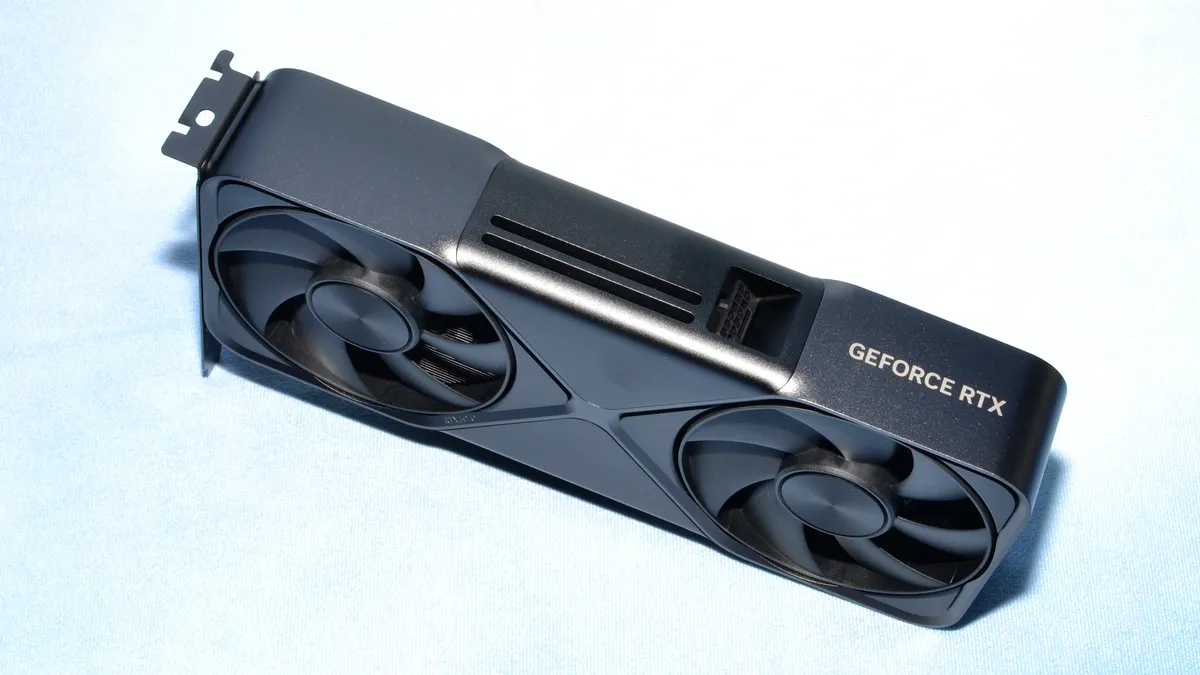
Nvidia's RTX 50-series Founders Edition cards are all dual-slot designs, but that's far easier to manage with a 250W TGP model like the RTX 5070 — the RTX 5090 packing a 575W TGP into a dual-slot chassis is far more impressive. The 5070 has smaller fans but otherwise follows the same design language as its bigger siblings.
There are two fans, measuring just 90 mm (maybe 91mm), compared to the 110 mm fans on the 5080/5090 cards. The card dimensions are also more compact, at 243x109x33 mm. It's still moderately heavy, however, weighing in at 1155g — not a welterweight, then.
Given the smaller dimensions and lower power requirements, the RTX 5070 FE doesn't use the double flow through design that Nvidia touted on the RTX 5090 and 5080 FE models. The back fan (away from the IO) does have a flow through design, while the front fan (near the IO) vents out the IO bracket. Which means the radiator fins opposite the fan near the IO bracket are more for appearances rather than actually being useful. (The RTX 4070 as an example just had a flat cover in the same location.)
There's also no RGB lighting to speak of, unlike the 5090 and 5080. That's also in keeping with Nvidia's tradition on the lower tier Founders Edition cards — the 4070 Super, 4070, and 4060 Ti FE models were all unlit in terms of LEDs. That's not necessarily a bad thing, but if you like the bling, you might want to look elsewhere.
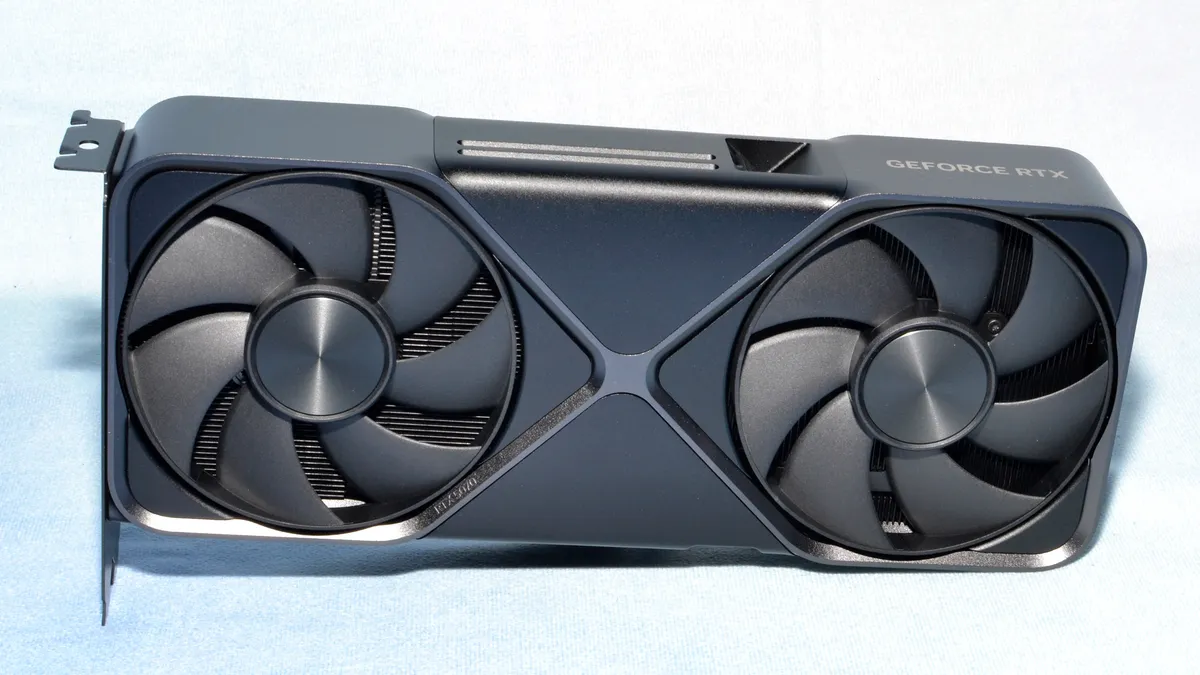




Display outputs follow the standard with three DisplayPort 2.1a and a single HDMI 2.1b. The DP outputs are all full UHBR20 (80 Gbps) capable, though do note that 80 Gbps cables tend to be very short at present — 1.2m or less.
As with every Founders Edition card going back to the RTX 30-series, Nvidia opts to not use native 8-pin power connections. Instead, you get a 16-pin 12V-2x6 connector, angled so that the cable doesn't stick straight up (which looks nicer but can be more difficult to disconnect), with a 16-pin to dual 8-pin adapter. The adapter has a much larger plastic shroud around the 16-pin connector, making it far easier to remove from the card; typical direct 16-pin cables from a PSU are a different story.
Melting connectors shouldn't be a problem for the RTX 5070, considering the 16-pin connector only needs to carry up to 250W of power. The 8-pin to 16-pin adapter features the same flexible individually sleeved cables as the 5080/5090, but with only two 8-pin connections.
In general, its a nice looking minimalist design that should work well even in compact cases. But enough talk; let's get to the benchmarks. We know that's what you're really here to see (and probably just skipped this whole page).
- MORE: Best Graphics Cards
- MORE: GPU Benchmarks and Hierarchy
- MORE: All Graphics Content
