Join for quick access. Enter your email below and we'll send confirmation plus sign you up to our newsletter.
By submitting your information, you confirm you are aged 16 or over,
have read our
Privacy Policy
and agree to the
Terms & Conditions. Geographical rules apply.
Stay On the Cutting Edge: Get the Tom's Hardware Newsletter
Get Tom's Hardware's best news and in-depth reviews, straight to your inbox.
You are now subscribed
Your newsletter sign-up was successful
Join the club
Get full access to premium articles, exclusive features and a growing list of member rewards.
An account already exists for this email address, please log in.
FCC issues first bans under new chip-level rule — dashcam and video transmitter carried Huawei AI silicon with face tracking
The FCC recently imposed a new rule allowing it to ban devices based on the internal chips instead of basing bans on individual products or brands, thus closing the loophole of rebranded products with parts from Chinese manufacturers on US export restriction lists. Using this new rule, the FCC has banned two devices from being sold and marketed in the US for the first time: a dashboard camera and a wireless video transmitter. As reported by The Verge, these devices were banned due to the HiSilicon Smart Vision SoC (System on a Chip) they contain, which features built-in detection algorithms for faces. HiSilicon is a subsidiary of Huawei, and the firm and its subsidiaries are on the FCC’s Covered List of entities that pose a risk to US national security.
The Hi3516CV610 UHD Smart Vision is an SoC for surveillance and camera products. The SoC is meant to be used for things like vehicle dashcams and wireless CCTV systems; fully equipped with WiFi, Ethernet, video encoding chips, an Arm Cortex-A7, and an NPU (Neural Processing Unit) for AI features. The NPU is what the FCC is concerned about, explaining that it is a device that contains logic-bearing “smart” components produced by entities on the Covered List.
(Image credit: HiSilicon)
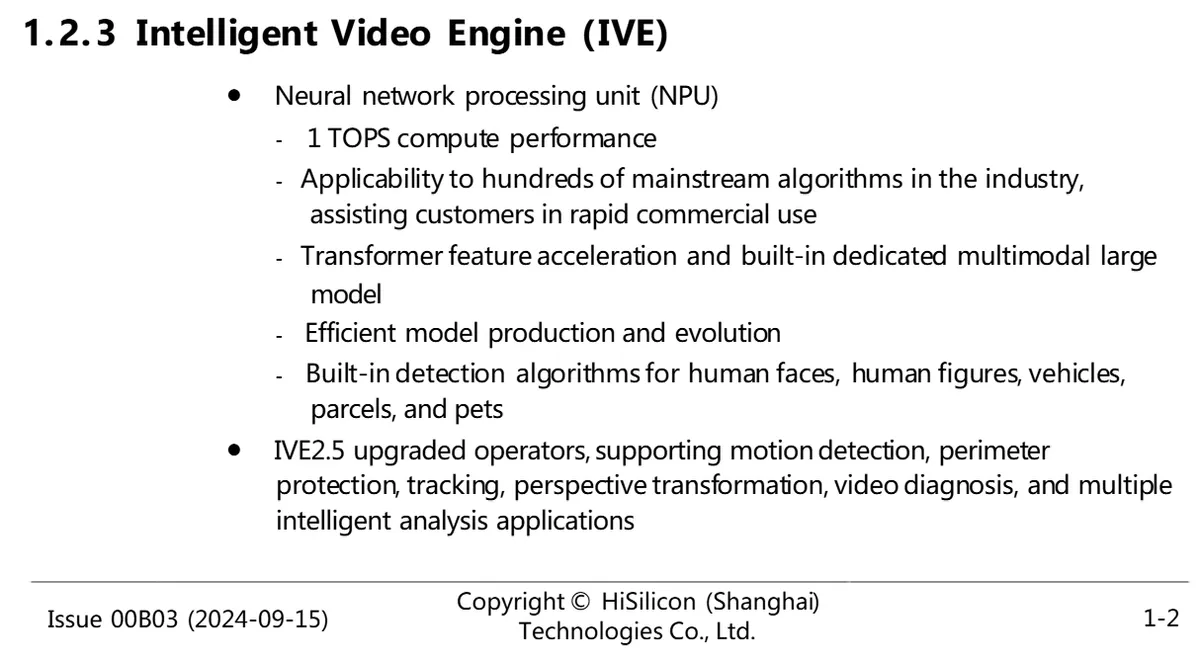
On the SoC’s data sheet, the Intelligent Video Engine (IVE) uses the NPU that runs a built-in dedicated multimodal large model and transformer feature acceleration. The transformer feature acceleration allows the AI model to understand the relationship between objects from one video frame to another, keeping “attention” between related objects: pets, faces, human figures, and parcels, as the data sheet advertises. For consumers, this potentially means the AI in a surveillance camera can understand whether it is your pet that is escaping, or an unknown person is stealing your parcel after understanding that it was placed by a courier worker.
However, the FCC believes the logic-bearing AI in the SoC can do something much more nefarious, surveying US citizens and logging faces for foreign surveillance. Huawei already had a previous AI chip scandal, using shell companies to deceive TSMC into producing AI chips for them, going against the US’ request for TSMC to halt supplies to a list of Chinese customers; among other Huawei scandals leading to other product bans in the US.
Jhet Borja is a serial hobbyist who was taking apart toys from childhood and sketching inventions. He now loves doing DIY projects ranging from designing custom 3D-printed parts, building PCs and keyboards, all the way to woodworking. If he's not getting his hands dirty, he's probably brainstorming his next project.
Yeah, logging people faces is strictly reserved for American surveillance! Get off my cloud.
When your government officials are just as bad as the bad guys they would have you believe are stealing your lunch, what are you to conclude but that this is more to do with tariffs by another name and controlling money for the mob boss than about safety of any sort for ordinary people.
Isn't the FCC's power limited to banning only products that include some form of wireless transmission? If so, then strictly wired security cameras (which is most of them) could be exempt from their regulation.
Isn't the FCC's power limited to banning only products that include some form of wireless transmission? If so, then strictly wired security cameras (which is most of them) could be exempt from their regulation.
Nope. The Communications Acts of 1934 tasks the FCC with protecting wireline (wired) and wireless interstate and international communications.
It should have always been a silicon-level ban, not brand names and models that can have numerous variations like revisions, adaptations for different geographic and regulatory markets, etc. Not to say that a specific brand, model, and SKU can't be pegged.
Nope. The Communications Acts of 1934 tasks the FCC with protecting wireline (wired) and wireless interstate and international communications.
Exactly! Their jurisdiction is communications.
DS426 said:
Nope. The Communications Acts of 1934 tasks the FCC with protecting wireline (wired) and wireless interstate and international communications.
Exactly! Their jurisdiction is communications. They police the signal across public lines of transmission, not the end user devices generating or receiving said signal. AT MOST, they have the authority to order ISPs to blacklist the device but they have no legal grounds to ban it outright. That's FTC jurisdiction.