The Graphics Cards Articles
- Battle of the Titans 2: Creative Labs's Annihilator 2 vs. Absolute...
- The Fastest GeForce2 GTS Card - Gainward's CARDEXpert GeForce2 GTS/400
- 3D Benchmarking - Understanding Frame Rate Scores
- Full Review of NVIDIA's GeForce2 MX
- Blue Wonder? The Guillemot/Hercules 3D Prophet II GTS
- Asus AGP-V7700 Pure Review
- Professional Affair: OpenGL Graphics Cards Compete
- NVIDIA GeForce2 GTS Battle Royal
- Tom's Take On NVIDIA's New GeForce2 GTS
- ATi Radeon256 Preview
News
Reviews
Forum
- Why are there 5 different kinds of AMD CPUs?????
- AMD pushes out three more triple-core chips!!
- Phenom as good or better than Intel in gaming?
- Build Now or Wait for Nehalem?
- Deneb in December
- 6000+ & 4870 cooling
- Should I air or water cool my gaming rig?-Please help!
- Good and cheap motherboard for overclocking my E6420
- AMAZING 3DMARK06 SCORE ! WITH DUAL CORE 4.4ghz AND 4870X2
- Overclocking Questions!! E8500
The Pixel Tapestry Architecture, Continued
Table of Contents:
The Pixel Tapestry Architecture, Continued
Still I'd like to show you this little table made by ATi:
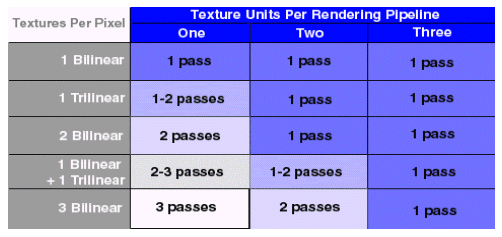
ATi, our new memory bandwidth economist, is also making the point that in case of three textures per pixel Radeon doesn't require as many texture memory accesses as GeForce2 GTS, because it can load all three texels, perform the rendering and then store the pixel, while an architecture with only two texture units per pipeline has to write the pixel to memory twice.
All in all it is important to note that Radeon is just as able to do per-pixel rendering as GeForce2 GTS.

Here are a few sample pics that show how 3 or more applied textures can make a 3D scene look quite awesome:


- Previous page C - The Pixel Tapestry Architecture
- Next page 3D - Textures

