Hardware T&L, Continued
This is an analogy though! In 'reality' the scene has still got no solid surfaces at all after it has been created by the T&L unit. I say that because some objects in this room could be see-through, other objects are hidden by things in front of them.
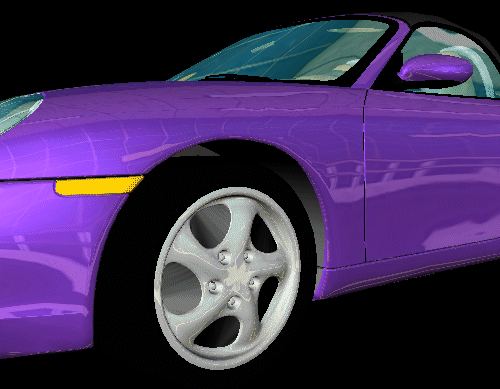
That's what the Boxster looks like once the whole rendering process is finished. You can see that the windows are see-through, so that you can spot the seats inside the car.
What is good about an integrated T&L unit? Well, if those complex T&L calculations don't have to be done by the platform (CPU, chipset, memory), but by a dedicated unit on the graphics chip that handles those kind of calculations much easier, a scene can be made out of a lot more 'vertices'.

For the human brain 'vertices', the 'corners' of an object', are rather difficult to understand, which is why we usually draw lines from each vertex to the ones next to it, creating the so called 'wire frame model'. A 'polygon' is a shape that lies in between the 'vertices', limited by the lines that run from the vertices that surround it. In most cases, the 'polygons' of a 3D model are triangles; only in some rare occasions a polygon has more than three 'corners' (vertices around it).
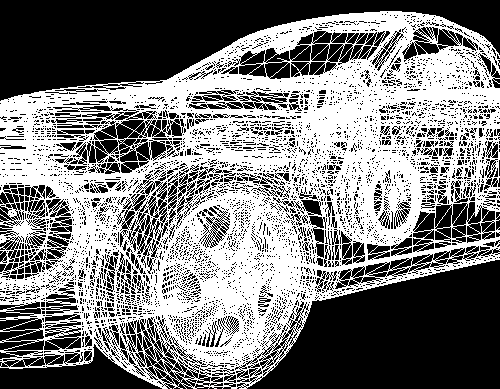
This is the Boxster as 'wireframe model'. You can easily spot all the polygons / triangles.
A scene is the more detailed the more vertices and thus polygons it is made of. To make 3D as realistic as possible, we have to allow as many vertices/polygons as possible. A T&L-unit helps to achieve that. It gets us one step closer to the famous 'photo realism'.
Radeon's T&L-unit is supposed to be able to transform and light 30 million polygons per second, which is higher than the 25 million polygons/s claimed by NVIDIA for their GeForce2 GTS chip. It is very hard to verify those numbers, so we might as well just accept it. However, in each of NVIDIA's own benchmark programs Radeon performs worse than GeForce2 GTS. This doesn't have to say much, because those benchmarks are probably optimized for NVIDIA chips, but at least it doesn't seem to be too obvious that Radeon's T&L-unit is more powerful than the one of GeForce2 GTS.