Shop for Computers
4GB Extreme III SDHC Memory Card 4GB Extreme III SDHC Memory Card

Compare the top 5 lowest prices by hovering your mouse over the product names on the left

$49.99
4GB Memory Stick Pro Duo 4GB Memory Stick Pro Duo $59.99
8GB Memory Stick PRO Duo 8GB Memory Stick PRO Duo $119.99
2GB microSD Card 2GB microSD Card $7.95
8GB Cruzer Micro USB U3 Flash Drive 8GB Cruzer Micro USB U3 Flash Drive $49.99

See More Products...

Kingston ValueRAM PC3-10600

Kingston is probably the most mainstream brand of this shootout, offering a complete module range from mundane to spectacular. In fact the company provided us with two similar-speed kits, its ValueRAM PC3-10600 being the "standard performance" parts.

The modules look rather mundane, but Kingston blesses its part number KVR1333D3N8/1G with performance-oriented 8-8-8-24 rated timings at a motherboard's stock 1.50 volts. Two of these 1 GB modules are needed to make a dual-channel "kit," thus the company provided two packages for this comparison.
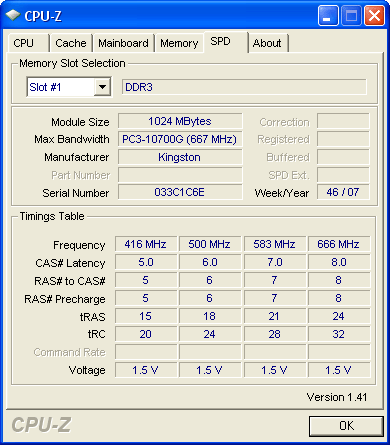
SPD values for 667, 583, 500 and 416 MHz allow automatic configuration to DDR3-1333, DDR3-1066, DDR3-1000 and DDR3-800 settings, with a little overclocking headroom for the odd-appearing 416 and 583 MHz clock rates.

Because these modules provide an SPD value exactly the same as the rated settings, a builder won't need to manually configure BIOS to reach rated performance levels.


Talkback

dv8silencer 05/07/2008 2:45 AM
Hide
-0+
dv8silencer
I have a question: on your page 3 where you discuss the memory myth you do some calculations:


"Because cycle time is the inverse of clock speed (1/2 of DDR data rates), the DDR-333 reference clock cycled every six nanoseconds, DDR2-667 every three nanoseconds and DDR3-1333 every 1.5 nanoseconds. Latency is measured in clock cycles, and two 6ns cycles occur in the same time as four 3ns cycles or eight 1.5ns cycles. If you still have your doubts, do the math!"

Based off of the cycle-based latencies of the DDR-333 (CAS 2), DDR2-667 (CAS 4), and DDR3-1333 (CAS8), and their frequences, you come to the conclusion that each of the memory types will retrieve memory in the same amount of time. The higher CAS's are offset by the frequences of the higher technologies so that even though the DDR2 and DDR3 take more cycles, they also go through more cycles per unit time than DDR. How is it then, that DDR2 and DDR3 technologies are "better" and provide more bandwidth if they provide data in the same amount of time? I do not know much about the technical details of how RAM works, and I have always had this question in mind.
Thanks
Deleted profile 06/27/2008 2:08 AM
Hide
-0+
Latency = How fast you can get to the "goodies"
Bandwidth = Rate at which you can get the "goodies"
Deleted profile 06/27/2008 11:23 AM
Hide
-0+
So, I have OCZ memory I can run stable at
7-7-6-24-2t at 1333Mhz or
9-9-9-24-2t at 1600Mhz
This is FSB at 1600Mhz unlinked. Is there a method to calculate the best setting without running hours of benchmarks?

Note You are going to post a comment as anonymous.