Introduction
A Breakthrough: The P4 Platform In The Mass Market
The tables have turned. For some time now, Intel has held back from the low-cost segment, leaving this part of the market to its arch-enemy AMD. In the meantime, a trend has been emerging: the motherboard manufacturers are beginning to rely heavily on the chipsets from the market leader, who has recently lost out a bit on the proverbial pie. This can be attributed to the fact that high performance chipsets for Socket 478 with DDR support are finally available. A few mistakes were made in the past: Intel's flagship product, Pentium 4, was only available in combination with expensive RDRAM (Intel 850 chipset). As a result, this solution wasn't very popular with most of the motherboard makers, so that the end user was only left with a few pricey boards from the market leaders (Asus, Gigabyte and MSI). In addition, production costs for boards with the RDRAM interface were very high, because only the six-layer technique could be used. The next mistake came from Intel's marketing strategists: the 845 chipset with SDRAM support was introduced to the low-price market. The consequence of which was that the mass market showed little interest in these systems, since PCs built on the Athlon platform were to be had for the same price and offered much higher performance. Now, the picture has changed completely: Intel has done its homework, and the signs are looking good.
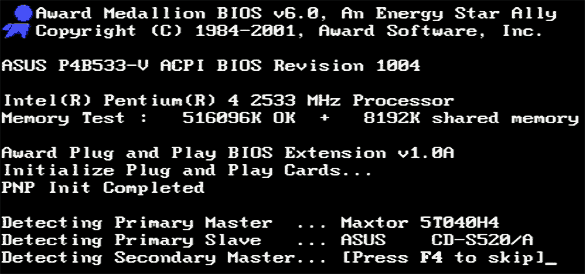
Test basis for all boards: Pentium 4/2533 and 512 MB DDR333 memory (CL2).
In a few preliminary tests , we were able to determine that the Intel 845G chipset offered the best DDR performance for the P4. The reason for this is that the Intel 845G is equipped with the most powerful memory interface, which unofficially (or from our point of view, officially) enables support for DDR333 (CL2). Whether it's official or not, faster DDR333 memory with CL2 has become widely available, and DDR400 is just about ready to take off. So it's not surprising that all participants in this test already offer DDR333.
