A keen-eyed Reddit user caught a brainwave while browsing for high-capacity SSDs and was struck with the following thought: with the AI-infused silicon shortages, we've reached the point where NVMe gumstick-style SSDs are more expensive than gold by weight. The thread generated discussion aplenty, so we figured we'd dig into this and look up pricing and weight across a range of models. Spoiler alert: It's very much true for 8 TB drives and quickly heading there for 4 TB models.
We compiled multiple searches from Newegg, Microcenter, Best Buy, and Walmart, collecting over a hundred sample points. The requirements were: NVMe SSDs on a PCIe 4.0 or 5.0 interface, with four terabytes of capacity, sold by the store itself, and in stock. The selection excluded enterprise drives, as those would quickly throw off the math, plus everyone knows they are priced like antimatter anyway.
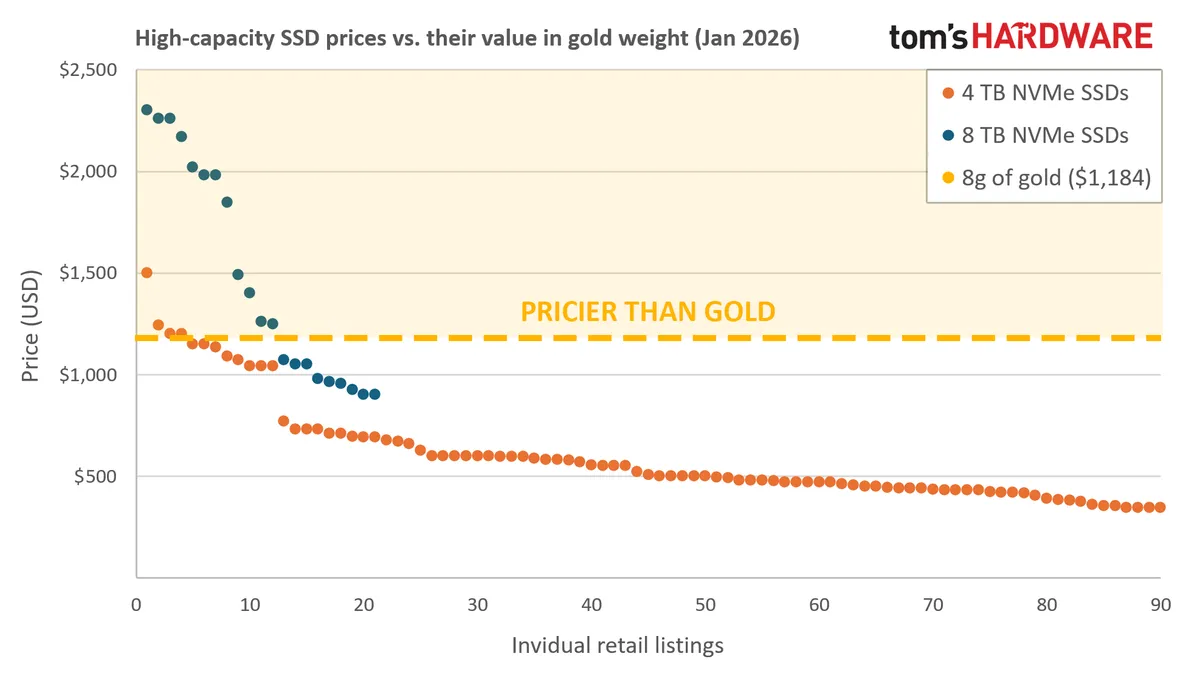
Gold is currently sitting at a shiny $148 per gram, so even picking the lower boundary of SSD weight at 8 grams, that makes your average SSD worth around $1,148. And guess what? The average price for an 8 TB consumer drive is around $1,476, and far higher than that if you want a performance unit instead of just a mass-storage model. So yes, at 8 TB, solid-state drives are indeed pricier than gold. But the story doesn't stop there.
Even 4 TB drives aren't immune to high pricing, with a portion of models now also hitting prices close to the equivalent in gold grams. Interestingly, there's definitely a strong divide between higher-priced units. Bar some exceptions, the majority of the sub-$800 space is made of mass-storage models, indicating that if you want both performance and capacity, be ready to loosen the purse strings.
There's also a divide by manufacturer, too. The upper echelons of the price ranks are filled almost exclusively by Western Digital (Sandisk) models, with relatively few offerings from competitors.
It's hard to read the tea leaves here. A cursory observation would state that WD is pricing itself out of the market, but it may be that WD drives are in high demand, and new stock is coming in at much higher prices. Anyone who's been shopping for SSDs recently certainly has noticed a rising trend overall, and PCPartPicker's price tracker illustrates this.
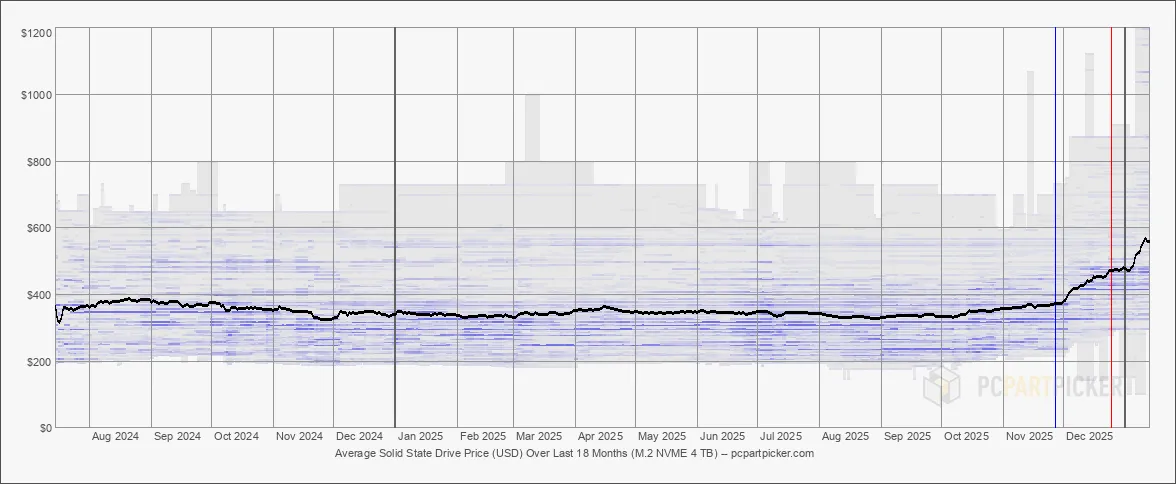
The graph above for 4 TB drives illustrates the trend very clearly, with an exceedingly sharp rise in the past two months. Also note the much wider distribution in prices (the gray area), potentially illustrating the wave of old-price stock going away.
For now, it's still easy to obtain speedy 4 TB drives around the $600-$800 mark, like the Corsair MP700 Elite or Samsung 9100 Pro. However, our guess is that those offerings are all but guaranteed to dry up really quickly, so if you're on the fence for buying one of them, it's best to pull the trigger right away on one of the best SSDs. And even mass-storage units around $500 like won't last long, either.

Follow Tom's Hardware on Google News, or add us as a preferred source, to get our latest news, analysis, & reviews in your feeds.