In a blind test, audiophiles couldn't tell the difference between audio signals sent through copper wire, a banana, or wet mud — 'The mud should sound perfectly awful, but it doesn't,' notes the experiment creator
Who knew listening to a banana sounded so good?
Get Tom's Hardware's best news and in-depth reviews, straight to your inbox.
You are now subscribed
Your newsletter sign-up was successful
A moderator on diyAudio set up an experiment to determine whether listeners could differentiate between audio run through pro audio copper wire, a banana, and wet mud. Spoiler alert: the results indicated that users were unable to accurately distinguish between these different 'interfaces.'
Pano, the moderator who built the experiment, invited other members on the forum to listen to various sound clips with four different versions: one taken from the original CD file, with the three others recorded through 180cm of pro audio copper wire, via 20cm of wet mud, through 120cm of old microphone cable soldered to US pennies, and via a 13cm banana, and 120cm of the same setup as earlier.
Initial test results showed that it’s extremely difficult for listeners to correctly pick out which audio track used which wiring setup. “The amazing thing is how much alike these files sound. The mud should sound perfectly awful, but it doesn't," Pano said. "All of the re-recordings should be obvious, but they aren't."
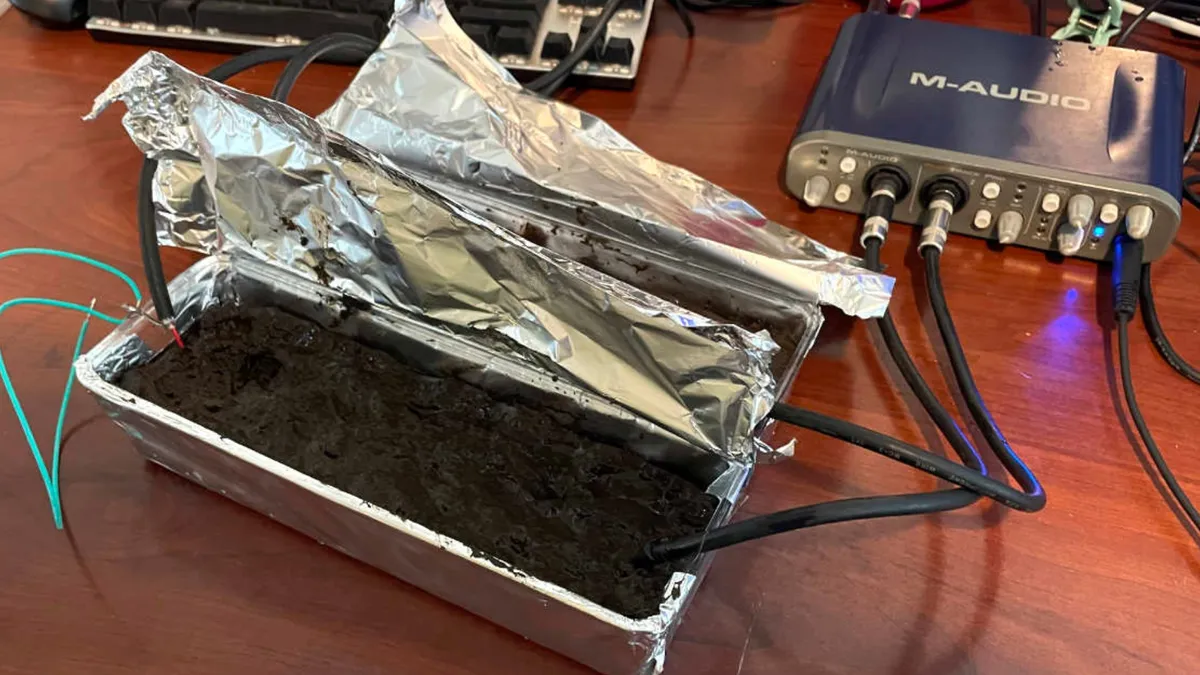
This is quite surprising, especially as we often don’t think of bananas, or even wet mud, as great conductors. However, the tester surmised that introducing the materials into the circuit is just like adding a resistor in series, and they’re unlikely to distort the audio too much, except by lowering the signal level.
After waiting a month for testers to submit their results, the following results were tabulated:
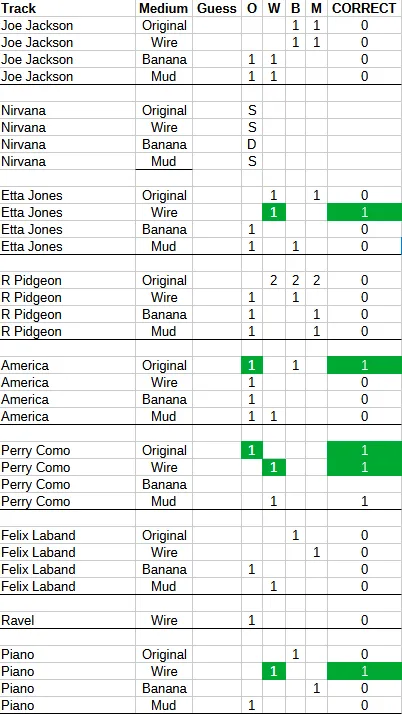
As we can see in the image above, there are only six correct answers out of 43 guesses. We put these numbers in a spreadsheet, which showed that only 13.95% of the answers were correct. Furthermore, we used the binomial distribution formula and determined there’s a 6.12% chance that we’d get the same or fewer correct answers if the listeners were randomly guessing — slightly above the 5% significance threshold many statisticians use, meaning the results are consistent with randomness. This goes in line with Pano's conclusion that "listeners can't reliably pick out the original from the looped versions," suggesting that they cannot detect any changes introduced by the loop — whether it's pro-grade copper wire or wet mud from somebody's backyard.
Pano came up with this idea after they watched a documentary, Amigo, where the U.S. Army was setting up a singular telegraph wire in the Philippines. They thought that it wouldn’t work as “you need two wires to complete the circuit.” However, it turns out that the telegraph system used the earth as a return, even through long distances. This got them thinking that if you could send telegraphy signals across the ground, what would an audio signal using the same medium sound like? They then tried various materials like mud and banana, which, although they’re pretty poor conductors, still seemed to introduce imperceptible changes to the signal, at least for the average person.

Get Tom's Hardware's best news and in-depth reviews, straight to your inbox.
Follow Tom's Hardware on Google News, or add us as a preferred source, to get our latest news, analysis, & reviews in your feeds.

Jowi Morales is a tech enthusiast with years of experience working in the industry. He’s been writing with several tech publications since 2021, where he’s been interested in tech hardware and consumer electronics.
-
voyteck 1) Room acoustics.Reply
2) Speaker and listener placement within the particular room (requires measurements).
3) Amp power sufficient to avoid clipping.
4) Loudspeakers within the particular room.
5) Getting accustomed to the sound.
Aside from some extreme cases, like serious impedance mismatch or poor engineering, everything else is just cosmetic treatment, pure voodoo, or simply the result of subtle differences in loudness. -
LordVile Audiophiles are such a weird crowd. They argue they can tell the difference between different sources despite both being beyond human perception but then buy tube amps that are just flat out bad at their job vs solid state.Reply -
USAFRet Reply
Monster has made millions off that cluelessness.LordVile said:Audiophiles are such a weird crowd. They argue they can tell the difference between different sources despite both being beyond human perception but then buy tube amps that are just flat out bad at their job vs solid state.
PC people are often no better.
Cat 8 cable must be faster than old school CAt5, right?
And extreme FPS is even worse. -
LordVile Reply
Most things end up into the land of finishing returns. Cameras, displays, audio, cars, all the sameUSAFRet said:Monster has made millions off that cluelessness.
PC people are often no better.
Cat 8 cable must be faster than old school CAt5, right?
And extreme FPS is even worse. -
USAFRet Reply
We already have people dancing with joy for the release of PCIe 6.0 SSDs, because their games will load and run faster.LordVile said:Most things end up into the land of finishing returns. Cameras, displays, audio, cars, all the same
(eyeroll) -
ingtar33 Reply
My father is an audiophile. He's in his 80s now, and he's insisted as long as he's lived the human ear cannot tell the difference between most audio equipment on the shelves today. he firmly believed if you went to a hobby store, and bought a kit speaker for $100-$150 then made it yourself, get a kit that uses real wood for the housing and with just basic copper wire to connect it to a $100 amplifier, you'd get basically identical sound to any high end audio system on the market.LordVile said:Audiophiles are such a weird crowd. They argue they can tell the difference between different sources despite both being beyond human perception but then buy tube amps that are just flat out bad at their job vs solid state.
he is a physicist so he had a lot of math and proof for it. but i grew up around good sound, and i gotta say his speakers are still the best i've heard; using them now on my system and they're far superior to any store bought speaker system i've heard in a decade now. -
Shiznizzle Reply
What do you mean? You cant tell the difference between 360 hz and 480 hz? Are you blind?USAFRet said:Monster has made millions off that cluelessness.
PC people are often no better.
Cat 8 cable must be faster than old school CAt5, right?
And extreme FPS is even worse.
Don't go there. I am not serious at all and taking the mickey, seriously.
I would like to see people telling me which one of the two screens is 480 hz. I bet they cant and if they do then i want to see 100 people doing that test since i suspect luck made the right choice and picked the right screen. -
LordVile Reply
I’m waiting for PCIe 7.0 myselfUSAFRet said:We already have people dancing with joy for the release of PCIe 6.0 SSDs, because their games will load and run faster.
(eyeroll) -
John Kiser Reply
I mean a cat8 cable is literslly up to 40 gigabit per second so yes it is better. Cat 5e is better than cat 5 since cat 5 has a limitation of 100 megabits per second so can't handle most modern speeds well. For most intents and purposes cat 6 is all most people would need or 6e with a bigger distance. Cat 8 is great if 30 meters or less atm, but home users only need 6e, 7 or 7e at most 5 is horrid 5e is the lowest people should use... so bad exampleUSAFRet said:Monster has made millions off that cluelessness.
PC people are often no better.
Cat 8 cable must be faster than old school CAt5, right?
And extreme FPS is even worse.