- Hot Contraband: P4 With 3.6 GHz
- Battling Brothers: Celeron vs. Pentium 4
- Speed Isn't Everything: P4/2800 Meets Athlon XP 2600+
- At The Last Second: AMD's Trump Card - The Athlon XP 2600+
- Accelerating Celeron: Available At 1.8 GHz Now
- A New Kind Of Fast: AMD Athlon XP 2200+
- VIA's C3 Hits 1 GHz
- Good Old Newbie: Intel's Celeron 1.7 GHz for Socket 478
- The Die Has Been Cast: Pentium 4/2533 vs. Athlon XP 2100+
- AMD's Opteron Comes Down Hard
- THGC Needs You -Team 40051
- 3lfk1ng's Project : Dream 98% Complete
- My New Build Please Rate It
- Which case should I get? antec 900, CM 690 or CM Centurion 5?
- Antec P180 - Cable Management 101
- Looking to replicate $500 Gaming PC, Need Help Overclocking
- Peculiar vcore mismatch with E7200 + Shuttle FX38
- My first overclock, how did I do?
- Water Cooling a CM Stacker 832
- Help me make sure everything is running fine please!
Source: Tom's Hardware US – Keywords: a, cool, bunch
Topics: Business, Buyer's Guides
Syndication:
Italian Moments: Neolec Venezia TB
Aluminum coolers usually consist of a solid aluminum base plate with cooling fins protruding from it.

Not so with the Venezia. One look at its profile and you'll see an area with symmetrically aligned cavities above the base plate. This is followed by a three-millimeter-thick layer of solid aluminum. It ends in a curve above which the cooling ribs start. This profile, quite similar to that of a Venetian bridge, is designed to rapidly dissipate heat pent up in the area of the cavities.

Neolec has come up with the meaningful name 'heat transmission channel' (HTC) for this profile.

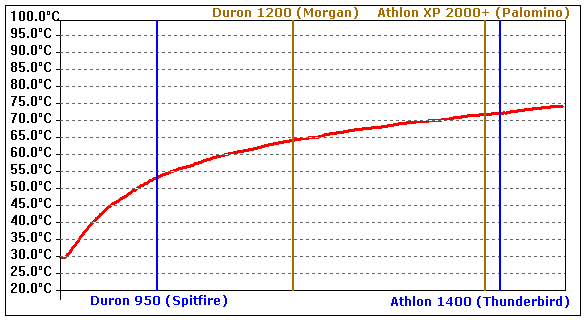
Practical experience reveals, however, that the HTC's impact on the cooling capacity is everything but dramatic. How could it? Air is simply no better or faster at dissipating heat than aluminum. And it would be foolhardy, considering the laws of physics, to hope for convection currents in the channels. But this cooler is still a good, and, at 54 dB(A), a relatively quiet, candidate.
- Previous page Fan Tower: Global Win TAK68
- Next page The Thrill Is Gone: Neolec Vento