Overclocking V - Dual-Core E6750 At 3.60 GHz
To achieve an overclock of 934 MHz, we had to increase the core voltage by an amount that becomes dangerous for the CPU. In the BIOS, we had to set a voltage tweak of 0.11250 Volts, for a core voltage of 1.46250 V to ensure stable operation across the entire benchmark suite.
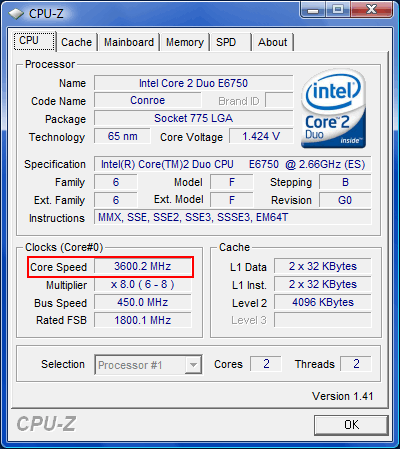
Overclocked by 35.3% and still stable!
At the high FSB speed of 450 MHz, we can set the memory to run at DDR2-900 once more with the help of the 2.00x memory multiplier. At this point, our sample of the E6750 has reached its maximum potential.

If you purchase an E6750 that operates at a lower default core voltage than our sample's 1.3500 Volts, you will in all likelihood be able to reach the same clock speed increase of 35.3% using a lower voltage.
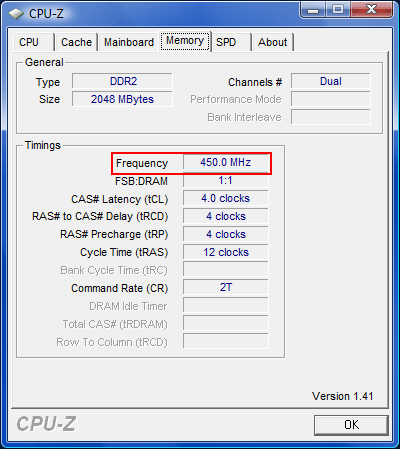
At these settings, the RAM is running at DDR2-900 again.
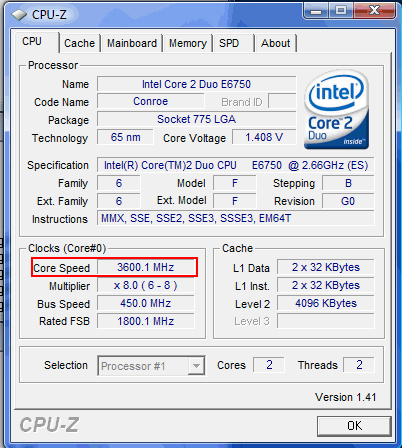
Prime95 is stable at 3.6 GHz
| Core 2 Duo E6750 @3.60 GHz | |
|---|---|
| CPU Frequency | 3.60 GHz (+35.3%) |
| FSB | 450 MHz (1800QDR) |
| Core Voltage | 1.46250 Volt |
| Memory Multiplier | 2.00x |
| Memory Frequency | DDR2-900 (450 MHz) |
| Memory Latency | CL 4.0-4-4-12 |

Our Core 2 Duo E6750 boots at 3.60 GHz
Core 2 Duo E 6750 At 3.70 GHz
We were even able to overclock our E6750 by 1.04 GHz up to 3.7 GHz. At this speed, the FSB runs at 463 MHz (1852 QDR). Although we raised the core voltage to 1.4750, which represents an increase of 0.1349 Volts, we were unable to get the processor to complete our Prime95 stress test successfully.
At this point, we decided to discontinue our overclocking tests, since the risk of damaging our CPU simply became too great for our liking.
We can't really recommend running a 65-nm processor at a voltage this high anyway, since we can't rule out the possibility that the core could be damaged beyond repair over the course of time due to electron migration. Simply put, you run the risk that the conducting paths inside the CPU could literally be ablated and thus destroyed by ion migration. The result is that one day, the computer suddenly shuts down and will never start up again with that CPU. We only ran our CPU at these speeds for a short while to determine its performance at these settings. On the other hand, some models may very well run at such high speeds without even needing the slightest core voltage tweak.