Overclocking I - Quad-Core Q6600 At 3.00 GHz
As mentioned above, our Intel Core 2 Quad Q6600 also uses the G0 stepping. Its stock clock speed is 2.4 GHz, which requires a comparatively low core voltage of 1.3125 Volts (the lowest core voltage available for this device). With any luck, this low-voltage value will be conducive to overclocking.

The Q6600 also uses a locked multiplier.
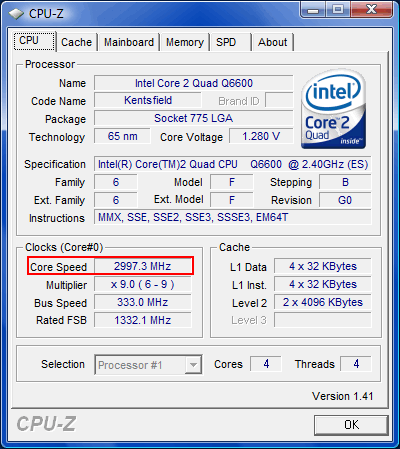
The Q6600 running at 3.00 GHz

We were unable to reach 3.00 GHz with our sample, at stock voltage. Thus, we were forced to increase it by 0.005 V to stabilize the processor at this frequency.
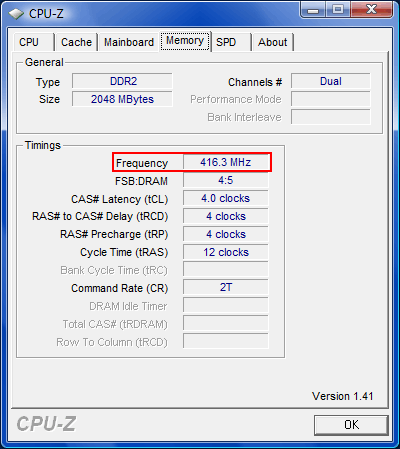
The memory runs at DDR2-833 with these settings
It may seem like a negligible bump, but in the end, that's what it took for our sample.
Running on a front-side bus of 333 MHz (1333QDR), the memory can run at a speed of DDR2-825 using the 2.50x memory multiplier.
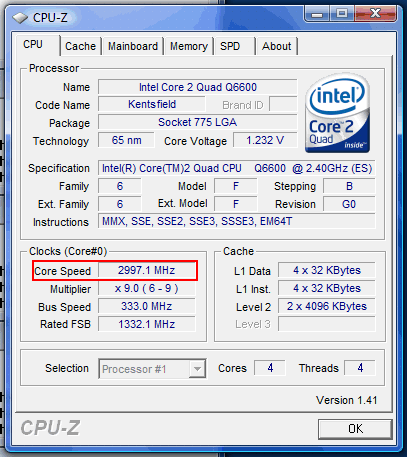
No errors in Prime95
| Core 2 Quad Q6600 @3.00 GHz | |
|---|---|
| CPU Frequency | 3.00 GHz (+25%) |
| FSB | 333 MHz (1333 QDR) |
| Core Voltage | 1,3125 Volt |
| Memory Multiplier | 2.50x |
| Memory Frequency | DDR2-833 (417 MHz) |
| Memory Latency | CL 4.0-4-4-12 |