Stay On the Cutting Edge: Get the Tom's Hardware Newsletter
Get Tom's Hardware's best news and in-depth reviews, straight to your inbox.
You are now subscribed
Your newsletter sign-up was successful
Join the club
Get full access to premium articles, exclusive features and a growing list of member rewards.
An account already exists for this email address, please log in.
Qualcomm aims Snapdragon C laptop chip at the budget laptop segment, as manufacturers feel the DRAM squeeze — analysts warn sub $500 laptop market may disappear before 2028
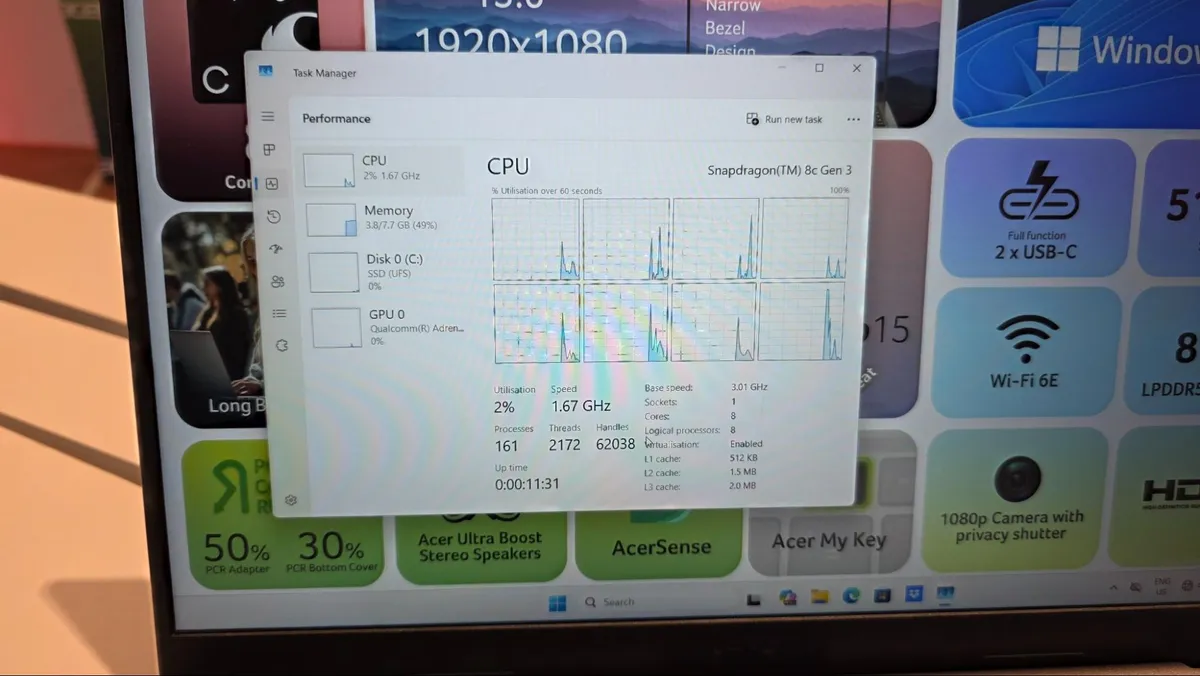
Qualcomm announced the Snapdragon C Platform on May 28th, ahead of Computex 2026 in Taipei, an entry-level Arm processor built to anchor Windows 11 laptops priced from $300. The chip abandons the Oryon CPU cores that define the Snapdragon X family in favor of an older Kryo design pulled from Qualcomm's smartphone parts, runs in machines carrying as little as 8GB of memory, and skips Microsoft's Copilot+ certification. We went hands-on with Snapdragon C at Computex 2026 today.
Meanwhile, analysts from TrendForce, Gartner, and IDC are all warning that a surge in memory prices is making the sub-$500 laptop market financially unviable, which could lead to its disappearance in its entirety.
Kryo cores, not Oryon
The "C" stands for Compute, and the new platform sits beneath every Snapdragon X and X2 part Qualcomm sells. Where those chips use the Nuvia-derived Oryon cores Qualcomm acquired in 2021, Snapdragon C reuses Kryo cores from its phone lineup, the architecture Qualcomm built laptop silicon on before the Oryon transition. Mandar Deshpande, senior director of product management at Qualcomm, told reporters at a pre-launch briefing that the platform "is not built to scale up to the Copilot+ requirements," meaning it clears neither Microsoft's 40 TOPS neural-engine floor nor the 16GB memory minimum tied to the Copilot+ PC program.
Qualcomm has disclosed little else; core counts, clock speeds, neural-engine throughput, the manufacturing node, and the supported memory type were all absent from the announcement, with the company saying it would detail them during its Computex keynote this week. Reported leaks point to a 6nm-class part with eight cores, though none of that is confirmed.
The first machine is Acer's Aspire Go 15. Acer's specification sheet lists a 15.6-inch 1920 x 1080 display, up to 8GB of memory, up to 512GB of storage, a 53Wh battery, and Windows 11 with a Copilot key but no Copilot+ branding. Acer hasn’t given the laptop a price or a release date, and HP and Lenovo, both named as launch partners, have yet to unveil their own machines.
Memory prices dictate retail prices
Snapdragon C enters a market where memory has arguably become the deciding factor in what a laptop ultimately retails for. TrendForce projects that conventional DRAM contract prices rose 90% to 95% in the first quarter of 2026 and will climb a further 58% to 63% in the second, with mobile DRAM — the LPDDR type Snapdragon C depends on — rising as much as 93% to 98% quarter over quarter.
Meanwhile, Gartner expects combined DRAM and SSD pricing to increase 130% by the end of 2026, lifting average PC prices 17% and pushing memory from 16% to 23% of a typical laptop's bill of materials. Ranjit Atwal, senior director analyst at Gartner, said in a February forecast that the increases have removed vendors' ability to absorb the cost, and that "the sub-$500 entry-level PC segment will disappear by 2028." IDC reached a similar conclusion, cutting its 2026 global PC shipment forecast to a decline of 11.3% and warning that bargain-priced PCs are, for now, behind us.
The squeeze is already visible further up the Windows line-up. HP told investors that memory now makes up roughly 35% of its PC bill of materials, up from the mid-to-high teens a quarter earlier, and Lenovo told TechRadar there was "no way around" the price increases it would pass to buyers. Microsoft's cheapest Surface Laptop now starts at $1,149, a position that no longer competes for budget buyers at all, and a significant jump from its original $899 launch price.
A new entry-level tier?
(Image credit: Tom's Hardware)
Qualcomm isn’t the first manufacturer to repurpose a binned phone processor; Apple’s $599 MacBook Neo, announced in March, runs the A18 Pro from the iPhone 16 Pro alongside 8GB of unified memory and 256GB of storage in a fanless 13-inch body. That’s the same maneuver Qualcomm is attempting by using Kryo silicon in the Snapdragon C.
Apple claims that the Neo runs up to 50% faster than a comparable Intel Core Ultra 5 laptop and three times faster in on-device AI, but that’s all based on its own internal benchmarks against an unnamed machine. Asus co-CEO S.Y. Hsu, on the company's first-quarter earnings call, called Apple's pricing "a shock to the entire industry."
On the Windows side, Intel launched Wildcat Lake as its Core Series 3 family in April, built on the 18A node with a roughly 17 TOPS neural engine and more than 70 laptop designs in the pipeline. Its Project Firefly reference platform targets sub-$600 x86 machines, and Chinese vendor CHUWI has already shown a Wildcat Lake laptop, the “UniBook,” at $449.
AMD's budget option remains the aging Ryzen 7020 "Mendocino" series, a 6nm part pairing Zen 2 cores with RDNA 2 graphics and no neural engine, with no direct successor yet below $500.
At this level, Qualcomm’s most immediate competition may well be its own back catalog. The Snapdragon X-powered Asus Vivobook 14, with 16GB of memory and 512GB of storage, has sold for $379.99 at Best Buy, undercutting the price Snapdragon C is chasing while offering twice the memory and faster Oryon cores.
$300 and up figure is guidance
The $300 figure is guidance Qualcomm shares with manufacturers, not a price it sets, and Acer's refusal to confirm a number for the Aspire Go 15 is arguably an immediate tell that it’s not going to retail anywhere near that price.
With LPDDR5 contract pricing reported above $10 per gigabyte, the memory alone in an 8GB configuration now costs roughly what a whole budget laptop's components once did, and OEMs are passing those costs through. A first wave landing between $349 and $449 in the U.S. is a more realistic price point.
Dropping Copilot+ is, of course, a concession that has made this price possible; buyers lose Recall, Cocreator, and the richer Windows Studio Effects modes, and because Copilot+ has yet to drive measurable Windows upgrade demand, Qualcomm and its partners appear willing to trade the badge for a lower bill of materials.
Whether the platform holds its line depends on the specifications Qualcomm has so far withheld, potentially coming imminently at Computex, and on whether HP and Lenovo ship Snapdragon C machines this year or wait for memory prices to ease.
Luke James is a freelance writer and journalist. Although his background is in legal, he has a personal interest in all things tech, especially hardware and microelectronics, and anything regulatory.