









Iran's forced nationwide internet blackout becomes second-longest on record as it passes 1,000 hours offline — possessing Starlink terminals punishable by death, country using 'military-grade jamming' against service
Connectivity has held at roughly 1% of normal levels since February 28.
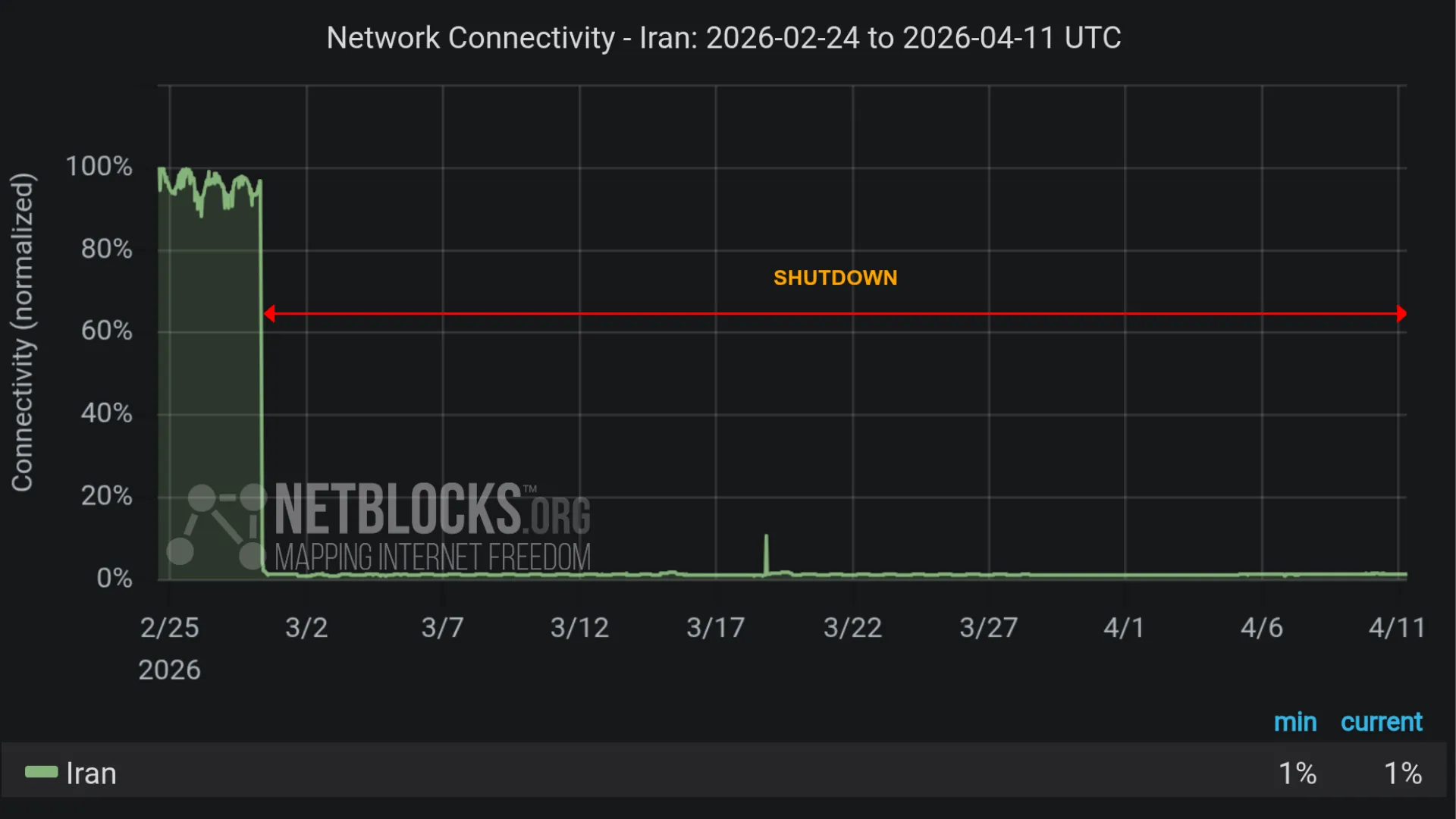
Iran's nationwide Internet blackout has crossed the 1,000-hour mark and is now one of the longest nation-scale shutdowns ever measured, according to connectivity monitor NetBlocks. The site has tracked the disruption since it was intensified on February 28 alongside joint U.S. and Israeli military strikes on the country. Starlink isn't the solution, either, as Iran is actively seeking those who possess Starlink terminals, and if caught individuals are punishable by execution.
⌛️ Network data show #Iran's internet blackout is now in its 44th day, continuing in its seventh week past the 1032 hour mark.The human and economic impacts of the extended censorship measure continue to pile up, breaking global records for shutdowns in a connected society. pic.twitter.com/Fyigozx8wGApril 12, 2026

Starlink inside the country is reportedly being blocked by “military-grade jamming,” per one researcher who spoke to IranWire back in January. The possession or operation of a Starlink terminal in Iran now carries potential penalties of execution under legislation passed this year, according to the Business and Human Rights Centre. Iran has also made threats to attack infrastructure owned by hyperscalers, including OpenAI, Nvidia, Apple, Microsoft, and Google.
NetBlocks marked the grim connectivity milestone on its official accounts on April 11, highlighting that the outage had exceeded 43 days and was still ongoing, with traffic remaining at around 1% of its pre-blackout volumes. According to them, the Iran shutdown has exceeded every comparable incident that it has cataloged. However, the Libya internet shutdown during the Arab Spring went on for six months (likely before NetBlocks started doing its thing).
Cloudflare Radar recorded a near-instant 98% collapse in Iranian HTTP traffic at around 07:00 UTC on February 28, across bytes transferred, HTTP bytes, and request counts simultaneously, with Tehran, Fars, Isfahan, Razavi Khorasan, and Alborz all going dark at the same moment.
Small volumes of web and DNS traffic have continued to move over specific IPv4 routes throughout the blackout, which Cloudflare attributed to a whitelisting system that keeps a limited set of approved users and domestic services online. State-affiliated media in Iran have said access is being routed through the National Information Network, the country's long-running domestic intranet project, with only pre-approved sites reachable.
This near-total Internet blackout follows on from earlier restrictions imposed on January 8 during widespread protests against the Iranian regime. Although the blackout had been relaxed by January 28, restrictions remained in place, and Internet traffic levels had been reduced by around 50% as of February 16. Iranian Minister of Communications Sattar Hashemi has previously acknowledged that the earlier January blackout cost the economy around $35.7 million per day, with online sales falling by as much as 80% during the cutoff.
Human Rights Watch has called the current shutdown a violation of fundamental rights and warned that it was obstructing access to emergency information during active military strikes, and Amnesty International marked the 1,000-hour threshold on April 10 with a public call for Iranian authorities to restore access.
Get Tom's Hardware's best news and in-depth reviews, straight to your inbox.

Follow Tom's Hardware on Google News, or add us as a preferred source, to get our latest news, analysis, & reviews in your feeds.

Luke James is a freelance writer and journalist. Although his background is in legal, he has a personal interest in all things tech, especially hardware and microelectronics, and anything regulatory.
-
bit_user Reply
If I understand correctly, the jamming is acting upon the satellites, overwhelming their ability to receive signals from terminals. It's only indirectly affecting the terminals, as opposed to directly jamming them.The title said:... country using 'military-grade jamming' against terminals ...
I'm sure that figure is much lower now, because there's much less potential economic activity such a communications blackout could stifle.The article said:Iranian Minister of Communications Sattar Hashemi has previously acknowledged that the earlier January blackout cost the economy around $35.7 million per day -
Notton In WW2, if you wanted to paint a big bullseye on yourself, you'd turn the lights on in your building at night.Reply -
bit_user Reply
Was it about individual houses, or just trying to keep the enemy bombers from being able to visually locate cities, during their night-time bombing runs?Notton said:In WW2, if you wanted to paint a big bullseye on yourself, you'd turn the lights on in your building at night.
Starlink terminals emit a beam that's directed at the satellite. I think that makes it hard to detect, unless you're either very nearby or somewhere in the path of the beam.
Since Iran has no functional airforce, I sort of doubt they could fly surveillance flights to try and locate the terminals. Maybe they could equip drones with some scanning equipment, but they could get shot down rather quickly. -
warezme Reply
I agree. The government already wants complete router control.Gururu said:Us in a couple years... -
af1980 It’s crazy they haven’t implemented a full blackout this entire time, especially considering all the U.S. companies that sell facial recognition data to the U.S. and Israeli governments. Just imagine trying to explain to the average citizen there that when they do something as seemingly innocent as using Facebook, Instagram, Google Photos, Amazon Photos, Pokemon Go, or any other app, anyone caught in the background of a photo will have their location handed over and used in real time for an assassination/airstrike.Reply -
Bikki Imagine life without connectivity. Like no chat, no mail, no meeting … wait it could be … good?Reply -
usertests Reply
Less good with bomb rainfall.Bikki said:Imagine life without connectivity. Like no chat, no mail, no meeting … wait it could be … good? -
Notton Reply
It's a metaphorbit_user said:Was it about individual houses, or just trying to keep the enemy bombers from being able to visually locate cities, during their night-time bombing runs?
Starlink terminals emit a beam that's directed at the satellite. I think that makes it hard to detect, unless you're either very nearby or somewhere in the path of the beam.
Since Iran has no functional airforce, I sort of doubt they could fly surveillance flights to try and locate the terminals. Maybe they could equip drones with some scanning equipment, but they could get shot down rather quickly.
And no, I wouldn't be worried about Iranian's targeting starlink terminals within their borders. The threat is external. -
bill001g Reply
I wonder if their younger generation are no longer zombies staring at their phone while they walk into traffic. I saw someone almost get hit just the other day crossing against a red light.Bikki said:Imagine life without connectivity. Like no chat, no mail, no meeting … wait it could be … good?