









Why you can trust Tom's Hardware Our expert reviewers spend hours testing and comparing products and services so you can choose the best for you. Find out more about how we test.
PBO Performance and maximum noise levels
We’re going to start by focusing on a traditional maximum performance test, with the CPU cooler’s fans allowed to reach their fastest speeds, for the best cooling possible.
Turning on PBO allows AMD’s Ryzen 9 9950X3D to stretch its legs to an extent and consume over 260W. Enabling PBO enables high power consumption and heat output, when using MSI’s X870E Carbon Wifi motherboard the CPU will reach its TJ Max (peak temperature) of 95 degrees Celsius (203 Fahrenheit) and thermally throttle to some extent with most coolers. When this throttling occurs, I’ve measured the average power consumption to determine performance.

You’ll notice there are two results for Cooler Master’s V8 Ace 3DHP, one marked with an asterisk. I wanted to include a test to see if there’s any point to using stronger or more powerful fans. When we tested the first iteration of Cooler Master’s 3DHP technology in the Hyper 212 3DHP, replacing the default fans with Montech’s flagship E28 fans resulted in ~5% better thermal performance.
Fortunately, the fans included with the V8 are strong enough to extract the maximum thermal potential of the 3DHP technology – the results are basically on par with the best coolers on the market.
The included fans are also a bit different than your average 120x25mm PC fan, measuring 30mm thick. At 45.6 dBA, their maximum noise level is audible, but those who prefer silence will be satisfied with our noise-normalized results.
The V4 Alpha’s thermal performance might not seem impressive at first glance, until you consider its noise level. Measuring at a maximum of 38.9 dBA, it is the quietest cooler we’ve tested in over a year.

200W thermal benchmarks
For the next thermal test, I leave the motherboard settings at their defaults, which results in a power limit of 200W when running Cinebench R23.
Get Tom's Hardware's best news and in-depth reviews, straight to your inbox.

Thermal results in this scenario were similar to our first test, with Cooler Master’s V8 Ace taking second place. The V4 Alpha’s results were on the low end of our charts, but that’s more or less to be expected with its quiet, low-power fans.
150W + GPU thermal results
Our next test runs Cinebench on the CPU with a 150W power limit, while also running Furmark on MSI’s RTX 4070 Ti Super Ventus 3x OC. This causes the GPU to consume ~295W of power. This test is designed to emulate the thermals of games, which primarily stress the CPU and GPU.

You’ll see there are two results for Cooler Master’s V8 Ace: the result in blue was obtained after pairing the heatsink with Montech’s flagship E28 fans, which are extremely strong. The result in red was testing performed with the default fans included.
This test highlights the one “weakness” of Cooler Master’s 3DHP lineup – the reduced fin area results in worse thermal results when the internal temperature of the computer case is higher, such as you’d see in warmer environments or when your GPU is being fully utilized (like in gaming.)
Noise-normalized testing
Most testing is performed with the cooler tied to the default fan curve of our MSI X870E Carbon motherboard, but some of y’all prefer to see tests when the noise levels of coolers are equalized. This is especially important to those of you who prefer silent computers. This next test has the CPU cooler noise-normalized to 38.9 dBA, with PBO enabled for the Ryzen 9 9950X3D CPU.
This test is especially difficult because in addition to the reduced noise from the CPU cooler, our current test bench’s system fans are configured to run extremely silently, below the floor of the noise meter I use to measure dBA.

Most coolers can’t keep the CPU from reaching its peak temperature (TJ Max) in this stress test. Cooler Master’s V8 Ace did especially well here, with the second-best result we’ve ever recorded. The V4 Alpha’s results aren’t as impressive at first glance, until you remember that it is powered by only two heatpipes – it outperforms other coolers with four to six heatpipes!
Karhu DDR5 RAM thermals testing!
Your CPU cooler does not operate in isolation. It has an impact on not just your CPU’s temperatures, but also the other components in your build, like your RAM and GPU. To that end, I’ve run the Karhu RAM stress test. This places a load of ~153W on the CPU and ensures system RAM (DDR5 in my case) is fully stable. In this type of scenario, most AIOs tend to produce worse results than air coolers.

Both of Cooler Master’s 3DHP coolers performed exceptionally well in this RAM thermal test. The V8 Ace outperformed all competing dual-tower air coolers, and the V4 Alpha tied with Arctic’s Freezer 36-S for the best results we’ve seen that don’t include a dedicated RAM fan!
Conclusion
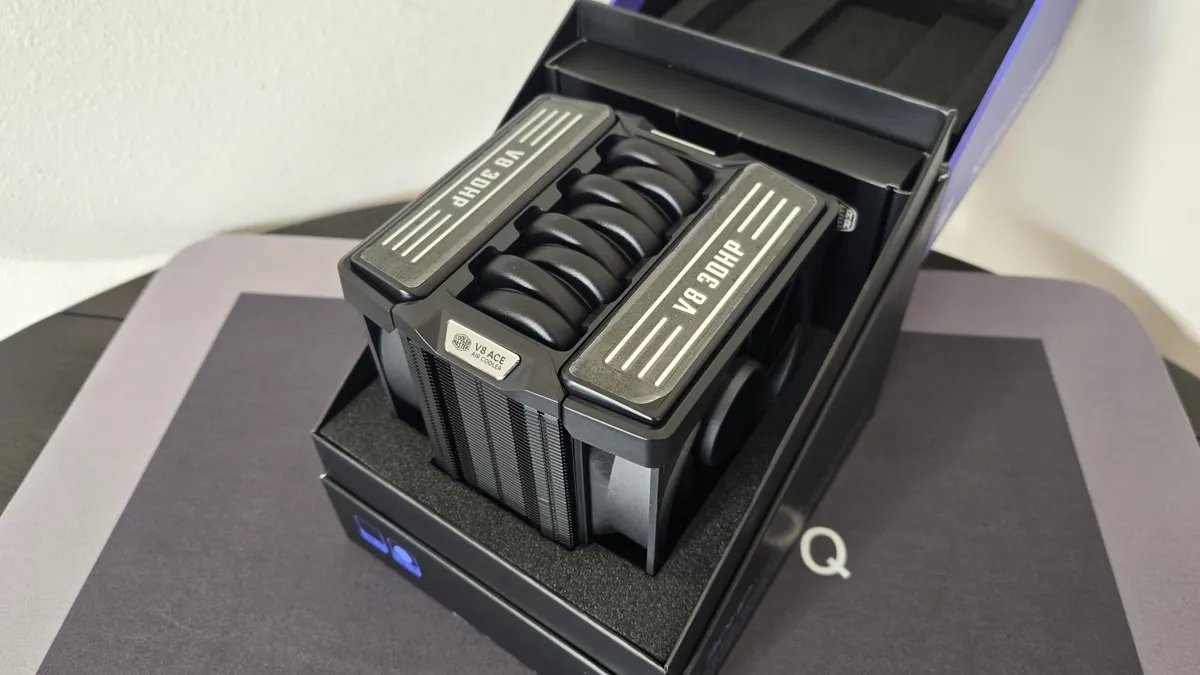
Cooler Master’s V8 Ace is an engineering masterpiece, using two 3D heatpipes and four standard copper heatpipes, combined with a single-tower heatsink to deliver thermal performance that beats most dual-tower heatsinks with eight heatpipes. Installation is simple, and noise levels are reasonable.
There’s not much more you could want in a cooler – except for a lower price. But as with all new cutting-edge technology, there’s an early adopter tax with a price tag of $119.99 for the V8 Ace. If you’re looking for a similarly powerful cooler with a lower price tag, I’d recommend Thermalright’s Royal Pretor 130. Alternatively, if you want a less-powerful, more-affordable option that incorporates Cooler Master’s three-pronged heatpipe tech, the Hyper 212 3DHP also impressed us in testing, and costs around $25. And of course there's the middle-ground V4 Alpha, which we also tested here and found to be one of the quietest air coolers you can buy. That model has a list price of $49, but was selling for $44 at Amazon when this was published.
I look forward to testing future products as Cooler Master continues to refine and improve its 3DHP manufacturing processes. I can imagine a future iteration of this technology will empower an air cooler stronger than anything previously possible.

Albert Thomas is a contributor for Tom’s Hardware, primarily covering CPU cooling reviews.
-
master737373 "3DHP" isn't some novel thing though. For example, Noctua has been using that same approach for ALL of their air coolers. Each heatsink has anywhere from four to eight heat pipes, where the single heatsink coolers on the cheaper end have four and the higher end coolers with either single or double heat sinks can have eight, all of which spread evenly through the heatsink.Reply
I was reading this thinking Cooler Master was doing something new but they're doing and trademarking something that's become a standard lol. -
thestryker Reply
No they haven't and nobody on the market does. The Cooler Master heat pipes in use here are 8mm with a second 6mm heat pipe attached to the middle to optimize fin usage. Noctua has been known to stagger their heat pipes in certain cooler designs, but that's not the same thing.master737373 said:"3DHP" isn't some novel thing though. For example, Noctua has been using that same approach for ALL of their air coolers. -
SkyBill40 Hard to imagine a worse case for thermal testing seeing this is one of the absolute worst out there. GN has shown this to be nothing more than a pretty heat box.Reply -
philged Reply
This just seems easily and demonstrably wrong. The Corsair Dominators are 56mm which is relatively giant in comparison.TomsHardware said:I think the sticks I’m using are about the tallest on the market, at 48.8mm height. -
thestryker I'm really liking what they're doing with the 3DHP technology design wise. I'm just not really sure what the market is for a $120 cooler that doesn't outperform cheaper competition but still needs the fan moved for DRAM clearance. I thought the Apex fit a good niche of being a really nice looking air cooler that performed well and expanding upon that would make more sense to me.Reply
Since the Thermalright Royal Pretor 130 was brought up there's now an Ultra version with 7th heat pipe. I'd be curious to see if it's another Peerless Assassin vs Phantom Spirit situation where that extra heat pipe does make a meaningful difference. -
80251 Reply
My single cylinder thumper XR650 could put out 45BHP.extremepcs1 said:A V8 with only 30 horsepower? It's the late 1970's all over again ;) -
bit_user Reply
I wish they'd make a down-draft version!thestryker said:I'm really liking what they're doing with the 3DHP technology design wise. I'm just not really sure what the market is for a $120 cooler that doesn't outperform cheaper competition but still needs the fan moved for DRAM clearance.
That said, I might just have to utilize your "80 mm fan on standoffs" technology and use a dual tower, when I build my Nova Lake. Noctua's NH-C14S just isn't going to cut it, and that's the best down-draft cooler I can find. -
bit_user Reply
LOL, it's certainly in the Noctua price range!8086 said:Why weren't there any references to noctua coolers in your benchmark list?