









Arm moves beyond IP with AGI CPU silicon — 136-core data center chip targets AI infrastructure with Meta as lead partner
Arm's first foray into selling production chips, not just licensing IP.
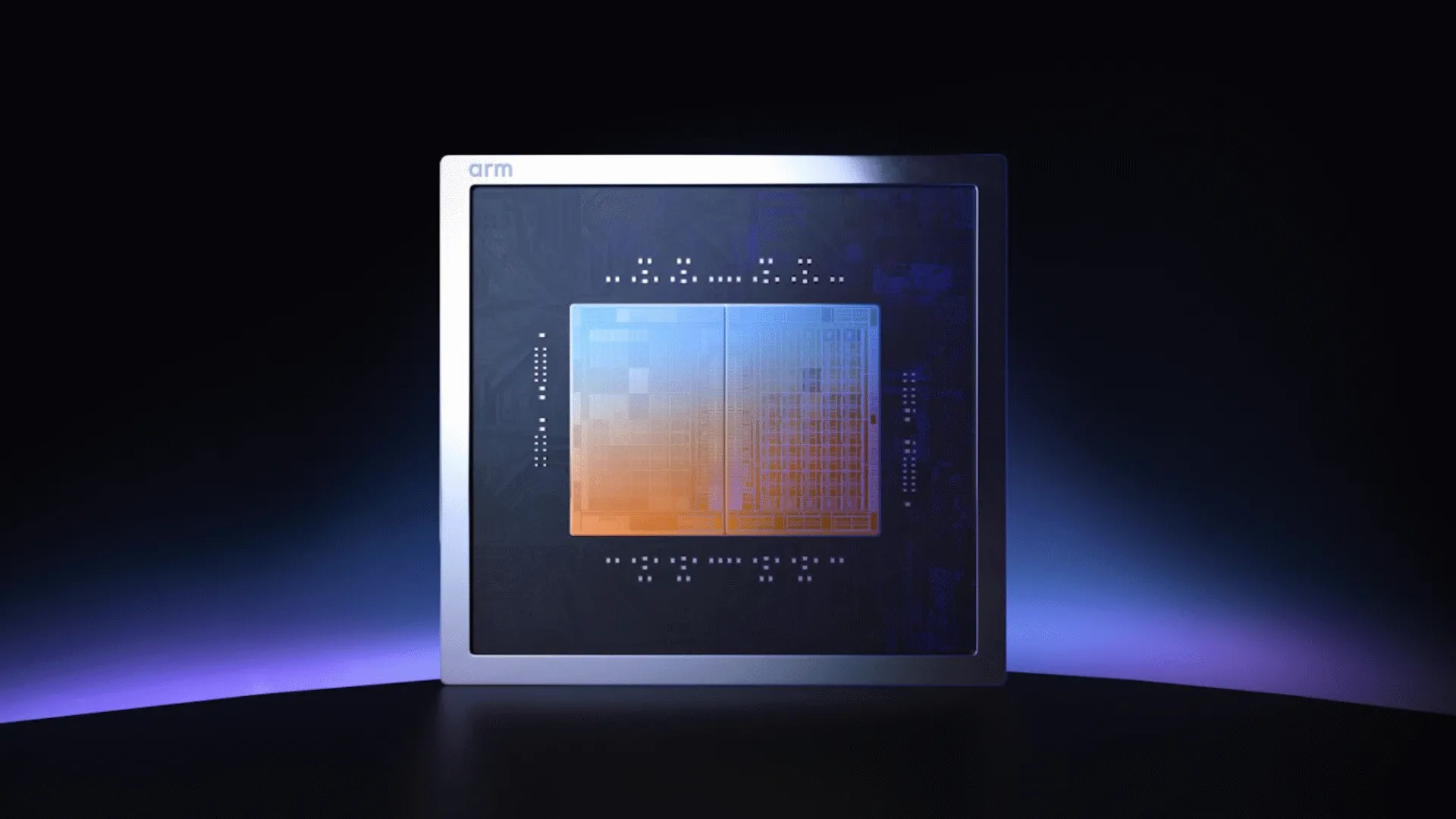
Arm today announced the AGI CPU, an up-to 136-core data center processor family that the company designed and will sell as finished silicon. The chip, built on TSMC's 3nm process with Neoverse V3 cores, was co-developed with Meta and represents the first time in Arm's 35-year history that the company has shipped its own production processor rather than licensing IP to partners.
The AGI CPU has been designed for what Arm calls "agentic AI infrastructure," the CPU-side orchestration work required to coordinate accelerators and manage data movement in large-scale AI deployments.
136 Neoverse V3 cores at 300 watts
The chip packs up to 136 Neoverse V3 cores running at up to 3.2 GHz all-core and 3.7 GHz boost across two dies, all within a 300-watt TDP. It supports 12 channels of DDR5 memory at up to 8800 MT/s, delivering more than 800 GB/s of aggregate memory bandwidth or 6GB/s per core with a target of sub-100ns latency. I/O includes 96 PCIe Gen6 lanes and native CXL 3.0 support for memory expansion and pooling.
Arm's reference platform is a 10U dual-node server compliant with the Open Compute Project's DC-MHS standard. Two AGI CPUs fit per blade, and a standard air-cooled 36kW rack holds 30 blades for 8,160 cores total. Arm has also partnered with Supermicro on a liquid-cooled 200kW configuration that houses 336 chips and more than 45,000 cores.
Arm claims the AGI CPU delivers more than two times the performance per rack compared to the latest x86 platforms. That figure is, of course, based on the company’s own internal estimates at this stage, not independent benchmarks.
GPUs have made most of the headlines surrounding AI hardware to date, but there’s a demand for more powerful general-purpose compute as agentic systems like OpenClaw explode in popularity. Arm is clearly hoping it can meet and cash in on this demand — and hopefully that won’t be to the detriment of non-AI customers, who seem to have long since been forgotten by the likes of Nvidia and Micron.
OpenAI among early customers
Meta served as the lead partner on the project and plans to deploy the AGI CPU alongside its custom MTIA accelerators. Santosh Janardhan, head of infrastructure at Meta, said the two companies worked together on the chip and are committed to a multi-generation roadmap.
Get Tom's Hardware's best news and in-depth reviews, straight to your inbox.
Beyond Meta, Arm confirmed commercial commitments from Cerebras, Cloudflare, F5, OpenAI, Positron, Rebellions, SAP, and SK Telecom. Sachin Katti, head of industrial compute at OpenAI, said the AGI CPU will play a role in OpenAI's infrastructure by strengthening the orchestration layer that coordinates large-scale AI workloads.
Arm has historically operated as an IP licensing company. Its partners, from Apple to Nvidia to AWS, design their own chips using Arm's instruction set architecture and core designs. The AGI CPU adds a third option alongside IP licensing and Arm's Compute Subsystems (CSS) program: Arm-designed, production-ready silicon that customers can deploy directly.
Arm said the AGI CPU product line will continue in parallel with the Arm Neoverse CSS product roadmap, and that follow-on products are already committed. The company seems keen to point out that this is an additive move rather than a pivot that competes with existing licensees, though how Arm manages that as it sells chips into the same data centers as Nvidia Grace, AWS Graviton, Google Axion, and Microsoft Cobalt remains to be seen.

Follow Tom's Hardware on Google News, or add us as a preferred source, to get our latest news, analysis, & reviews in your feeds.

Luke James is a freelance writer and journalist. Although his background is in legal, he has a personal interest in all things tech, especially hardware and microelectronics, and anything regulatory.
-
roboj1m Not sure it's really, "Arm's first foray into selling production chips."Reply
Technically I think that would be the ARM in the Apple Newton.
So this is a return to ARM selling silicon after transitioning to an IP only company. -
Bigshrimp It's really just a ginormous money pit that converts into beasts of concrete and silicon that consume as much power, water, and land that you can feed them.Reply -
bit_user Reply
This CPU is just a server CPU and it does what any server CPU does. It's really aimed at general-purpose cloud workloads and can do so arguably more efficiently than x86.Bigshrimp said:It's really just a ginormous money pit that converts into beasts of concrete and silicon that consume as much power, water, and land that you can feed them.
But, like everything these days, it has to be branded "AI". In fact, ARM seems to be decidedly disingenuous in their choice of AGI as its name, which is more commonly used to refer to Artificial General Intelligence - a feat it certainly cannot do, and that we're probably years away from anyone accomplishing. -
usertests Reply
Phoronix users jumped on that name immediately. Very funny, ARM (and a leg).bit_user said:But, like everything these days, it has to be branded "AI". In fact, ARM seems to be decidedly disingenuous in their choice of AGI as its name, which is more commonly used to refer to Artificial General Intelligence - a feat it certainly cannot do, and that we're probably years away from anyone accomplishing. -
thestryker Reply
Doubly so since reading this article and their release it doesn't sound like there's anything custom about this chip.bit_user said:In fact, ARM seems to be decidedly disingenuous in their choice of AGI as its name, which is more commonly used to refer to Artificial General Intelligence - a feat it certainly cannot do, and that we're probably years away from anyone accomplishing. -
SwampRatUK Reply
Before the transition to IP only wasn't there a much longer / older history of Acorn RISC Machines like the BBC Micro etc through the 80s?roboj1m said:Not sure it's really, "Arm's first foray into selling production chips."
Technically I think that would be the ARM in the Apple Newton.
So this is a return to ARM selling silicon after transitioning to an IP only company. -
User of Computers This looks scarcely competitive with current-gen offerings, what on earth will they do to compete with the next gen of AMD chips?? Doesn't look good for them unless they iterate quickly.Reply -
bit_user Reply
Their bid seems to be competing on perf/W, more than perf/CPU. It's also a bit more competitive on the I/O front, which is probably where they expected the bottlenecks to be.User of Computers said:This looks scarcely competitive with current-gen offerings, what on earth will they do to compete with the next gen of AMD chips??
If you look at Nvida's Vera CPUs, they also don't seem terribly competitive, in absolute performance. However, they integrate into the compute fabric in a way like nothing else.
These Neoverse V3 cores are derived from Cortex X4. If you look at the performance difference between X4 -> X925 -> C1 Ultra, ARM has lots of improvements in the pipeline. So, rapid-iteration should be in the cards.User of Computers said:Doesn't look good for them unless they iterate quickly.
The big downside of those newer cores is that they're substantially larger. For instance, the X925 is about twice as large as the X4. However, at 2.8 mm^2, the X925 is still only about 62% the size of Lunar Lake's P-core (4.53 mm^2).
References:
https://www.reddit.com/r/hardware/comments/1gvo28c/latest_arm_cpu_cores_compared_performanceperarea/ https://www.reddit.com/r/hardware/comments/1fuuucj/lunar_lake_die_shot/ -
User of Computers Reply
This is something that Intel is addressing by partnering with Nvidia for that supposed NVLink Xeon. I assume that the purpose of Vera's existence, as ever, is to have a diversification option. Why they're selling it on the open market is beyond me. It might make them a few bucks but this to me will always be a product focused inward on their own product stack.bit_user said:Their bid seems to be competing on perf/W, more than perf/CPU. It's also a bit more competitive on the I/O front, which is probably where they expected the bottlenecks to be.
If you look at Nvida's Vera CPUs, they also don't seem terribly competitive, in absolute performance. However, they integrate into the compute fabric in a way like nothing else. -
bit_user Reply
No, I doubt that. I think those Xeons are still meant to serve as host CPUs, rather than replace Vera's role within in the compute fabric.User of Computers said:This is something that Intel is addressing by partnering with Nvidia for that supposed NVLink Xeon.
I think customers like Facebook are interested in Vera-only systems for better perf/W and scalability. Facebook said they're already getting 2x perf/W with Grace than they did with x86.User of Computers said:I assume that the purpose of Vera's existence, as ever, is to have a diversification option. Why they're selling it on the open market is beyond me.