Stay On the Cutting Edge: Get the Tom's Hardware Newsletter
Get Tom's Hardware's best news and in-depth reviews, straight to your inbox.
You are now subscribed
Your newsletter sign-up was successful
Join the club
Get full access to premium articles, exclusive features and a growing list of member rewards.
An account already exists for this email address, please log in.
China’s top chip foundries move to consolidate as Beijing pushes semiconductor self-sufficiency — SMIC and Hua Hong Semiconductor deals pave the path to unified power
China’s leading contract chipmakers are pursuing large domestic acquisitions to expand capacity as Beijing doubles down on semiconductor self-sufficiency.
China’s two largest pure-play foundries, SMIC and Hua Hong Semiconductor, are in the middle of significant consolidation efforts that demonstrate how industrial policy is reshaping the country’s chip sector, with SMIC about to take full control of a subsidiary for US$5.8 billion and Hua Hong set to acquire 97.5% of Shanghai Huali Microelectronics from its state-owned parent for US$1.2 billion.
The two multi-billion-yuan deals come as China’s access to advanced manufacturing equipment remains constrained by U.S.-led export controls, forcing domestic players to rethink how they scale, where they invest, and which parts of the semiconductor market they prioritize. While the most obvious and immediate aim is capacity and operational efficiency, the broader objective is to harden China’s semiconductor supply chain against external pressure while consolidating state resources around a smaller number of national champions.
According to the South China Morning Post, SMIC’s proposal to acquire its Beijing-based subsidiary, SMIC Jingcheng, for roughly ¥40 billion is emblematic of what is becoming an emerging trend. The Beijing fabs are already majority owned by SMIC, but bringing them fully onto the parent’s balance sheet simplifies governance, capital allocation, and future expansion planning. Meanwhile, Hua Hong is pursuing a similar approach by acquiring Shanghai Huali, its closely linked sister foundry, in a deal valued at more than ¥8 billion.
These might look like internal restructurings on paper rather than straight-up mergers between rivals, but they represent a deliberate pivot away from the fragmented growth model that defined China’s foundry build-out over the past decade. Instead of creating new entities to chase specific technologies or regional subsidies, Beijing now appears to be encouraging consolidation around existing leaders, with state investors providing the financial backstop.
Why? Because building and equipping fabs has grown dramatically more expensive, even at mature process nodes. At the same time, export controls have reduced the returns on chasing leading-edge manufacturing, particularly below 7nm. By consolidating, SMIC and Hua Hong can pool cash flows from profitable legacy production, reduce duplicated R&D and administrative overhead, and present a more coherent face to regulators and customers.
A deliberate focus on mature nodes
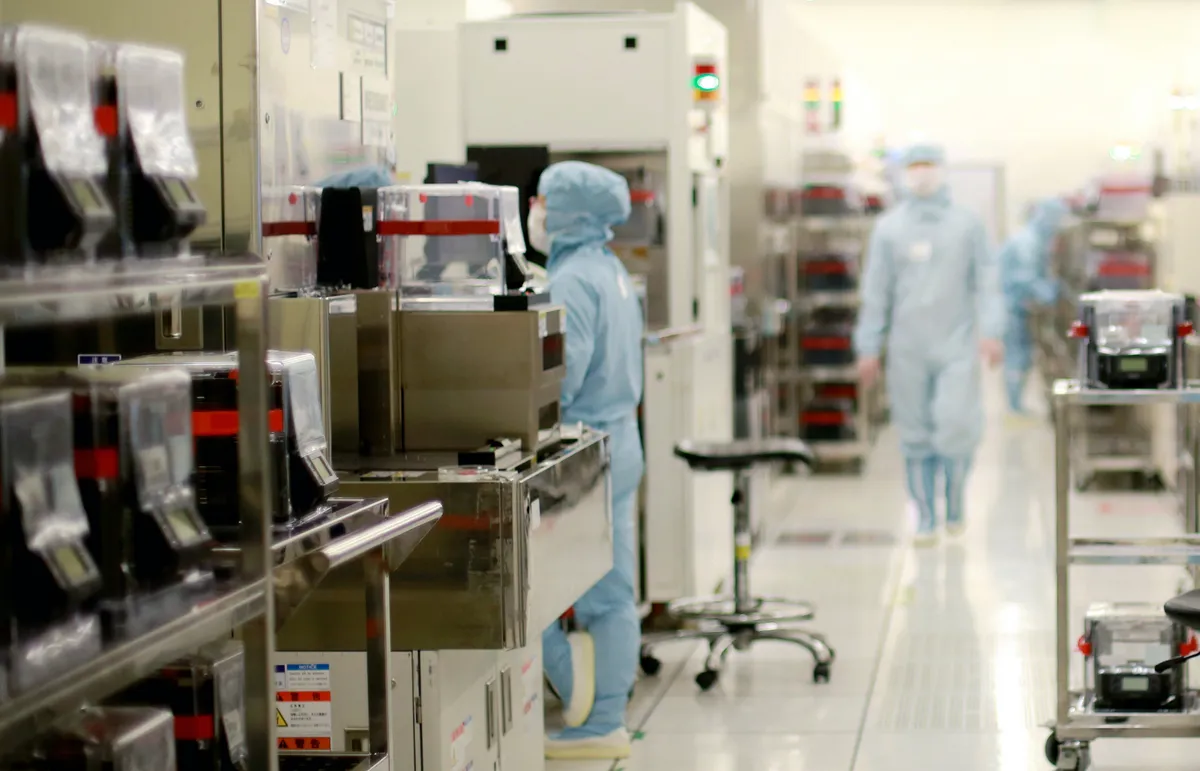
(Image credit: SMIC)
Perhaps the most striking feature of China’s current foundry strategy is not what it is building, but what it is not. While SMIC has demonstrated limited capability using DUV lithography, the bulk of new capacity tied to these consolidation moves sits at 28nm and above, including 40nm, 55nm, and 65nm processes.
These nodes are far, far away from the prestige of leading-edge 2nm or 3nm, but they remain both commercially viable and important. Automotive microcontrollers, power management ICs, display drivers, connectivity chips, and a wide range of industrial and consumer components still rely on mature manufacturing. Global shortages during the pandemic — and the recent, still-ongoing Nexperia-Wingtech spat — highlighted just how fragile supply at these nodes can be.
China has leaned heavily into this, with industry estimates suggesting that more than half of all new global capacity additions at mature nodes through the mid-2020s are located in China. Hua Hong’s Shanghai fabs alone add tens of thousands of wafers per month at 40nm and 65nm, while SMIC’s multiple sites cover an even broader spread of legacy processes.
This serves several purposes for China. Firstly, it reduces dependence on foreign suppliers for essential components used across the economy. Secondly, it creates a buffer against sanctions that target advanced equipment. Thirdly, it positions Chinese foundries as increasingly important suppliers to global customers who need stable access to mature nodes, even if geopolitical concerns complicate sourcing decisions.
Sanctions, scale, and structural limits
U.S. export controls remain the defining constraint on China’s ambitions at the cutting edge. Restrictions on EUV lithography tools, advanced deposition equipment, and certain design software have slowed progress below 7nm and raised costs for any attempt to push further using workarounds.
Consolidation does not remove these limits, but it does change how Chinese firms operate within them. Larger, integrated foundries are better positioned to absorb higher tool costs, manage complex multi-patterning flows, and negotiate with domestic equipment suppliers that are still maturing. They also offer a clearer channel for state support, whether through direct funding, favorable financing, or guaranteed demand from state-owned enterprises.
As Washington tightens scrutiny of potential sanctions circumvention, having fewer, larger entities also simplifies compliance and reduces the risk that smaller, less visible fabs become flashpoints for enforcement actions. From Beijing’s perspective, consolidation is as much about political risk management as it is about manufacturing efficiency. China’s foundry consolidation is likely to have its biggest impact at mature nodes, and as Chinese capacity continues to grow, pricing pressure on legacy processes is expected to increase. Foundries in Taiwan, Japan, and parts of Southeast Asia that rely heavily on these nodes may find margins squeezed, particularly for commodity products.
At the same time, not all customers will be willing to shift sourcing to China. Concerns around export controls, intellectual property protection, and supply chain resilience are obvious sticking points, and some Western companies are already looking to diversify away from Chinese fabs even if that means higher costs. This points toward a more segmented market, where Chinese foundries dominate domestic and select international demand, while non-Chinese fabs serve customers with stricter geopolitical or regulatory constraints.
SMIC and Hua Hong’s acquisitions are unlikely to produce dramatic short-term shifts in China’s technological standing. They do, however, reveal a maturing phase in Beijing’s semiconductor strategy. The emphasis is shifting from rapid expansion to consolidation, from aspirational leadership at the cutting edge to dependable strength across the bulk of the market.
While U.S. and allied firms continue to concentrate resources on advanced nodes, advanced packaging, and heterogeneous integration, China is building scale and resilience where it can compete most effectively today. That does not preclude future breakthroughs at the leading edge, but it suggests a longer-term strategy built on volume and incremental gains rather than rapid node-to-node leaps.
Luke James is a freelance writer and journalist. Although his background is in legal, he has a personal interest in all things tech, especially hardware and microelectronics, and anything regulatory.