- 20" LCD Monitors: XXL Displays
- Asus PW191 LCD: Looks Can Deceive
- 19" LCD Monitors: The Spring 2006 Collection
- Is the Acer F20 the Ferrari of LCD Monitors?
- Do You Want a 16:9 LCD Monitor Now?
- ViewSonic VP930 LCD Monitor: The New Champion?
- The Secret Sauces of THG's LCD Tests
- Do The New 19" LCDs Pass Muster?
- A Revolution? The First Lumileds LCD Display
- LCD TV Set Fall Preview
- THE PC vs. CONSOLE WAR: PC's are LOSING.
- Four Wide Screen 19" Monitors Compared
- Post-NDA Conroe Benchmarks
- 20
- Driver help for my monitor
- LCD monitors (screen ratios)
- Per Pixel Color Component Output / Bit Display Pipeline....
- LCD resolutions / aspect ratios
- Why is the video card industry driven by games but not the..
Spatial Uniformity
Source: Tom's Hardware US – Keywords: wide, format, lcd, monitors
Syndication:
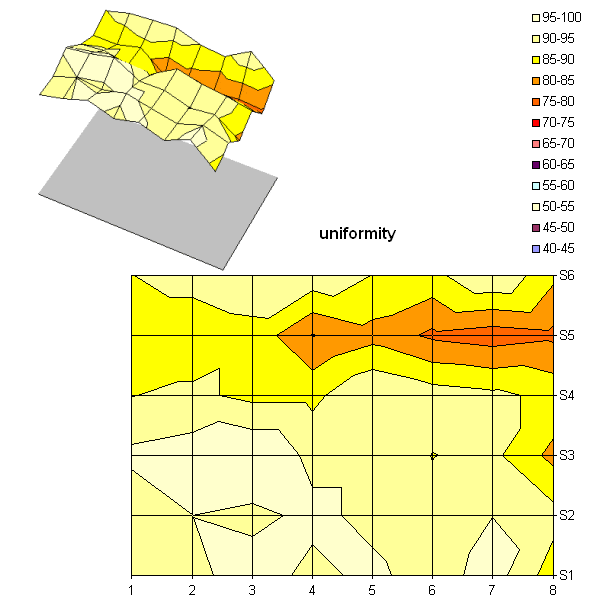
Spatial Uniformity

In absolute terms, the panel's uniformity was fairly good. The values were all between 100% and 80%. But the light distribution was somewhat bizarre, as the graph shows, which was visible. The lower right corner thus looked slightly brighter than the rest of the panel.
Despite its age, the F2105 confirmed its quality as a static monitor. The colors were rich and accurate and the contrast can match that of any recent model. Our only criticism is the excessive brightness, as with the Samsung monitor we discussed above.
Old-Fashioned Reactivity

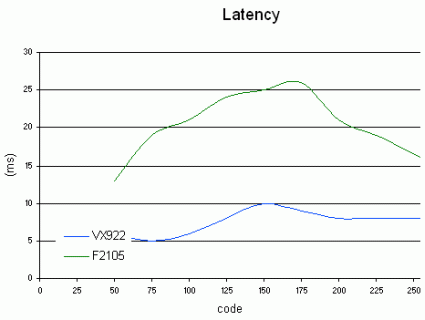
But if there's an area where the F2105 showed its age: it's reactivity. The panel showed an average latency of 22.5 ms, with a peak of 26 ms, which is flaccid compared to recent models.
Overshoot
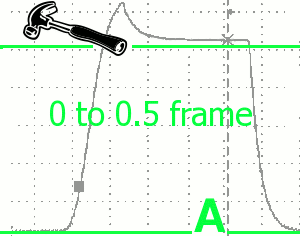
No Overdrive = no overshoot. That puts the HP2105 into the top category, A, in this area.
- Previous page Ergonomics
- Next page In Use