Tech hobbyist makes shoulder-mounted guided missile prototype with $96 in parts and a 3D printer — DIY MANPADS includes assisted targeting, ballistics calculations, optional camera for tracking
Quite the feat...
Get Tom's Hardware's best news and in-depth reviews, straight to your inbox.
You are now subscribed
Your newsletter sign-up was successful
The democratization and subsequent ubiquity of 3D printers have enabled almost any home enthusiast to produce utilities and products previously only attainable to large factories with big equipment. "You can 3D print those nowadays" has become a common utterance. Even still, it's safe to say that our bingo cards did not predict a techie making a shoulder-mounted, 3D printed guided missile system for all of $96.
In a five-minute YouTube video, Alisher Khojayev goes over the basics of this Stinger-like creation, comprising the launcher, the actual missile, and even an optional camera node tracking system for added tracking capabilities. Most of the missile's major parts are 3D printed, while the electronics bits are cheap, widely available microprocessors and sensors. All the gear is tied down and wired with off-the-shelf hardware store parts, too.
When a user inserts a missile into the launcher and hits the first switch, they activate a Wi-Fi network between the launcher and a control computer. The computer takes in all the rocket's telemetry and starts performing ballistic calculations to relay to the launcher, and then to the missile.
Article continues belowOnce the second switch is hit, the connection extends to the rocket itself, and at that moment, orientation angles start being calculated for the missile's canards to use (the movable wings that jut out of the missile to orient it).
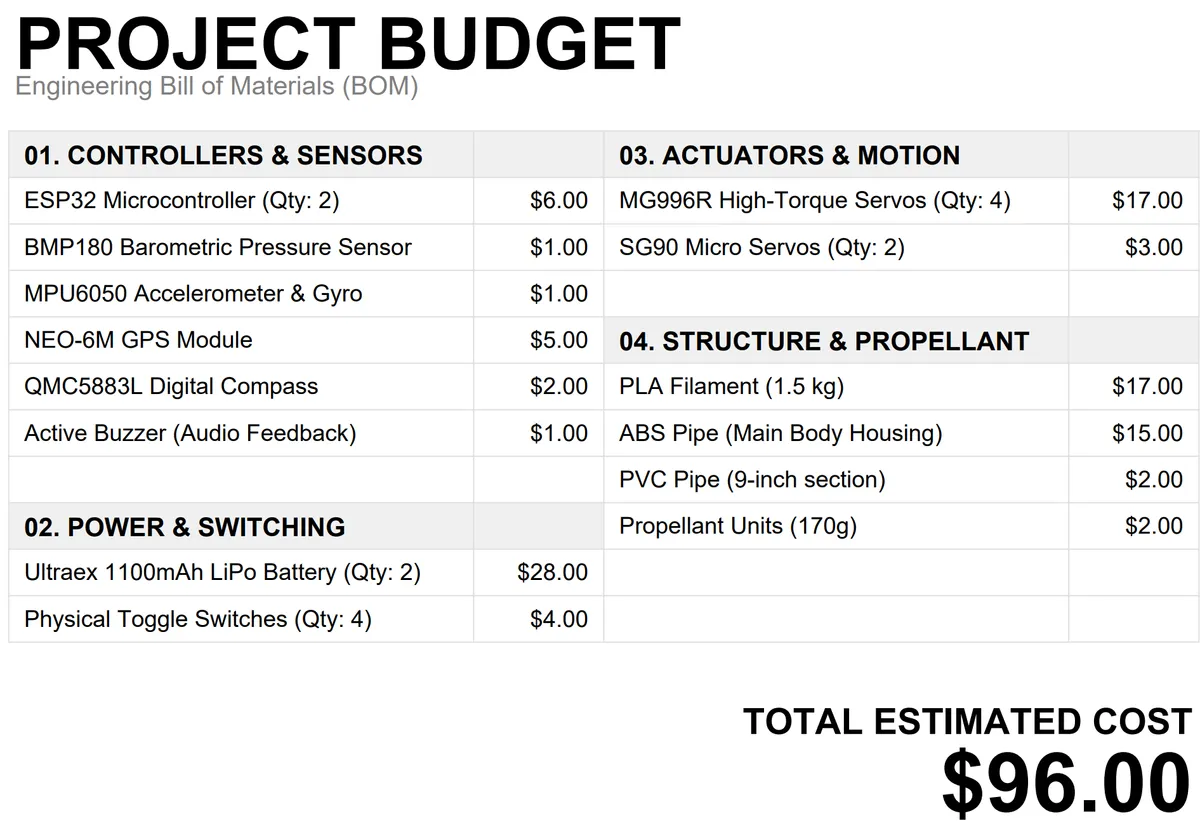
The launcher contains an ESP32 microprocessor along with a GPS, barometer, and compass. The missile itself contains another ESP32, coupled with an MPU6050 inertial measurement unit for calculating orientation and velocity, and move the canards as mentioned.
Khojayev points out that although the 'MANPADS' ought to function well enough on its own, he proposes that it'd be at its best as part of a camera-and-GPS mesh node, for which he conveniently also made a prototype with commonly available parts.
Both projects and their documentation are freely available, and links are in the video description and comments. Despite the tech-cool factor of the project, Tom's Hardware does not condone making your own weapons system at home.
Get Tom's Hardware's best news and in-depth reviews, straight to your inbox.
As points of comparison, Ynetnews points out that the well-known Stinger MANPADS goes for up to a cool $480,000, and that even the U.S. Air Force's CAMP low-cost missile program is currently targeting half a million per launch. While these are literally military-grade units with high reliability, and Khojayev's just-launched prototype has no effectiveness track record, at $96, it is roughly 5,000 times cheaper to make.
Some may see this latest development as predictable in the grand scheme of things. The effectiveness of improvised explosives in Middle Eastern war theaters and the ingenuity of Ukrainian drone engineers have adeptly proven that necessity is the mother of invention. Couple that with 3D printers being ever more capable of producing strong, weapons-grade parts, and it's clearly displayed that the proverbial "three guys in a shed" can be far more effective than the military procurement machine.

Follow Tom's Hardware on Google News, or add us as a preferred source, to get our latest news, analysis, & reviews in your feeds.

Bruno Ferreira is a contributing writer for Tom's Hardware. He has decades of experience with PC hardware and assorted sundries, alongside a career as a developer. He's obsessed with detail and has a tendency to ramble on the topics he loves. When not doing that, he's usually playing games, or at live music shows and festivals.
-
Findecanor I don't feel comfortable with seeing the word "democratization" be used to describe that is has become easier to build a weapon.Reply
The democratisation that I want to read happen is that a society has become more democratic so that people have got less inclined to build their own weapons. -
edzieba Might work in an uncontested environment, as an unguided rocket, if your target is so obliging to stand still and there is no wind.Reply
Unfortunately, if you need AA then you're operating in a contested environment by default, so there goes your WiFi and GPS to EW. Now you're stuck with trying to find a cheap microbolometer array for tracking, building (or building your own SARH array), and either implementing a jamming-resistant wireless link, moving all guidance on-board, or buying an expensive fibre spool. Oh, and you'll need to do some actual ProNav homing. -
Rand0m_Guy Cool toy, I want one, but I see 2 issues for this being practical.Reply
#1 needs to put a tungsten core or something in the head to simulate a payload.
#2 the engine is massively underpowered. You need to at a bare minimum get 10x more burn/thrust out of that motor, and double that once carrying a payload (warhead) for practical use.
The added weight of a payload and additional power of a bigger motor will result in higher stresses. Id be curious to see if the 3d material continues to hold up. This is why a stinger cost $400K. -
PEnns Comparing this to a Stinger MANAPD? Really???Reply
I doubt this could even hit (forget damage) the neighbor's intrusive civilian, $200 drone! A shotgun has a better chance. -
KitsuneKas Y'all, chill out. What this guy has made is essentially a toy. It's a model rocket with guidance, that's it. It's no more a weapon than a hobby drone is. Your car is more deadly.Reply
I mean it's made of PLA. It'll deform if it gets too much sun. -
Rudybird This is obviously a toy, but it is exactly articles like this that cause fear in people and our legislators and is exactly the reason some states are making laws to spy on our 3d printers through firmware updates and backround checks to own a 3d printers. You are reading this article because you are interested in 3d printing and technology and you should be concerned! Stop producing articles like this. When someone really does make a REAL rocket launcher, then write about it, not when people make stuff like this. This article is a disservice to the community. Shame on you Toms!Reply -
FITCamaro As Crunchlabs found out, it's illegal to make and distribute the technology for guided missiles.Reply
Yes, this is a toy. But what if someone put an explosive in it with an impact trigger? Then it's not. -
USAFRet Reply
And from a hobby quadrotor, you can have a remote control drop mechanism to release anything you want. Up to the flyable payload of your little flying robot.KitsuneKas said:Y'all, chill out. What this guy has made is essentially a toy. It's a model rocket with guidance, that's it. It's no more a weapon than a hobby drone is. Your car is more deadly.
I mean it's made of PLA. It'll deform if it gets too much sun.
Of course, dropping explosives violates any number of FAA regulations. -
salgado18 The 3D printed parts can be easily changed into metal parts. Even cheap aluminium cans are stronger.Reply
Impact based explosives are also possible to create in house. Or some sort of proximity calculation for a regular explosive.
Solve those two issues, and suddenly any civilian can build a missile from home, and throw it at the annoying neighbour, the cheating spouse and lover, the cinema, whatever.
It should at the very least be painted pink or neon yellow, with letters saying "just a toy".
Technically? Very nice. But it did strike some fear of the consequences.