AMD rockets past 35% market share in desktop PC market as Intel's share loss accelerates — AMD also hits 25% in laptops and nears 30% in crucial server market

Data by Mercury Research, compiled by Tom's Hardware
(Image credit: Data by Mercury Research, compiled by Tom's Hardware)

AMD ended 2025 with fanfare as it managed to increase its market shares across all major CPU product segments, according to Mercury Research, and achieved a 29.2% share of all x86 processors shipped in the fourth quarter, which is an all-time record for the company. The company now controls its highest unit share across desktop, laptop, and server CPU markets while also capturing the most lucrative parts of these markets, and now controls 35.4% of x86 CPU revenue share.
Client CPUs: AMD gains 3.8% of the market in a single quarter

In the client PC segment, AMD finished 2025 with one of its strongest quarters ever, partly because Intel struggled to get enough client silicon from its own fabs and from TSMC, but to a large degree because of highly competitive desktop CPUs and meticulously calculated mobile CPU lineup.

Data by Mercury Research, compiled by Tom's Hardware

(Image credit: Data by Mercury Research, compiled by Tom's Hardware)

AMD's client CPU unit share rose to 29.2% in Q4 2025, up 3.8% quarter-over-quarter (QoQ) and 4.6% year-over-year (YoY), driven by sales of both desktop and mobile offerings.

Intel remained the clear volume leader with about 70.8% of client CPU shipments, which is a sharp decline both sequentially and compared to the same quarter a year ago, which is not surprising as Intel had to reassign its internal manufacturing capacities to produce server CPUs instead of client silicon and could not get enough silicon from TSMC.

What is perhaps more alarming for Intel is that its client PC CPU revenue share declined to 68.8%, allowing AMD to control 31.2% of the dollar share of PC processor sales, up 2.9% QoQ and 7.4% YoY. This reflects AMD's higher average selling prices (ASPs), stronger sales of premium desktop and notebook processors, and continued gains in higher-margin segments.

Intel admits that it is hard to compete against AMD with its current lineup and hopes that things will begin to change in late 2026 – 2027, which means that AMD will likely continue to enjoy eating Intel's lunch in the coming quarters.

Desktop CPUs: A new record set by AMD

Given AMD's strong Ryzen 9000 lineup, Intel's inability to ship enough 14th Generation Core, and lack of Core 2 Ultra refresh in the fourth quarter, AMD was poised to win market share away from Intel in Q4, which is exactly what happened.

Data by Mercury Research, compiled by Tom's Hardware

(Image credit: Data by Mercury Research, compiled by Tom's Hardware)

AMD's desktop CPU unit share climbed to 36.4%, increasing both sequentially and year-over-year as demand for its latest Ryzen processors remained strong among gamers and enthusiasts. Of course, Intel retained the majority of desktop shipments with a 63.6% share, but this is down by a whopping 9.5% from the fourth quarter of 2024, a bad hit for the company. The gap between AMD's and Intel's desktop CPU market shares is still around 27%, meaning that the blue company maintains its undisputable lead, but the pace at which AMD is shrinking it looks quite formidable.

On the revenue share side of things, AMD's performance was even more notable. The company's desktop CPU revenue share reached 42.6% in Q4 2025, which clearly indicates strong sales of higher-margin processors and a favorable product mix. Intel still generated 57.4% of desktop revenue overall, but mostly due to its great relations with large PC OEMs that tend to sell mainstream systems, and where Intel is a little more flexible than AMD to win contracts.

Mobile CPUs: AMD posts highest unit share ever

The mobile PC segment has always been Intel's stronghold as the company has traditionally offered a very wide range of CPUs that could power anything from an ultra-low-power thin and light laptop to a full-fat desktop replacement machine. Yet, it is getting harder for Intel to protect its stronghold with its Arrow Lake and Lunar Lake processors now that AMD has greatly broadened its lineup of processors for notebooks.
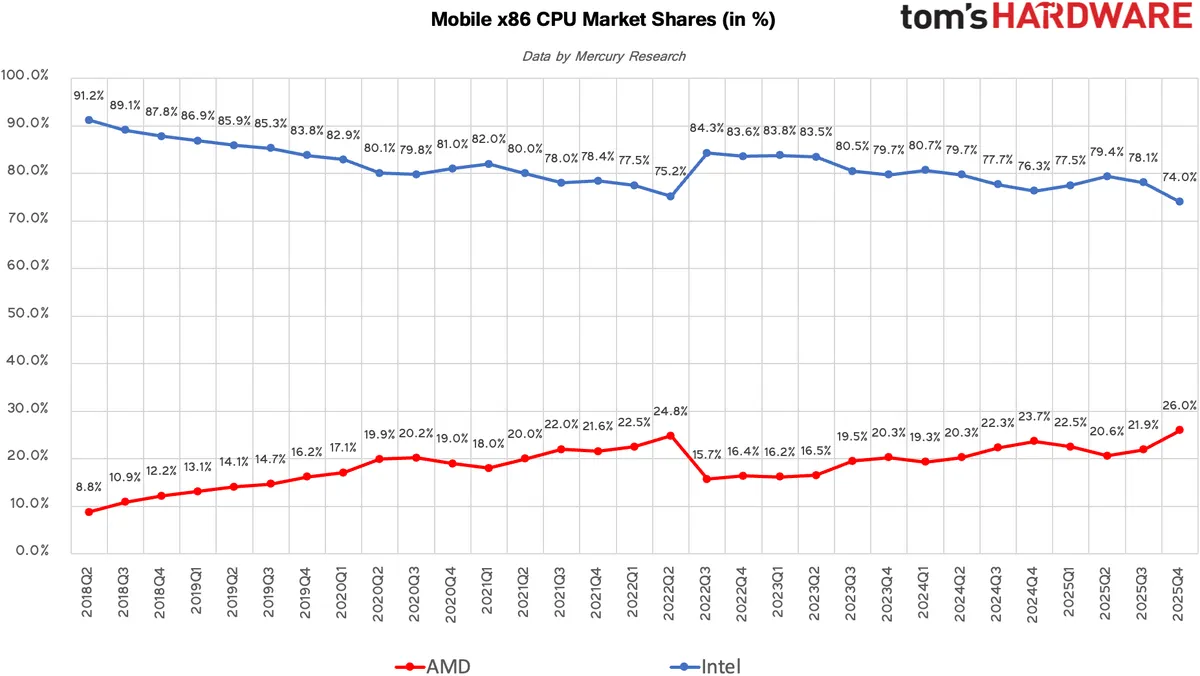
Data by Mercury Research, compiled by Tom's Hardware

(Image credit: Data by Mercury Research, compiled by Tom's Hardware)

After floating around 22% of the market for several quarters, AMD delivered a strong recovery in Q4 2025, capturing a 26% unit share and gaining 4.1% of the market QoQ, according to Mercury Research. Intel remained the dominant supplier with 74% of the market, which represents roughly three-quarters of mobile CPU shipments. When compared to its result in the fourth quarter of 2024, Intel only lost 2.2%. However, it remains to be seen what AMD manages to do while Intel will be ramping up its Panther Lake and then Nova Lake CPUs in the coming quarters.

As far as revenue share is concerned, AMD also posted meaningful 3.3% sequential and year-over-year gains as its mobile CPU revenue share reached 24.9%. Intel continued to generate the majority of mobile CPU revenue, a little over 75%, but AMD's progress clearly indicates that the company is getting increasingly competitive not only in the high-volume laptop CPU segment, but also in higher-margin segments of the notebook market.

Server CPUs: Another quarter, another percent of the market for AMD

As data center CPU market is particularly conservative, it is hard to quickly gain or lose share. For AMD, this translates into 'another quarter, another percent of the market' gain, which means that the company is gaining ground from its rival slowly but surely and is closing the year with a new high.

Data by Mercury Research, compiled by Tom's Hardware

(Image credit: Data by Mercury Research, compiled by Tom's Hardware)

Although Intel shipped 71.2% of all x86 server CPUs during the quarter (without taking into account shipments of Hygon Dhyana CPUs), AMD's server CPU unit share reached 28.8%, up 1% sequentially and 3.1% year-over-year as adoption of EPYC processors across cloud, enterprise, and AI/HPC deployments is accelerating.

As for revenue side of matters, AMD's server CPU revenue share climbed to a record 41.3%, which highlights its success in selling higher-priced, higher-margin processors. Intel commanded the majority of server CPU revenue overall — 58.7% — though it is evident that it is losing to its rival in the premium segments of the market.

Summary

If we were to summarize AMD's performance on the CPU market in 2025 in one sentence, we would say that the company was not only shipping more CPUs, but was increasingly capturing the most lucrative parts of all the markets it served due to its strong product mix and high ASPs. By contrast, Intel shipped fewer CPUs and increasingly lost the most lucrative contracts to its rival.

As a result, AMD closed 2025 with a record momentum as it managed to increase its market share across client, desktop, mobile, and server CPUs and reached a new all-time high in both x86 CPU units and revenue share, according to Mercury Research. In the fourth quarter of 2025, AMD shipped 29.2% of all x86 processors by volume and 35.4% of all x86 CPUs by revenue, both record numbers for the company.

While AMD's success was driven by a strong product mix, Intel's declines were a result of a combination of events, including a lack of competitive offerings for the high-end parts of the market as well as supply constraints in the low-end. Intel admits that to improve its position going forward, it will need to regain performance and process technology leadership as well as have enough manufacturing capacity to serve the market. Which is exactly what its management is working on these days.

Google Preferred Source

Follow Tom's Hardware on Google News, or add us as a preferred source, to get our latest news, analysis, & reviews in your feeds.

Anton Shilov
Contributing Writer

Anton Shilov is a contributing writer at Tom’s Hardware. Over the past couple of decades, he has covered everything from CPUs and GPUs to supercomputers and from modern process technologies and latest fab tools to high-tech industry trends.

  • Kindaian
    This kind of comparison needs to include ARM (aka Apple silicon, snapdragon, etc) and Socs (raspberry pi etc...) nowadays. Otherwise it skews the stats to high power desktop CPUs only, when the market is way more vast nowadays.
    Reply
  • WINTERLORD
    Intel will make a huge comeback with panther lake and snuff out amd for good all across the board

    288mb L3 cache will destroy amds 188mb L3 server side same deal plus intel has way more L2 cache to boot

    I believe it so much i even bought intel stock for like 31 a share but is 48 a share now there abouts
    Reply
  • TerryLaze
    WINTERLORD said:
    and snuff out amd for good all across the board
    That's not in intel's interest , they don't want to kill them completely.
    They are attacking laptop/handheld etc now which means that desktop will be a bit more relaxed, also they will still use TSMC for desktop for now so double the reason not to go too strong on that front.
    WINTERLORD said:
    288mb L3 cache will destroy amds 188mb L3 server side same deal plus intel has way more L2 cache to boot
    If intel is even going to make a monster like that they will charge so much for it that AMDs offerings will still be worthwhile.
    WINTERLORD said:
    I believe it so much i even bought intel stock for like 31 a share but is 48 a share now there abouts
    Intel stock will rise anyway, even if the new gen would only be middling, because their fabs are going to start making their products more profitable again plus whatever customers they will get.
    Reply
  • Shiznizzle
    WINTERLORD said:
    Intel will make a huge comeback with panther lake and snuff out amd for good all across the board

    288mb L3 cache will destroy amds 188mb L3 server side same deal plus intel has way more L2 cache to boot

    I believe it so much i even bought intel stock for like 31 a share but is 48 a share now there abouts
    Not likely. The word is out and the word is that for gaming, AMD is king.

    AMD is also the king on GNU/Linux.

    AMD also has a built in, on-die, memory controller, whereas Intel relies on a cpu to chip based memory management, using motherboard copper traces that connect the CPU and Northbridge. Hardly breaking the sound barrier with speed when AMD has that on-die.

    If Intel reversed that they might make some gains. However the northbridge/southbridges have been present for how many decades now? Three and a half that i can count.

    Intel is behind by a long way.

    There is no shame in being passed. AMD was the underdog for decades and i still bought them since they were cheaper and still allowed me to play games. Albeit with less performance. But for the money i paid i was happy.

    I bought AMD based on price since i did not want to form out for top dollar Intel. Considering AMD prices now i may have to reconsider Intel in the future as budgets dictate what i use, not tech on a chip. I do not mind less FPS for a %30 reduction in price
    Reply
  • Samlebon2306
    Kindaian said:
    This kind of comparison needs to include ARM (aka Apple silicon, snapdragon, etc) and Socs (raspberry pi etc...) nowadays. Otherwise it skews the stats to high power desktop CPUs only, when the market is way more vast nowad

    Reminder: Apple and Qualcomm do not make X86 chips. Read again at least the title of the article.
    Reply
  • Notton
    What I want to see from AMD:
    Can you please stop increasing the price on a stagnant mobile lineup?
    Rembrandt to Pheonix was a nice jump in both CPU and iGPU, but Pheonix to Strix Point was a huge let down.
    And then you decided to do a refresh of a boring product for 2026.

    What I want to see from Intel:
    You gotta lower the price on your Lunar Lake and Panther Lake (12Xe3) chips.
    They are good products no doubt, but it's not worth 50%~80% more than a Ryzen Z1E/7840
    Your desktop lineup sucks. It's trying to cover too many bases, and doesn't offer a good cheaper gaming alternative to the 9800X3D. I can understand getting an i9 for productivity, but it's overkill for gaming and way too expensive.
    Reply
  • Gururu
    High chance my next upgrade in 2027 will be a x86. I don't care if it's Intel or AMD.
    Reply
  • thestryker
    Shiznizzle said:
    AMD also has a built in, on-die, memory controller, whereas Intel relies on a cpu to chip based memory management, using motherboard copper traces that connect the CPU and Northbridge. Hardly breaking the sound barrier with speed when AMD has that on-die.
    None of this is accurate...

    AMD's memory controller is located in the IO die which is connected to the CCDs with infinity fabric using organic substrate.

    Intel was using a monolithic die design until MTL which means cores and memory controller were always together. With MTL the memory controller was moved to the SoC Tile, LNL only has two tiles so it's on the same as everything but GPU and ARL has it on the SoC Tile. The tiles all utilize very high speed interconnects so the physical design is better than AMD's.

    Where Intel has faltered in comparison here is the overall memory subsystem design on the tiled architectures. AMD over time massively improved memory behavior with their chiplet designs so it's entirely possible Intel can do similarly.
    Reply
  • TechieTwo
    Choice is good for consumers. Intel tried to eliminate AMD for years and got convicted for same. Unfortunately they bought their way out of the crime that prevented vendors and customers from being able to sell/purchase AMD products for years. Intel's evil will never be forgotten.
    Reply
  • TerryLaze
    Notton said:
    What I want to see from AMD:
    Can you please stop increasing the price on a stagnant mobile lineup?
    They are already operating on a margin of ~10% so, NO!
    Stuff gets more expensive for them and they have no other choice than to make their stuff more expensive to compensate, they are already not making enough money.
    Notton said:
    What I want to see from Intel:
    You gotta lower the price on your
    LOL, NO!
    After the expenses they had in the last few years they need to be asking for as much as they possibly can get away with.
    Notton said:
    doesn't offer a good cheaper gaming alternative to the 9800X3D.
    Nobody needs an 9800x3d for gaming, or an i9 for that matter.
    People that get these level of chips for gaming are the ones that don't need to care about money so price doesn't matter, for us mortals i5/r5 level is more than enough...ain't nobody got any money for the $2k + GPU needed to see any difference.
    Reply