Join for quick access. Enter your email below and we'll send confirmation plus sign you up to our newsletter.
By submitting your information, you confirm you are aged 16 or over,
have read our
Privacy Policy
and agree to the
Terms & Conditions. Geographical rules apply.
Why you can trust Tom's Hardware
Our expert reviewers spend hours testing and comparing products and services so you can choose the best for you. Find out more about how we test.
AMD Ryzen 5 9600X Gaming Performance — The TLDR
EDIT 8/14/2024: We have replaced our existing gaming testing with results that reflect Intel's new microcode fix. We do see a marked performance improvement, particularly in gaming, but this should not be taken as an improvement from the new microcode update — all performance increases are attributable to the higher power limits we used for this retesting. We did notice a slight regression in Hitman 3, which Intel has also acknowledged in its microcode announcement, but all other indicators point to slight performance differences that fall within the margin of error. We also removed the Watch Dogs Legion benchmark from our suite for the time being — the benchmark is now delivering odd results with Intel processors that aren’t reflective of our prior testing. As such, Intel sees an additional improvement in these cumulative results. The text covering performance data has been adjusted as necessary. We also re-validated our Ryzen results with an expanded number of titles, which you can read about here.
AMD’s processors in our test pool fit into three buckets: the standard Ryzen models for the AM5 socket (Ryzen 7000 and 9000), the gaming-specialized Zen 3 X3D models for the AM4 platform (5800X3D and 5700X3D), and the Zen 4 X3D model for AM5 (the 7800X3D).
AMD’s X3D models deliver exceptional performance in some game titles due to their unique 3D stacked chip design that arms the chip with ludicrous amounts of L3 cache, but they don’t accelerate all game titles equally. The X3D models also come with performance tradeoffs in productivity applications — especially with the 5000X3D models, as they come with the aging Zen 3 architecture and thus significantly lag behind the competition in productivity applications. Make sure you're aware of the pros and cons of the X3D chips before pulling the trigger.
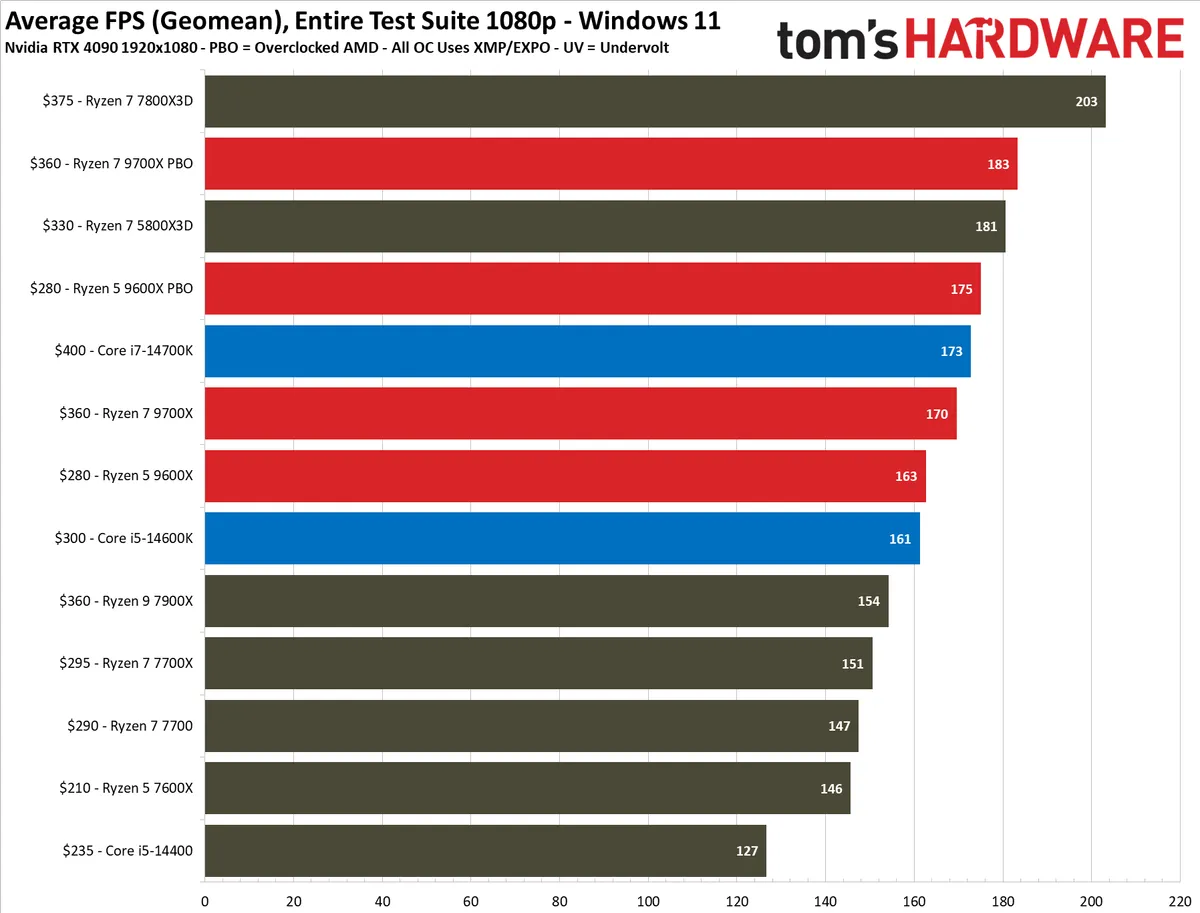
Be sure to head to our test setup page for the particulars of our test configurations. Below, you can see the geometric mean of our gaming tests at 1080p and 1440p, with each resolution split into its own separate chart. We tested with an Nvidia GeForce RTX 4090 to reduce GPU-imposed bottlenecks as much as possible. Still, differences between test subjects will shrink with less powerful cards or higher resolutions. You'll find further game-by-game breakdowns below.
Compared to the other conventional models, the $280 Ryzen 5 9600X delivers strong gaming at its price point. At stock settings, the $300 Core i5-14600K is 4% faster in 1080p gaming. Bear in mind that the Ryzen 5 9600X delivers these results from within a 65W TDP envelope.
The Ryzen 5 9600X is 12% faster than the previous-gen Ryzen 5 7600X, a solid generational gain, especially considering the 7600X's 105W TDP. Enabling the auto-overclocking PBO feature and bumping memory speed up to DDR5-6000 yields a solid 8% increase in performance, but it’s possible that more directed tuning could expose larger performance increases. Intel’s chips are also overclockable, but many of the underlying settings in the BIOS may change in the future, so we’ll wait to add overclocking results until the issue has been proven to be fully rectified.
On the gaming front, AMD’s stiffest competition comes from its own roster. The Ryzen 7 5800X3D comes out 11% faster than the 9600X at 1080p gaming for a $50 premium, while the Ryzen 7 5700X3D offers essentially the same performance as the 9600X on average but for $70 less. It also comes on the less expensive AM4 platform, and though the pricing delta between DDR4 and DDR5 isn't as severe as in the past, the 5000X3D chips do support more economical DDR4 memory. These chips do come with the older Zen 3 architecture, however, so they won’t be nearly as performant in daily tasks.
In contrast, the $375 Ryzen 7 7800X3D comes with the newer Zen 4 architecture, and while it does have its tradeoffs in productivity apps, it has a much more balanced performance profile. The Ryzen 7 7800X3D is the fastest gaming chip on the market, and it shows — it's 26% faster than the Ryzen 5 9600X. You’ll have to pay an extra $95, but it drops into the same AM5 platforms as the 9600X, so the platform and memory cost delta will be smaller than stepping back to AM4 for the 5000X3D models.
The $360 Ryzen 7 9700X is 8% slower than the $400 Core i7-14700K in 1080p gaming and delivers 12% higher performance than the $295 prior-gen Ryzen 7 7700X. Overclocking again yields solid results, with the 9700X getting an 8% increase in performance from dead simple tuning.
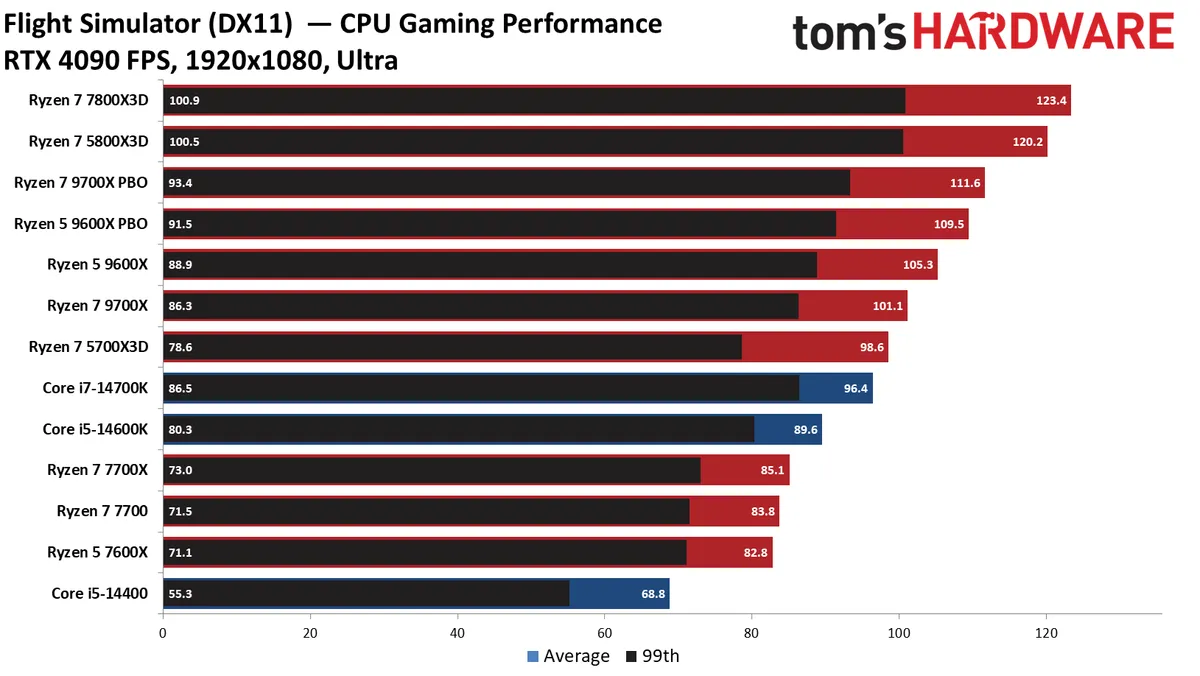
The deltas in these charts can be slim, and large deltas in individual game titles, as we see with the 5000X3D and 7000X3D chips, can have a big impact on cumulative measurements. Also, the competition between AMD and Intel chips can vary based on the title and the GPU you use. It's best to make an informed decision based on the types of titles you frequently play, so be sure to check out the individual game tests below and consult our GPU benchmarks hierarchy to see where your particular graphics card lands.
Nice review! Another site mentioned some power issues, where both the new cpus were idling at at 45-50W. Did you come across this problem yourself? I'm sure the issue will be dealt with relatively quickly, but as the other site mentioned, their test bench and config may have been part of the initial issue.
The gaming benchmarks appear to diverge wildly from the testing conducted by others (e.g. Eurogamer, Anandtech, Techpowerup) despite having very similar test rigs.
Nice efficiency, but GN and Jay reported the pre release bios isn't stable, need to wait (if) the imporved bios release and for all round, better pay for the top tier ones in the Zen lineup
Check out the page on power and thermals. The third album down has the power trace during different workloads. You can see the idle at the tail end. Sub-25W.
Hmm. I dont get the 4.5stars. A new architecture cannot beat a two gen old one in the 5800x3d consistently at gaming? Sure efficiency is better, but I don't really care about that unless it means a higher OC. Application performance is great, most of the time, except when its beat by the 14600k. I guess Ill wait and see how this shakes out in the next month or so. There is also a mistake in the article where you call the cpu 9700x3d, in the test system area.
Check out the page on power and thermals. The third album down has the power trace during different workloads. You can see the idle at the tail end. Sub-25W.
I'd like to see you guys try a test with Star Citizen vs the 7800x3D and 7700x and the new 9800x. Star citizen is very math intensive with very heavy physics. It's a very cpu bottlenecked game because of it. I'm wondering if the new parallel floating point pipelines in the 9000 series will really help.
Very different from other reviews this morning that shows 3-5 percent gains and called 9700x meh or bad value
Nice to see both base and PBO for all tests.
PBO turns it into a different beast, similar power consumption to the previous gen but much better all core frequencies, 4.4/4.5 GHz to approximately 5.3GHz. (The friendly German overclocker demonstrated this).
PBO off it looks a little meh compared to the 7000 series. It will be a good upgrade from my 3900x.
Very different from other reviews this morning that shows 3-5 percent gains and called 9700x meh or bad value
Nice to see both base and PBO for all tests.
Note that the 4.5 stars is for the 9600X, while the 9700X only gets 3.5 stars. Paul will be putting together a standalone review of the 9700X as time permits (same data, some different text with a different overall score). The overall combination of gaming performance, price, and efficiency is what makes the 9600X an attractive option. It's not always faster than an i5-14600K, but it's using about half as much power.
YSCCC said:
Nice efficiency, but GN and Jay reported the pre release bios isn't stable, need to wait (if) the improved bios release and for all round, better pay for the top tier ones in the Zen lineup
There are definitely some teething pains with the initial BIOS releases to support these chips, from what I've seen. The specific boards used along with BIOS settings applied will certainly impact results, and initially there's going to be some tuning required and probably clean installing the AMD chipset drivers for each processor.
We can't say how others test, what settings, memory, etc. gets used, or other potential instability-causing aspects of reviewing. Brand-new hardware can be problematic, but I'd expect any serious problems to be ironed out shortly with updated firmware. Paul may have gotten 'lucky' with his chosen board, memory, and test settings (or simply been more pragmatic and careful about what 'stock' settings to run). Others have reported issues.