Join for quick access. Enter your email below and we'll send confirmation plus sign you up to our newsletter.
By submitting your information, you confirm you are aged 16 or over,
have read our
Privacy Policy
and agree to the
Terms & Conditions. Geographical rules apply.
The SanDisk Optimus GX Pro 8100 is a top-tier drive with excellent performance, exceptional random read latency, and good power efficiency.
Reasons to buy
+
Up to 8TB of PCIe 5.0 goodness
+
Exceptional random read latency
+
High all-around performance
+
Very good power efficiency
Reasons to avoid
-
Price
Why you can trust Tom's Hardware
Our expert reviewers spend hours testing and comparing products and services so you can choose the best for you. Find out more about how we test.
What we have today is the WD Black SN8100 by another name, with one very important and exciting change: it’s 8TB. This puts the SanDisk Optimus GX Pro 8100 on an entirely different plane, as it delivers a capacity everyone wants with insanely fast hardware. The 2TB Black SN8100 that we reviewed previously was a pleasant surprise given its high power efficiency, but its absurdly low random read latency remains the real draw. Can all this goodness be repeated at 8TB with a new SKU firmly under the SanDisk name? And will anyone be able to afford it?
The previous 8TB champion, the WD Black SN850X, still remains interesting from a value perspective – if you can call current prices a value in any circumstance – but we’ve had a hard time finding high-end PCIe 5.0 drives at this capacity. The only one we’ve reviewed is the 8TB Samsung 9100 Pro, which, if you missed it when it was on sale, is probably promoting a stinging sensation right now. We’ve been promised an 8TB SKU of the Kingston Fury Renegade G5 – which has the same hardware as the Black SN8100 and Optimus GX Pro 8100 – and 8TB versions of Phison E28 drives, too. So far, these promises haven't materialized. The good news is, if you like the Optimus GX Pro 8100 at 8TB, then you can pick it up in its Black SN8100 form if that happens to be the better bargain.
Whether or not it’s a deal at all is up to you, but it’s hard to beat this level of performance at 8TB. The drive is power-efficient, too, and we have some faith in WD’s and SanDisk’s reliability and willingness to offer support. It’s probably best to buy something you know than roll the dice with unknown hardware, even if the latter comes with some price savings. We think the Optimus GX Pro 8100 qualifies as a better-known option, and given the level of investment at 8TB, that’s the safest way to go, even if there were other options.
The SanDisk Optimus GX Pro 8100 is available in the same capacities as the WD Black SN8100: 1TB, 2TB, 4TB, and 8TB. At the time of our Black SN8100 review, the 8TB model was not available, but it is now.
The current price disparity is worth a mention. The Optimus GX Pro 8100 is, right now, priced at $349.99, $694.63, $1,339.99, and $2,799.99. This is significantly higher than the Black SN8100’s $259.99, $439.99, $789.99, and $1,799.99. These prices are without heatsinks – check the table for the Optimus GX Pro 8100’s heatsink price per SKU, which only makes sense at 1TB, as is the case with the Black SN8100. You’re better off providing your own heatsink in most cases, and going for the Black SN8100 instead of the Optimus GX Pro 8100 makes sense until the price of the latter comes down to reality. Alternatives in this price range include the Kingston Fury Renegade G5 and the Samsung 9100 Pro, both of which also have 8TB SKUs, although we’ve only reviewed the latter at that capacity.
The drive’s maximum performance is impressive, with bandwidth up to 14,900 / 14,000 MB/s for sequential reads and writes and up to 2,300K / 2,400K random read and write IOPS. This is about as good as it gets. This level of performance is, on average, attainable with less than 7W of power consumption – a far cry from the 11.5W+ we saw on the earliest high-end PCIe 5.0 SSDs – which makes the drive even more impressive.
SanDisk includes support for TCG Opal 2.02 for encryption. In addition, the drive is backed up to 600TB of writes per TB of capacity within the five-year warranty period. This is standard and comes out to 4,800TB or 4.8PB of writes for the 8TB sample we have today.
Stay On the Cutting Edge: Get the Tom's Hardware Newsletter
Get Tom's Hardware's best news and in-depth reviews, straight to your inbox.
SanDisk Optimus GX Pro 8100 Software and Accessories
SanDisk features two pieces of software for the Optimus GX Pro 8100: the SanDisk Dashboard, based on WD’s Dashboard, and Acronis True Image for SanDisk. Both applications support other products, and SanDisk also has other software that applies to other products, so check the Software Downloads page if you own a different drive. While the OEM Acronis package has obvious applications – it’s for backing up, cloning, and recovering files – the Dashboard may be more involved for the average user. This SSD toolbox helps you stay on top of your drive’s health, it covers optional features, allows you to update the firmware, and more.
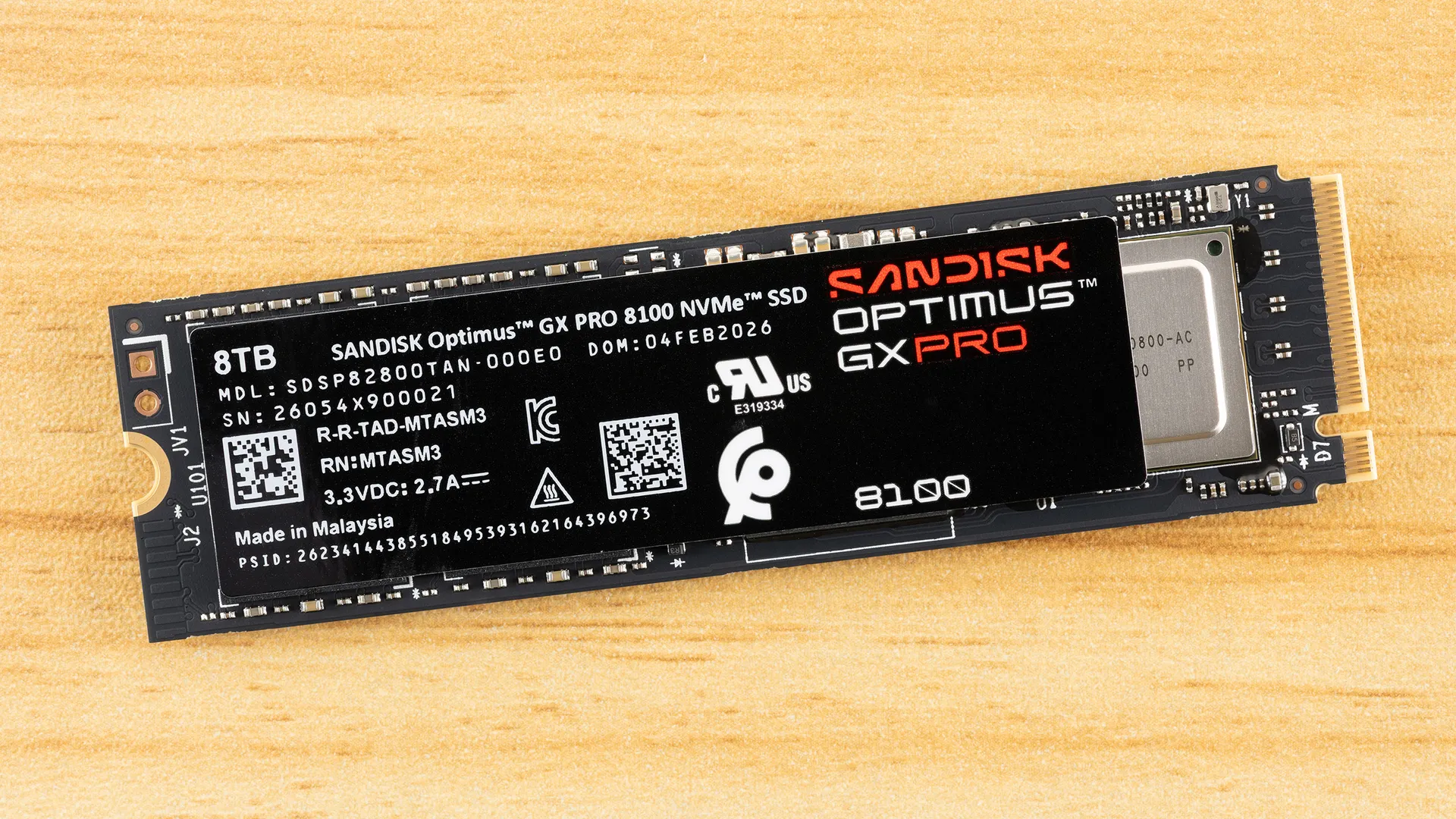
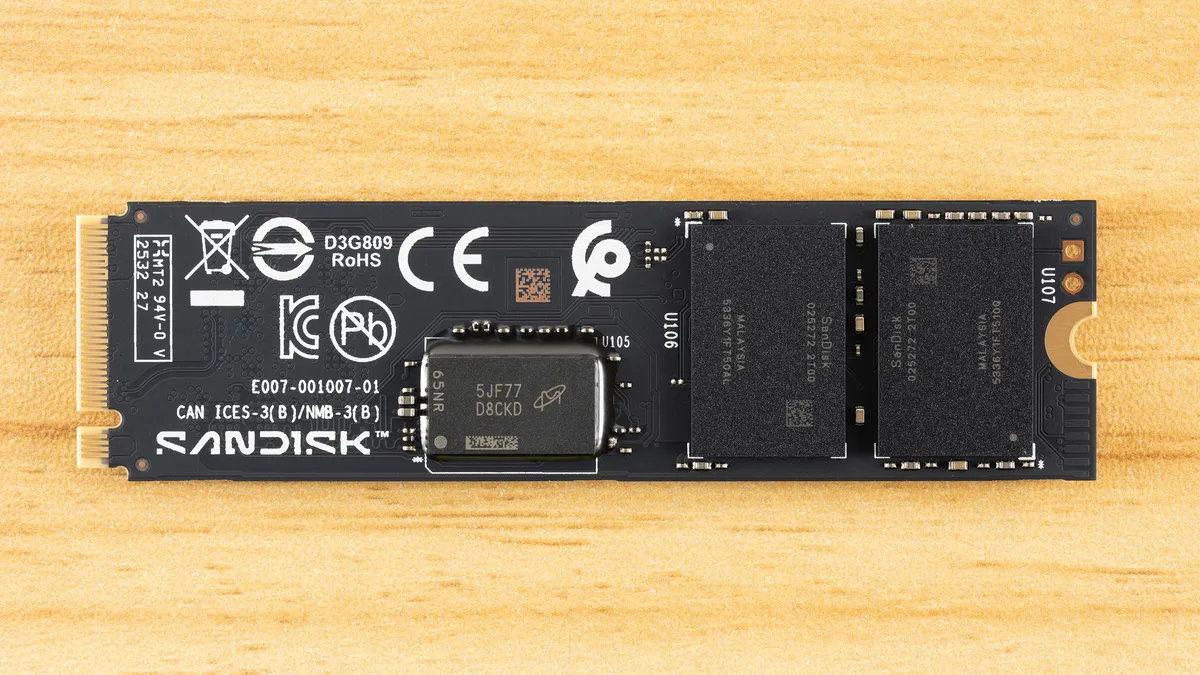
The 8TB Optimus GX Pro 8100 is a double-sided drive. At all other capacities, it is single-sided. If you’re going for the heatsinked version of the drive, this doesn’t matter, though. In rare cases, you might have a system that needs or prefers a single-sided drive, in which case it’s worth being aware of the fact that you will be limited to 4TB.
As to why the drive is double-sided only at 8TB, that has to do with how many NAND flash packages can fit on the PCB. With the controller and DRAM on the top side, there is only room for two flash packages. Each package can usually have a maximum of sixteen dies. Each die is 1Tb, or 128GB. Therefore, each package contains a maximum of 2TB of flash. Since four packages are necessary for 8TB, the 8TB SKU is necessarily double-sided. There will be exceptions to this on drives that can fit four flash packages per side – DRAM-less drives, and especially ones with only four flash channels, as the controllers may be smaller, or drives with denser flash. 2Tb QLC flash is certainly a possibility, although for the time being, such flash would be prioritized for enterprise.
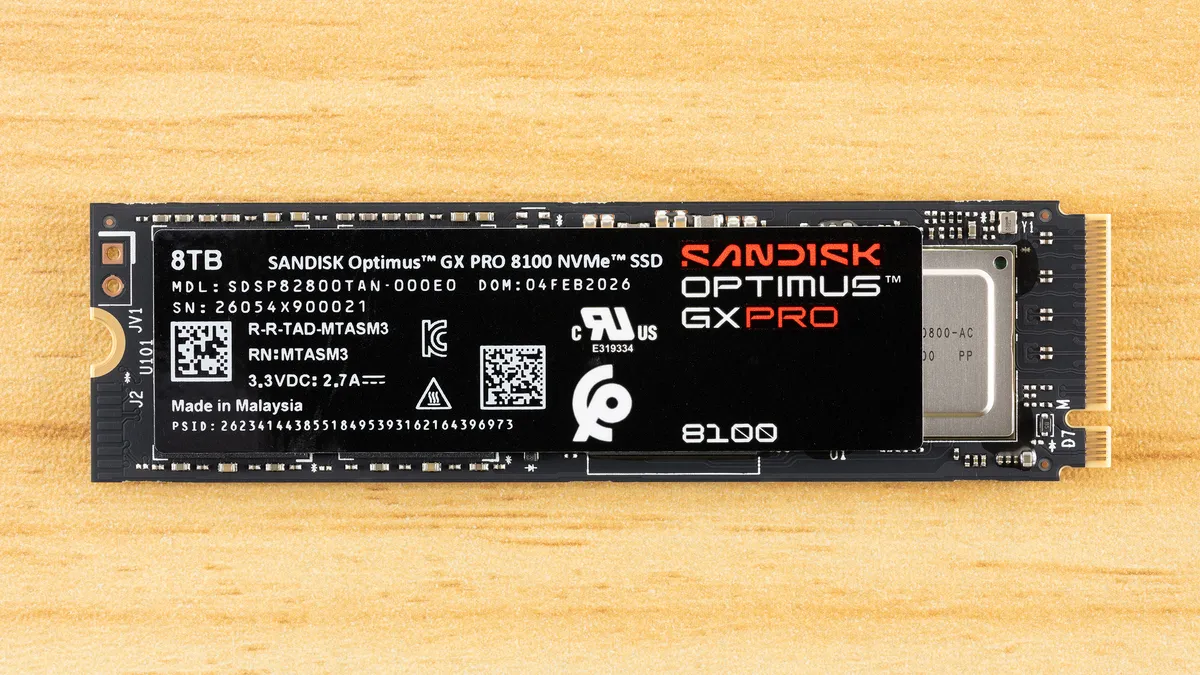
The only other interesting information here is the power rating. 3.3V / 2.7A puts the power ceiling around 9W, which is more than ample for the average power numbers that SanDisk lists on the specifications sheet. We should point out that those numbers are averages, and for reads and writes separately. In fact, the drive via SMART is rated for active power draw of 8.9W – exactly where 3.3V / 2.7A hits – with a potential peak of 9.5W. Active power could include mixed workloads, that is, both reads and writes, and as that’s what we test, we would expect our maximum value to be closer to that active power number.
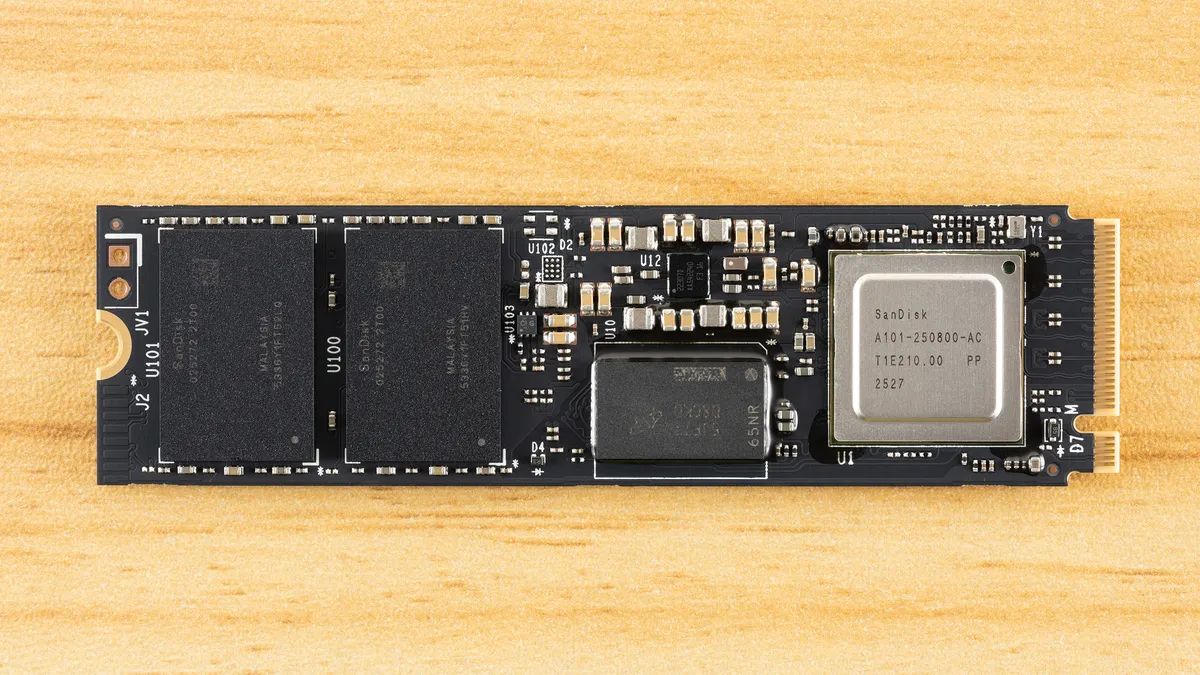
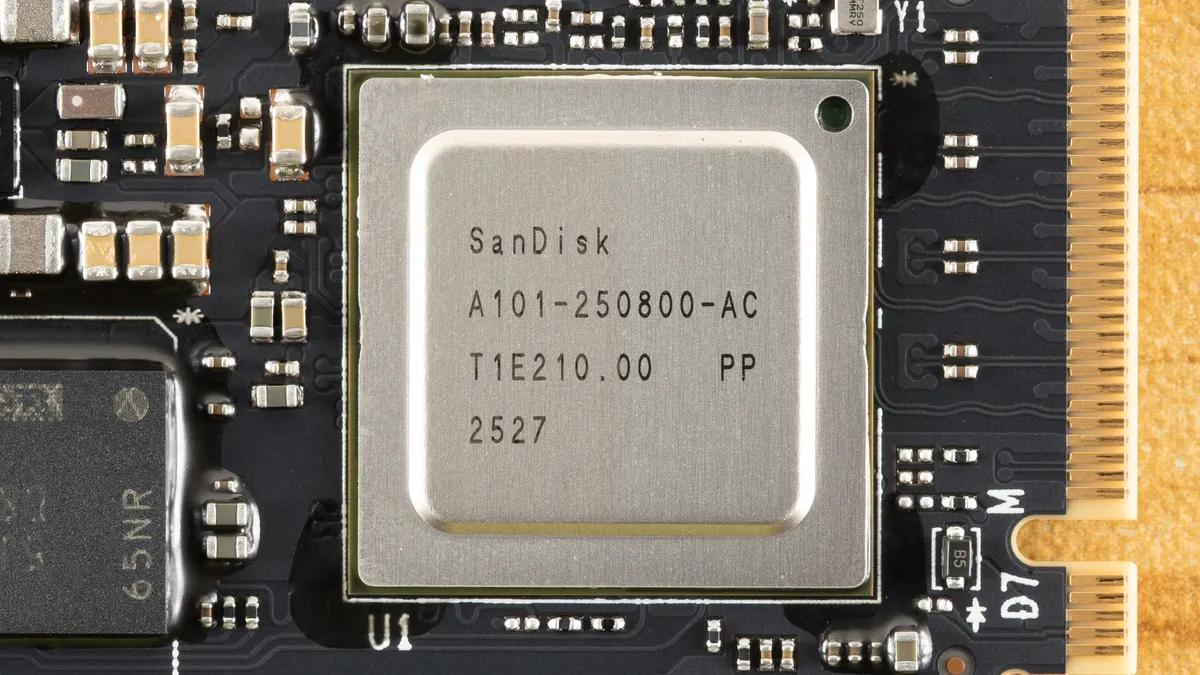
The drive has an SSD controller, power management circuitry, two DRAM packages, and four NAND flash packages. The controller is branded SanDisk with the “A101” being telltale, but the “2508” in the middle tells us the truth: this is a Silicon Motion SM2508 and not a proprietary solution. This is a high-end PCIe 5.0 controller with eight flash channels and DRAM support. It’s newer than the original PCIe 5.0 controller, the Phison E26, and is made in a smaller process node. As a result, it is significantly more power-efficient, which is a very good thing considering that some E26 drives came with active cooling. WD and SanDisk do tweak the controller firmware and use nCache 4.0 to separate the drive from more generic designs.
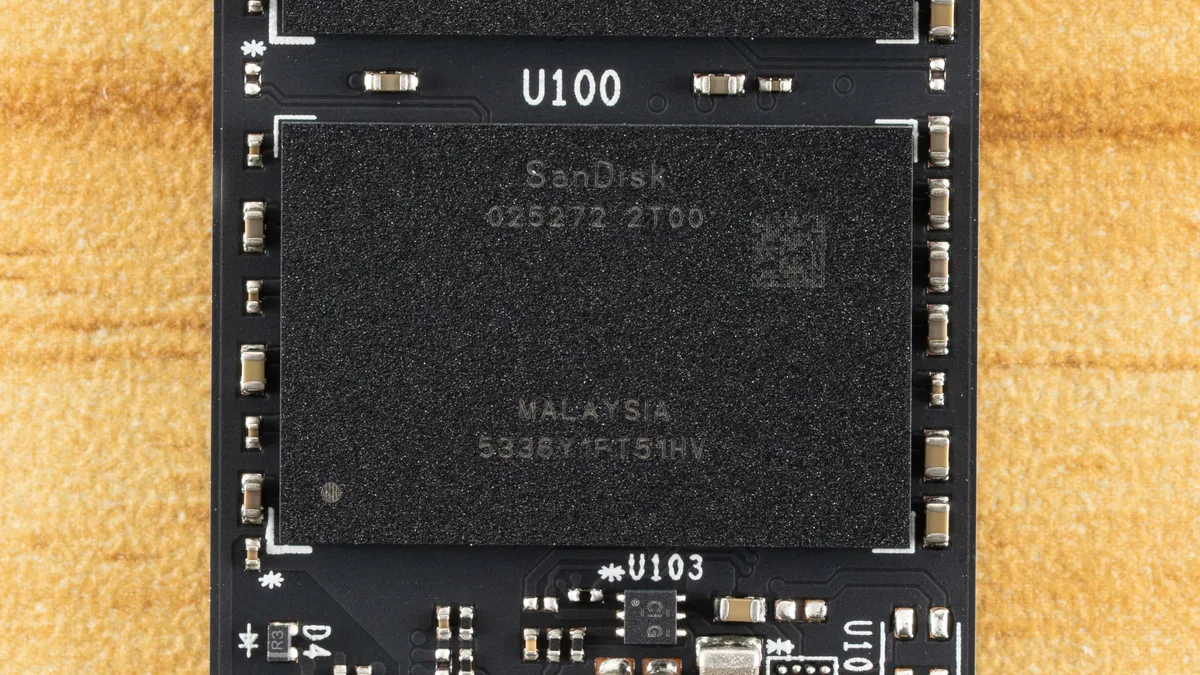
The DRAM is labeled D8CKD, and each package is thus 32 GB or 4GB of DDR4 in a 16-bit configuration. This is 8GB total, which maintains the 1GB:1TB DRAM:NAND flash ratio we expect for optimal performance. You could use more efficient DRAM, but the power savings would be relatively small. The flash – labeled in part with 2527 for the 27th week of 2025, exactly matching the controller’s 2527 – is 1Tb BiCS8 TLC. This flash has proven to be power-efficient with exceptionally low random read latency. There’s a reason we find the Black SN8100 hard to beat, and that’s with this combination of characteristics.
So I wish these NVME manufacturers would just manufacture a version that just target datacenters. That way it's allocated directly to them. Keep the consumer versions for consumers at a lower price point. Basically fleet vs commercial per se.
The SN850X has plenty of performance for my needs, and I'd like to buy another 4TB or upgrade to 8TB when the prices are sane again, but I highly doubt it'll get a price reduction as newer models are released, at least in this market.
Maybe this is a little unfair, but I'm somewhat stuck by the visual and naming similarity between the Sandisk GX Pro 8100 and the Samsung 9100 Pro.
Not so much when you look at them side-by-side, but I could imagine that someone might confuse the Sandisk as being a drive in Samsung's product line, if they're not very familiar with either company. And, Sandisk's color and naming scheme certainly doesn't do anything to discourage the confusion.
So I wish these NVME manufacturers would just manufacture a version that just target datacenters.
But the same NAND chips are used in both, and that's the scarce commodity. Even if they'd have consumer-only NAND chips, those are made in the same fabs as the datacenter ones and those fabs are booked at full capacity for the next couple years.
The only way supply constraints ease up is if the AI bubble pops.
So I wish these NVME manufacturers would just manufacture a version that just target datacenters. That way it's allocated directly to them. Keep the consumer versions for consumers at a lower price point. Basically fleet vs commercial per se.
That is not at all how this works. The core components for datacenter, enterprise, commercial, and consumer products are all the same. So if someone is willing to pay more to goggle up more parts that raises the price for the parts for everyone. That is what's going on. They can't make a cheaper consumer drive.
And they can't just make more. It costs billions to bring more manufacturing online and takes years. And if AI really is a bubble, and no it's not anymore that personal computers and the internet were thought to be fads, or if something goes wrong you are screwed. A company that spends billions to bring more production online and then cannot use it is a company that is dead and gone. So they really can't just ramp up production.
And if AI really is a bubble ... or if something goes wrong you are screwed. A company that spends billions to bring more production online and then cannot use it is a company that is dead and gone. So they really can't just ramp up production.
I've read that they're getting purchase commitments from customers specifically so they don't have too much excess production they can't sell, if the market crashes. Also, they're hopefully using some of their current windfall profits to finance new production, rather that the usual practice of financing it with debt. Finally, if/when a crash does come in the datacenter segment, there should a lot of pent-up demand from consumers. Between these three factors, I hope they'll be able to weather the storm.