









Tom's Hardware Verdict
The Framework desktop is small and powerful, even for 1080p gaming. But for the price, you can get a full-on gaming rig with discrete graphics.
Pros
- +
Strong 1080p performance on integrated graphics
- +
Fun and customizable
- +
Small footprint fits easily on a desk
Cons
- -
Expensive
- -
Required to buy tiles to decorate the chassis
- -
PSU cable not included
- -
Not as upgradeable as traditional desktops
Why you can trust Tom's Hardware Our expert reviewers spend hours testing and comparing products and services so you can choose the best for you. Find out more about how we test.
When Framework built its first laptop, it was with the ethos of a desktop: repairable, customizable, and upgradable when new parts came out. Now, Framework has a desktop of its own.
But the Framework Desktop ($1,599 as tested before a myriad of components and add-ons), isn't a traditional PC by any means. Using an AMD Ryzen AI Max+ 395 “Strix Halo” APU with soldered RAM, the customization options on this desktop are limited to storage, Wi-Fi, your case fan, and some decorative elements. The soldered RAM is effectively required for the bandwidth this system needs, and the mix of powerful graphics and plentiful RAM is why Framework is pushing this as an AI system.
The Desktop has a ton of charm, from its 4.5-liter size to its surprising power with the right configuration. But it's also very expensive compared to the best gaming PCs in its price range, and if you don't use all of the RAM, you might be better off with a cheaper system.
Design and Upgradeability of the Framework Desktop
The Framework Desktop is really small. It's a 4.5-liter Mini-ITX system that will fit on even the small desks.
The system is a plain, black case. Ours came with a black side panel, though there is a $40 window option (see configurations, below). Since we weren't using a fan with RGB, I was fine with the opaque panel. The side panels are plastic with some metal shielding inside, while the top panel is entirely plastic.


View Original

View Original

Most of the system comes pre-installed in the box. The motherboard is already installed, and since it's using a soldered CPU and RAM, those are there, too. The heatsink comes mounted to the board, and the 400-watt FlexATX power supply is already all hooked up. When Framework refers to this as a "DIY" system, it really means removing the side panel and the top, installing an SSD and a fan, and boom, complete system. That took me less than 20 minutes, and Framework has a handy step-by-step guide on its website. The hardest part is plugging in the fan header on the motherboard (and I suppose, the RGB header if your fan supports it), which requires some nimble finger placement.
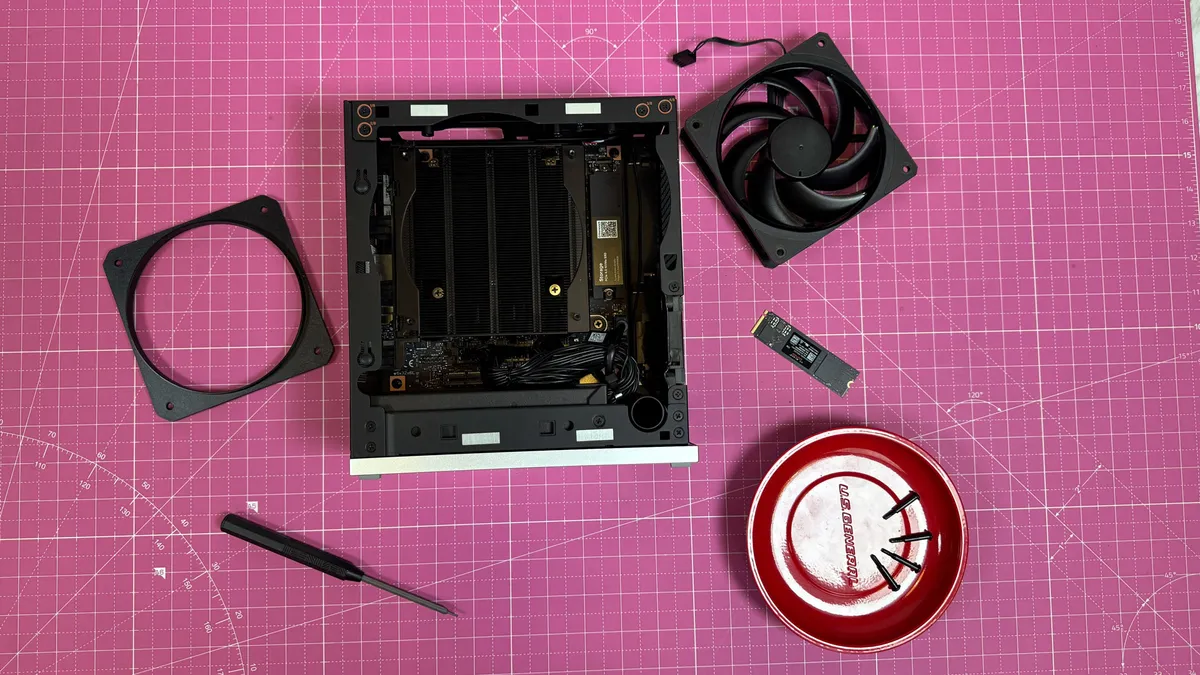
The system comes with a screwdriver that has both a Phillips and Torx head. Its primary difference from the company’s Laptop screwdriver is that it's far longer, letting you get into the case to install your SSD.
Our review unit came with an early version of a carrying handle, but that's not available to the public just yet. I didn't carry the desktop around the office too much, but it sure looks cute. Otherwise, the top is held on by two thumbscrews.

The upgrade potential on this system is limited. On the left side, you can put in your primary storage drive and add a fan of your choosing to the heatsink. Open the right side of the chassis and the reverse side of the motherboard has a second M.2 slot for storage, as well as access to the AMD RZ717 Wi-Fi 7 card.
Get Tom's Hardware's best news and in-depth reviews, straight to your inbox.


View Original

View Original

View Original

View Original

View Original

That fan and heatsink serve as all of the cooling for the system. The heatsink is sizeable, with six copper heatpipes, aluminum fins, and Honeywell PTM7958 thermal paste. The desktop comes with a mounting kit to attach a 120mm fan. The fan sucks cool air in through perforations in the side of the case.
On the front of the desktop, there is room for a 92 mm fan. The tooling is there, and there's also a second fan header on the motherboard. A company rep told me that "Framework originally put a placeholder for a slim fan there. They learned quickly that the main CPU/system fan provides enough cooling for the whole system."

One thing you can change to your heart's content: the front ports on the case. There are two slots for Framework's expansion cards — the same pick-your-port adapters that it uses on its laptops. I stuck one USB Type-C port and one USB Type-A port, which accommodates most of the accessories I use every day, though I could see some people picking a 3.5 mm headphone jack for gaming, as the permanent one is on the back of the system. Other choices include SD or microSD card slots, an Ethernet jack, or extra USB-C connected storage.
The expansion cards will be very welcome for those who already have a Framework Laptop, as you can mix and match. But using the adapters on the desktop shows its limits. You can only have two ports of your choosing due to the width of the expansion cards. Just by eyeballing it, it’s clear Framework could have fit more ports on without the cards.

The rest of the ports are on the rear, attached to the motherboard. They're plentiful. There are two USB 3.2 Gen 2 Type-A ports, a pair of USB4 Type-C ports, HDMI 2.1, two DisplayPort 2.1 outputs, Ethernet, and a headphone jack.
On the front of the system, there's a magnetic frame meant to hold 21 tiles, which are Framework's way of adding personalization to the system. I wish Framework included a blank set with purchase, but you have to buy them separately. Otherwise you'll have gaps in the front of the system.


View Original

View Original

The tiles highlight Framework's maker roots and allow for tons of different customization options. On the other hand, they look kind of cheap and feel like something that came from a 3D printer. I would have preferred an option to use a single colored sheet, perhaps matching some of the colors Framework uses for its Laptop bezels.
At 8.9 x 8.09 x 3.81 inches, the Framework Desktop is quite small for a desktop. It's got some graphics chops, but it's more in the range of Apple's Mac Mini (5 x 5 x 2 inches, no upgradeability) than classic gaming desktops. For instance, the CyberPowerPC Gamer Supreme is 9.3 x 19.5 x 18.1 inches and the Acer Predator Orion 5000 measures 19.09 x 18.98 x 8.62 inches.


View Original

View Original

One thing is missing from the Framework Desktop: a list of the names of the people in the company. In its laptops, you get a list of everyone who worked on them printed inside the chassis. That's not the case here.
Framework Desktop Specifications
Processor |
AMD Ryzen AI Max+ 395 |
Motherboard |
Framework FRANMFCPO4 |
Memory |
64GB LPDDR5-8000 |
Graphics |
AMD Radeon 8060S (integrated) |
Storage |
1TB WD Black SN7100 SSD |
Networking |
AMD RZ717 Wi-Fi 7, 5Gbit Ethernet |
Front Ports |
Two expansion card slots of your choosing |
Rear Ports (Motherboard) |
HDMI 2.1, 2x DisplayPort 2.1, 2x USB 4 Type-C, RJ45 Ethernet, 2x USB 3.2 Gen 2 Type-A, 3.5 mm headphone jack |
Power Supply |
FlexATX 400W PSU |
Cooling |
Heatsink, Cooler Master Mobius 120 CPU fan |
Operating System |
Windows 11 Home |
Dimensions |
8.9 x 8.09 x 3.81 inches (226.1 x 205.5 x 96.8 mm) |
Price as Configured |
$1,599 + $99 SSD + $22 fan kit + $5 power cable, before expansion cards and case tiles |
Gaming and Graphics on the Framework Desktop
The Radeon Strix 8060S graphics on the AMD Ryzen AI Max+ 395 are impressive. The chip, often referred to by its "Strix Halo" codename, features 40 compute units and shares our system's 64GB of RAM with the CPU. Yes, you can game on these integrated graphics, no question.
As a challenge, I booted up Alan Wake 2. While I got a VRAM error message, I pressed on without issue. On the medium graphics preset with no ray tracing, FSR enabled, and a 720p render with upscaling to 1080p, the game saw the titular hero explore a nightmare New York at between 73 and 78 frames per second. The game also ran at high settings, but dropped below 60 FPS.
Death Stranding, too, played well (and better understood the shared RAM situation). At 1080p, on the very high preset, I carried packages between 124 - 132 FPS. Even at 4K, the game ran between 41-50 FPS at the most demanding settings. For most intense games, though, this is a solid 1080p rig.
Our benchmarks, which are typically run on discrete graphics cards, are run at quite demanding settings. Some of them may appear unplayable, but if you turn some settings down, you can get the Framework Desktop to playability territory. Here, we're comparing the Framework to other gaming desktops, and, unsurprisingly, the larger, more traditional systems won out in most tests. The CyberPowerPC Gamer Supreme has an Nvidia RTX 5060 Ti, while the older Acer Predator Orion 5000 used an RTX 4070 Super. Both of them, however, are within the range of what our configuration of the Framework Desktop in terms of cost.


View Original
View Original
View Original
View Original
View Original
On Shadow of the Tomb Raider, the Framework Desktop ran the game at 87 FPS on the highest settings at 1080p. It also excelled on CPU-heavy games like Far Cry 6 at ultra settings (83 FPS) and Borderlands 3 on the "badass" preset (103 fps.) The game performed passably on Red Dead Redemption 2 at medium settings (57 fps). It only faltered on Cyberpunk 2077's challenging Ray Tracing Ultra preset.
To stress test gaming PCs, we run the Metro Exodus benchmark 15 times on a loop using the RTX preset to simulate about half an hour of gameplay. Across the runs, the game ran at an average of 51 frames per second. You might want to turn off the ray tracing, though – the average minimum 99th percentile frame rate was 24 fps. During the test, the Ryzen chip, which includes the graphics, ran at 66.46 degrees Celsius.
Productivity Performance on the Framework Desktop
Sure, the AMD Ryzen AI Max+ 395 is a mobile chip in a desktop's clothes, but with 64GB of RAM and a fast 1TB SSD, the system can compete with some recent gaming desktops we've tested when it comes to productivity.


On Geekbench 6, the Framework Desktop notched a single-core score of 2,966 and achieved a multi-core score of 17,574. The CyberPowerPC and its AMD Ryzen 7 9800X3D outperformed, as did the Mac Mini with M4 Pro, (3,880 and 22,661, the highest of the group). But the Framework surpassed the Acer Predator Orion 5000 and its Intel Core i7-14700F.
The file transfer speed on your Framework Desktop will depend heavily on which drive you choose. With the 1TB WD Black SN7100 that Framework sells alongside the Desktop, we saw it blaze through our file transfer test at a rate of 2,976.46 MBps, handily surpassing everything else on our test. The Mac Mini was the next closest, at 2,237.31 MBps.
It took the Framework Desktop 2 minutes and 43 seconds to transcode a 4K video to 1080p on Handbrake. Only the Predator beat it at 2:40, while the Mac came in at 2:47.
You can't overclock the Strix Halo chip. Framework's BIOS doesn't have options for it, and installing Ryzen Master doesn't work. It throws up an error stating that the chip isn't supported and that the software can't be installed.
Framework Desktop Dissonance
Throughout my time with the Framework Desktop, I felt a sort of dissonance. I've always enjoyed the amount of tinkering I get to do with the company's laptops.
With the Desktop, it's far more limited. In a way, using a soldered CPU and RAM feels antithetical to Framework's entire ethos of choice, repairability, and upgradeability. Framework says there’s a reason for that, though.
"To enable the massive 256GB/s memory bandwidth that Ryzen AI Max delivers, the LPDDR5x is soldered," a Framework blog post announcing the desktop reads. “We spent months working with AMD to explore ways around this but ultimately determined that it wasn’t technically feasible to land modular memory at high throughput with the 256-bit memory bus. Because the memory is non-upgradeable, we’re being deliberate in making memory pricing more reasonable than you might find with other brands."
Framework made the choice to use Ryzen's AI Max processors anyway. If you want replaceable memory, though, there are hundreds of other gaming and productivity PCs on the market with that option. And, of course, you can still build your own.
I've reduced this dissonance by thinking of the system more like a Mac Mini that is bigger because it is upgradeable. Still, that may not satisfy some diehards, who see the company's laptops as more repairable than its desktop.
There is one part that feels very Framework. The company is selling the mainboard and every single component — including the case — individually and separately. This should allow for all sorts of projects (Framework has suggested the use of multiple mainboards for LLM racks to run models).
Software and Warranty on the Framework Desktop
The Framework Desktop comes free of any manufacturer-provided bloatware, and it's refreshing. The only mark against it is a link to the Framework Marketplace in the Start menu's application list in Windows 11.
If you use Windows like I did, you will still get some shortcuts you don't want, like a pinned link to download a local LinkedIn app, but nothing major.
Framework sells its Desktop with a one-year warranty.
Framework Desktop Configurations
We tested the $1,599 variant of the Framework Desktop, pairing a Ryzen AI Max+ 395 processor featuring Radeon 8060S graphics and 64GB of RAM. With our review unit, Framework included a 1TB WD Black SN7100 ($99), a Cooler Master Mobius 120 CPU fan ($22), a power cable ($5), two USB Type-C and two USB Type-A expansion cards ($11 each), and three sets of tiles (two $10 black sets and a $15 red set, plus a custom Tom's Hardware tile, which you can't really put a price on), as well as five decal tiles and two blank tiles ($5 each and $3 each, respectively). Add that all up, and it's $1,835. We installed Windows 11 Home on our own, but if Framework included it, the company charges $139 for the download.
The cheapest configuration, before any add-ons, is $1,099 with a Ryzen AI Max 385 with lesser Radeon 8050S graphics and 32GB of RAM. The highest step up, and a shoe-in for people interested in local AI, is a $1,999 option with the same processor as our review unit, but with a whopping 128GB of memory.
There are a number of other add-ons. While our review unit came with the standard black side panel, a clear one will cost you $40. Tiles come in various colors, and there are $5 options with logos for AMD and a number of Linux distros. While I think that expansion cards with USB Type-A and Type-C make the most sense for the expansion slots, Framework sells all of the same options it has for its website, including storage, Ethernet, and a microSD card slot, should you want them. I feel that the desktop should come with a set of blank tiles; it's an incomplete system without the front of the chassis.
There are a variety of fan and storage options, though you can also bring your own instead of paying Framework. Those are the only two major components that you can change out, so they're important choices.
I think the fact that Framework charges for the power cable for a desktop is kind of obnoxious. Enthusiasts may have extras, but this isn't a phone where everyone has extra cheap cables around their house. For a system, this should come in the box.
Bottom Line
The Framework Desktop offers a lot of power for a small system. AMD's Strix Halo shows off in Framework's 4.5-liter case, delivering strong 1080p gaming performance for a system that doesn't have a discrete GPU. You can have a solid 1080p system that fits on your desk and doesn't get in the way.
But the system doesn't feel entirely like Framework. The fact that it's less repairable and upgradeable than the company's laptops is odd, but it's the cost of using a mobile processor, which is soldered to the board, along with soldered RAM (which is effectively necessary for the chip the team chose). It's not wrong, but it will likely make the system less appealing for many potential buyers who aren’t specifically interested in AI.

Despite all of that, I've become enamored with the system during my time with it. It's versatile, small, and surprisingly powerful for its size. Despite its plastic casing, it's pretty cute.
The real issue is price. For the $1,599 our review unit starts at — before all of the components and an OS, you can get a decent gaming PC with a discrete GPU. For over $1,800 as ours was configured, you can get a nice one. So if you're going for gaming, a bigger machine with more traditional desktop pieces makes more sense, and will be more customizable down the line, too. (It may, however, have less RAM.) I don't fault Framework for offering a DIY edition to its enthusiast-forward fanbase, but I do think its pricing should consider everything you need to add. That's before you get nickeled and dimed with effectively mandatory tiles for the front of the chassis.
In competition with something like the Mac Mini, you can really only compare to Apple's most expensive configuration with a 12-core M4 Pro CPU, 16-core GPU, 24GB of RAM, and 512GB SSD storage for $1,399. Bumping to 1TB of storage and 64GB of RAM is a minimum of $2,199, so while the Mac is a huge budget for light productivity starting at $599, it isn't necessarily a budget competitor on the high end. The Mac Studio starts at $1,999 with an M4 Max and 36GB of RAM.
That leaves the Framework in a place as a solid small system for people who need a ton of RAM. There's a reason the company has pitched it for running local LLM's — that's who the system makes the most sense for. If you're going to make use of this much RAM with a mobile CPU and a tiny chassis, there may be value here, as well as the fun of putting parts of the system together yourself. But for everyone else, a stronger gaming rig or a cheaper productivity system might do the job — and will come with everything you need out of the box.

Andrew E. Freedman is a senior editor at Tom's Hardware focusing on laptops, desktops and gaming. He also keeps up with the latest news. A lover of all things gaming and tech, his previous work has shown up in Tom's Guide, Laptop Mag, Kotaku, PCMag and Complex, among others. Follow him on Threads @FreedmanAE and BlueSky @andrewfreedman.net. You can send him tips on Signal: andrewfreedman.01
-
ottonis While it may seem that soldered RAM is antithetical to Framework's product philosophy, one need to have in mind that replaceable RAM moduels would entirely defeat the purpose of a Strix Halo CPU/APU, which NEEDS super-fast and super large memory bandwidth in order to feed both iGPU (by allocating the system RAM as VRAM) and the CPU.Reply
This system is a dream come true for sound engineers and composers juggling with Gigabytes worth of sample libraries and massive orchestral pieces. Templates for the notation sofware Steinnberg Dorico with a massive orchestral library such as EastWest Hollywood Orchestra already take up 70-80 GB of RAM.
The other use case is AI training/tuning where large amounts of memory (e.g.128 GB), most of which can be allocated to the GPU, is critical for large LLMs with many billions of parameters. Even if the GPU itself may not be the fastest, computation will drastically benefit from these large amounts of ultra fast memory that can be used as VRAM. Imagine having a modern RTX card with like 96 GB of VRAM. That alone would probably cost 10.000- 15.000 USD, if not more.
So people who want to tinker with larger LLMs at home, orchestral composers etc will be drooling over this system. -
Antiphonal Replyottonis said:While it may seem that soldered RAM is antithetical to Framework's product philosophy, one need to have i mind, that replaceable RAM moduels would entirely defeat the purpose of a Strix Halo CPU(APU, which NEEDS super-fast and super large memory bandwiidth in order to feed both iGPU (by allocating the system RAM as VRAM) and the CPU.
This system is a dream come true for sound engineers and composers juggling with Gigabytes worth of sample libraries and massive orchestral pieces. Templates for the notation sofware Steionberg Dorico with a massive orchestral library such as EastWest Hollywood ORchestra alreaty take up of 70-80 GB of RAM.
The other use case is AI training/tuning where large amount of memory (e,g, 128 GB), most of which can be allocated to the GPU is critical for large LLM with dozens of billions of parameters. Even if the GPU itself may not be the fastest, computation will drastically benefit from these large amounts of memory that can be used as VRAM.
So people who want to tinker with larger LLMs at home, orchestral composers etc will be drooling over this system.
Totally agree. It seems strange to me to see a review focusing on FPS in gaming instead of the workloads this machines was meant to deliver.
I'd like to see tokens/sec with one of the larger models (or even the new GPT-OSS 120B). -
Makaveli Reply
NV already sell this card the workstation model with 96GB of VRAM cost about 12kottonis said:Imagine having a modern RTX card with like 96 GB of VRAM. That alone would probably cost 10.000- 15.000 USD, if not more.
Antiphonal said:Totally agree. It seems strange to me to see a review focusing on FPS in gaming instead of the workloads this machines was meant to deliver.
I'd like to see tokens/sec with one of the larger models (or even the new GPT-OSS 120B).
This I was expecting to see some benchmarks from LM studio at the minimum not gaming. -
Notton If you compare the Framework to similarly priced desktops, the competition will win.Reply
But if you compare it to similarly sized desktops, you might see the value. -
pug_s Don't know the business model of Framework because most Desktop PC's parts are standard without proprietary parts from Framework.Reply -
Notton Reply
It uses standard parts.pug_s said:Don't know the business model of Framework because most Desktop PC's parts are standard without proprietary parts from Framework.
Mobo: mITX
PSU: Flex ATX
Fan: standard 120mm
Heatsink: Proprietary, but there was no way a S1200/S1700/AM4/AM5 heatsink would have fit on this CPU.
Here a more useful review for how the Framework handles computing workloads.
N5xhOqlvRh4
ETA Prime is not my first choice for gaming PC reviews, but this one was very useful because he compares it to mobile parts.
uv7_1r1qgNw -
nrdwka FW prices are comparable to others strix halo desktops, like gmktec.Reply
+1 for more workload testing instead of gaming.
The point is what no other solution comparable to AMD's offer with that amount of vram at that price exist.
would be nice to add what from amd testing the issues with non soldered ram is signal integrety (this subject was already covered by other outlet)
I hope next gen can be used with camm2 modules. -
doomtomb Reply
No offense mate, but this was teased as a LAN gaming machine. Seems totally reasonable to me to test what it was designed for - an APU with iGPU strong enough to not need a dGPU.Antiphonal said:Totally agree. It seems strange to me to see a review focusing on FPS in gaming instead of the workloads this machines was meant to deliver. -
timecop1818 wasn't CAMM memory modules supposed to resolve the high bandwidth wide bus problem?Reply -
Roland Of Gilead Reply
Well, soldered ram is not in keeping with the framework ethos. I think that's the point. Having soldered ram just defeats the purpose.ottonis said:While it may seem that soldered RAM is antithetical to Framework's product philosophy, one need to have in mind that replaceable RAM moduels would entirely defeat the purpose of a Strix Halo CPU/APU,
This is kinda niche. I think those people would prefer to be able to upgrade the ram to whatever their needs might be. I think they'd be drooling more about that, rather than being limited by soldered ram.ottonis said:So people who want to tinker with larger LLMs at home, orchestral composers etc will be drooling over this system.